































Why do services need platform thinking now?
Leaders face a structural shift. Digital networks concentrate demand, compress cycles, and reward orchestrators that turn services into scalable exchanges. Platform thinking reframes a service not as a linear process but as a managed marketplace of interactions among customers, employees, partners, and data. In contrast to pipeline operations, platforms unlock network effects, reduce marginal costs of matching, and accelerate innovation through external contributors. Harvard Business Review shows how platform models outcompete pipelines by rewiring value creation and control points.¹ Strategies for two-sided markets explain why pricing, governance, and chicken-and-egg dynamics make or break adoption.² Service executives who master these mechanics convert today’s fragmented journeys into repeatable, trusted interactions that compound over time. This orientation fits service organizations because services are already interaction rich, co-created, and data dependent. Service leaders can move first by codifying interactions, opening interfaces, and orchestrating standards.³
What is platform thinking in a service context?
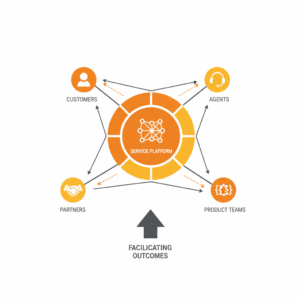
Platform thinking is the discipline of designing, governing, and scaling interactions that create value among distinct participant groups. In services, those groups often include customers, agents, partners, and product teams. The platform provides the rules, interfaces, data contracts, and trust mechanisms that allow participants to solve needs with each other. Service-dominant logic defines value as co-created through the application of resources for another’s benefit, and it positions service ecosystems as self-adjusting systems of actors and institutions.³ This orientation treats the contact centre, field service, and digital channels as a single interaction fabric rather than separate silos. The platform’s job is to standardize how parties discover, transact, fulfill, and learn. When service leaders adopt this model, they evolve from delivering tickets to facilitating outcomes. That shift changes measures, incentives, and investment decisions from volume handling to ecosystem enablement.³
How do platforms actually create value in services?
Platforms create value by reducing friction, enabling scale, and catalyzing innovation. Two-sided market strategy highlights cross-side network effects where value for one group rises with participation by another.² In services, customer demand for faster resolution meets partner supply of specialized capabilities. A well-governed platform sets access rules, pricing, and quality signals that increase participation while preventing congestion and bad behavior.¹ Architecturally, platforms modularize capabilities behind APIs that expose consistent contracts for identity, cases, knowledge, and entitlements. McKinsey research links API maturity to ecosystem value capture because APIs make capabilities discoverable and reusable across firms.⁴ Effective orchestration then decides which capabilities the platform owns, which the ecosystem contributes, and which the platform certifies. Tiwana’s work emphasizes aligning architecture and governance to sustain complementor motivation while protecting the platform’s integrity.⁵
Where should CX and service leaders start?
Leaders start by mapping interactions that recur across journeys and partners. Use an interaction inventory to find the smallest set of high-frequency exchanges, such as authenticate, triage, diagnose, fulfill, and update. Make each exchange a product with clear contracts, SLAs, and telemetry. Next, define roles. BCG distinguishes orchestrators that set rules and own experience, contributors that build solutions, and enablers that provide infrastructure.⁶ Decide your role by comparing your ability to attract participants, set standards, and fund shared services. Then invest in an API backbone tied to identity, consent, case, knowledge, and catalog. McKinsey recommends establishing decision rights and an API centre of excellence to manage prioritization, developer portals, and lifecycle governance.⁷ Pilot with one external partner to validate onboarding speed, quality gates, and revenue sharing. Scale only after resolving governance and data issues to avoid complexity debt.⁴
What governance models keep a service platform healthy?
Governance balances openness with control. Two-sided markets require pricing, curation, and conflict resolution that sustain both sides over time.² Set participation terms that specify data rights, quality standards, and liability. Define dispute paths that are transparent and fast. Establish certification tiers for partners with benefits tied to performance. Tiwana recommends evolving governance as the ecosystem grows, using architectural safeguards such as sandboxing and versioning to manage change without breaking complements.⁵ Orchestrators should publish roadmaps, deprecate predictably, and share telemetry that helps contributors improve. BCG shows that orchestrators who underinvest in governance fail to capture value even with strong participation.⁶ Healthy governance also protects end users. It enforces ethical use of data, clear consent, and observable AI behavior, which raises trust and reduces regulatory risk. A stable rule set encourages innovation while deterring opportunism that would erode network value.¹
How do platform metrics differ from traditional service KPIs?
Traditional service KPIs focus on efficiency. Platform metrics measure interaction health and ecosystem growth. Track cross-side metrics such as active participants by role, successful matches per cohort, and time to first value for new contributors. Measure interaction quality with resolution probability, repeat engagement, and complaint rate. Monitor supply elasticity by partner category. Tie monetization to value events such as verified resolution, NPS improvement, or documented cost avoidance. Include API product metrics: adoption, call success rates, change failure rate, and developer portal conversion. McKinsey advises quantifying value in savings, efficiency, and redeployment to secure funding.⁷ Balance growth with quality by introducing congestion controls when usage degrades experience. Over time, compress time to resolution while raising ecosystem diversity. These metrics shift the conversation from case handling to value orchestration, which aligns incentives across customer, partner, and internal teams.²
How does composability amplify platform effects?
Composable enterprises treat capabilities as packaged business components that can be assembled for new outcomes. Industry analysis describes composability as using modular building blocks with well-defined interfaces to respond to change.⁸ In services, composability allows rapid creation of new workflows, channels, and partner offerings without redesigning the core. Each component exposes APIs, events, and policies that the platform registers and secures. This pattern reduces coupling, increases experimentation, and shortens time to market for new service propositions. When leaders couple composability with ecosystem roles, they multiply innovation because contributors can assemble their own offerings from standard parts. The result is a service portfolio that adapts as demand shifts while maintaining governance. Composability also helps modernization because legacy capabilities can be wrapped behind stable contracts and gradually replaced without disrupting customers or partners.⁸
What organizational changes support platform operations?
Platform operations require a cross-functional unit that manages product, engineering, risk, legal, and partner success. Establish a platform product council to set priorities, approve major changes, and arbitrate conflicts. Create a partner success function that recruits contributors, manages certification, and co-markets high-value solutions. McKinsey research stresses decision rights and a clear home for API ownership, often a centre of excellence reporting to the CTO.⁷ Empower service product managers to own interactions such as triage and fulfillment. Align incentives by tying bonuses to platform health, not just internal efficiency. Document playbooks for onboarding, revenue sharing, and support. Share telemetry across the ecosystem so that contributors can see how to improve. Finally, invest in developer experience. Provide a portal with documentation, reference apps, test data, and mock services. These investments reduce friction and increase complement quality and retention.⁴
How do you mitigate risks while scaling a service platform?
Risk concentrates where interactions and data intersect. Start with identity, consent, and encryption as table stakes. Segment partners by risk and restrict scopes through least privilege. Use event logs and anomaly detection to monitor misuse. Define escalation playbooks for fraud, abuse, and outages. BCG highlights that orchestrators who clarify roles and value distribution reduce disputes and improve ecosystem resilience.⁶ Tiwana recommends architecture patterns that keep core assets insulated while allowing complementor freedom at the edge.⁵ When AI is involved in routing, summarization, or recommendations, disclose model roles and provide human oversight on high-impact decisions. Periodically audit partner access and data retention. Update terms when regulations change. Treat governance debt like technical debt. Pay it down on a schedule to preserve trust and maintain the right to operate as participation grows.¹
What is the phased roadmap to platformize a service?
A pragmatic roadmap follows four phases. Phase 1 defines the interaction portfolio and the minimum viable governance, including identity, consent, and case APIs. Phase 2 opens a developer portal and onboards the first partners, focusing on one market segment with clear value events. Phase 3 scales supply by seeding contributor categories, adding certification tiers, and introducing monetization aligned to outcomes. Phase 4 optimizes network health by tuning matching, incentive design, and data network effects. Throughout, publish a platform scorecard with cross-side metrics and API product health. McKinsey’s case work suggests that quantifying value and establishing decision rights are decisive early moves.⁷ HBR research underlines that platforms win when they curate participation, prevent disintermediation, and continually realign incentives as the network grows.¹² Treat the roadmap as a living artifact that links strategy to day-to-day operations.
How will platform thinking change customer experience outcomes?
Platform thinking will increase resolution speed, expand choice, and personalize service through richer ecosystems. Customers benefit from more options and faster matches to expertise. Employees gain tools and contributions that remove repetitive work. Partners access customers and operational data that help them tailor offers. Orchestrators capture value by taking a small share of many interactions and by learning from every exchange. This model compounds because every resolved interaction improves the data that powers future matches. Service-dominant logic frames this as a virtuous cycle where institutions and resource exchange evolve together.³ The endpoint is not a marketplace alone. It is a service fabric where governance, architecture, and economics align. Leaders who move now will build durable advantage as ecosystems reshape categories and as interactions replace transactions as the unit of value.¹
FAQ
What is “platform thinking” in Customer Experience and Service Transformation?
Platform thinking is a management approach that designs and governs interactions among customers, employees, and partners through rules, APIs, and trust mechanisms, enabling network effects and faster innovation in services.¹³
How do two-sided markets apply to contact centres and field service?
Two-sided market strategy explains how value increases for customers as more partners participate and for partners as more customers engage. Effective pricing, curation, and governance overcome the chicken-and-egg challenge in CX ecosystems.²
Why are APIs critical to service platform success?
APIs expose identity, case, knowledge, and entitlement capabilities as reusable contracts. They reduce integration friction, speed partner onboarding, and capture ecosystem value when paired with clear decision rights and a developer portal.⁴⁷
Which roles should we play in an ecosystem: orchestrator, contributor, or enabler?
Choose based on your ability to attract participants, set standards, and fund shared services. Orchestrators own rules and experience. Contributors build solutions. Enablers provide infrastructure and common services across verticals.⁶¹⁴
How should we measure a service platform’s health?
Prioritize cross-side participation, successful matches, time to first value, quality metrics such as resolution probability, and API product health indicators like adoption and change failure rate. Tie monetization to verified value events.²⁷
What governance practices protect customers and brand trust?
Publish transparent participation terms, data rights, and certification tiers. Use sandboxing, versioning, and predictable deprecation. Monitor misuse with event logs and enforce least-privilege access for partners.⁵⁶
How does composability accelerate service innovation at Customer Science clients?
Composable building blocks with well-defined interfaces let teams assemble new workflows and partner offers quickly without rewriting the core, which increases adaptability and reduces modernization risk for enterprises.⁸
Sources
Pipelines, Platforms, and the New Rules of Strategy — Marshall W. Van Alstyne, Geoffrey G. Parker, Sangeet Paul Choudary — 2016 — Harvard Business Review. https://hbr.org/2016/04/pipelines-platforms-and-the-new-rules-of-strategy
Strategies for Two-Sided Markets — Thomas R. Eisenmann, Geoffrey Parker, Marshall W. Van Alstyne — 2006 — Harvard Business Review. https://hbr.org/2006/10/strategies-for-two-sided-markets
Institutions and Axioms: An Extension and Update of Service-Dominant Logic — Stephen L. Vargo, Robert F. Lusch — 2016 — Journal of the Academy of Marketing Science. https://www.sdlogic.net/pdf/vargo_lusch_2016_jams-6.pdf
What It Really Takes to Capture the Value of APIs — Hugo Sarrazin, Shivam Srivastava, et al. — 2017 — McKinsey & Company. https://www.mckinsey.com/capabilities/mckinsey-digital/our-insights/what-it-really-takes-to-capture-the-value-of-apis
Platform Ecosystems: Aligning Architecture, Governance, and Strategy — Amrit Tiwana — 2014 — Morgan Kaufmann. https://books.google.com/books/about/Platform_Ecosystems.html?id=IYDhAAAAQBAJ
Four Strategies to Orchestrate a Digital Ecosystem — Stefan Gross-Selbeck, Maximilian Kluge, et al. — 2020 — Boston Consulting Group. https://www.bcg.com/publications/2020/four-strategies-to-orchestrate-digital-ecosystem
APIs: The Secret Ingredient for One Company’s Massive Tech Leap — McKinsey & Company interview — 2022 — McKinsey & Company. https://www.mckinsey.com/capabilities/mckinsey-digital/our-insights/apis-the-secret-ingredient-for-one-companys-massive-tech-leap
The Composable Enterprise brings us into The Great App Explosion & Big Ops — Scott Brinker citing Gartner — 2021 — chiefmartec.com. https://chiefmartec.com/2021/11/the-composable-enterprise-brings-us-into-the-great-app-explosion-big-ops/