

















Why do CX leaders need a build–buy–partner decision today?
Executives face a simple choice with complex implications. Leaders either build capabilities internally, buy them via acquisition or technology procurement, or partner to access them through an ecosystem. Transaction Cost Economics defines this as choosing the most efficient governance structure for a given activity once coordination, contracting, and risk costs are considered.¹ Resource-Based View reframes the choice as a search for scarce, valuable, and hard-to-imitate resources that produce advantage.² Open innovation adds a practical gloss by urging firms to let ideas flow in and out so value grows faster than internal R&D alone.³ In customer experience and service transformation, these lenses converge. The decision determines speed to market, control over the journey, resilience of operations, and the economics of service quality. Making it explicit reduces bias, surfaces risk, and aligns product, operations, and technology to a measurable outcome.¹²³
What is the Build–Buy–Partner decision in plain terms?
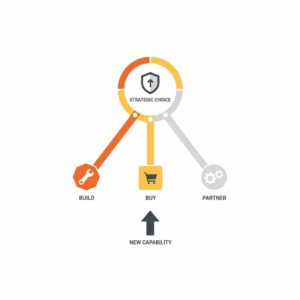
Leaders pick one of three paths to add a new capability such as a proactive service workflow, AI routing, or a payments handoff. Build means develop the asset in house, staff the capability, and own the roadmap. Buy means acquire a vendor platform or M&A target that already delivers most of the value. Partner means co-create or integrate through an alliance, marketplace, or ecosystem so you access external capabilities without owning them. A practical variant, “Build, Borrow, or Buy,” asks whether you can develop the resource, borrow it through a relationship, or purchase it outright.⁴ In service transformation, the right path depends on the specificity of the process, the economics of scale, and how the capability differentiates the brand experience.⁴
How do the core theories guide the choice?
Theory provides disciplined questions. Transaction Cost Economics asks when market transactions become expensive due to asset specificity, uncertainty, or frequency, making internal coordination preferable.¹ Resource-Based View asks whether the target capability is valuable, rare, inimitable, and organized to capture value.² Open innovation asks whether external partners can speed discovery or commercialization without eroding advantage.³ Together, they establish a sequence. If transaction costs to coordinate multiple vendors are high and the capability is deeply specific to your brand, lean to build.¹² If the capability is non-differentiating and scale vendors exist, lean to buy.² If the capability evolves quickly and complementary assets live outside your walls, structure a partnership that flexes with learning.³
Where do alliances and ecosystems change the calculus?
Ecosystems create value by connecting services across journeys and industries, which expands demand while lowering friction for participants.⁶ Leading companies mobilize analytics, agile delivery, and platform governance to capture ecosystem value and accelerate innovation through partnerships.⁶ Alliances are powerful but fragile. Studies have reported wide performance variation, with many alliances failing to meet goals when governance, trust, and capability fit are weak.⁵ The lesson is pragmatic. Partnerships win when governance is explicit, data access and decision rights are designed, and operating rhythms align with the speed of the customer journey.⁵⁶
What questions separate Build from Buy from Partner?
Leaders decide with nine tests across economics, control, and learning.
Is the capability a differentiator? If it shapes the signature moments in your customer experience, favor build or structured co-development to preserve uniqueness.²
What is the total cost of ownership over five years? Lifecycle costs include integration, operations, upgrades, training, compliance, and retirement, not just license or capex.⁷
How fast must you move? When time to value is critical and fit is acceptable, buying can compress timelines. When moving targets require fast iteration, partnering can explore while you de-risk.⁶
How specific are the assets? High asset specificity and high frequency use tilt toward internalization.¹
Do partners bring complementary assets you cannot replicate at speed? Ecosystem partners can unlock channels, data, or IP efficiently.³⁶
How reversible is the choice? Modular architectures make buy or partner paths less binding.
Can you sustain the capability? Build implies a durable backlog, talent model, and security posture.²
What governance will protect value? Alliances need decision rights, KPIs, and exit ramps to avoid drift.⁵
What evidence supports the bet? Use stage-gated experiments and reference architectures to validate assumptions before scaling.⁶⁷
How do you quantify the total cost and value at stake?
Executives measure TCO and value capture with a simple equation. TCO equals the sum of acquisition or build cost, integration cost, run cost, change cost, exit cost, and risk cost such as compliance or outage exposure.⁷ Value equals incremental revenue, cost-to-serve reduction, experience lift, and risk reduction over the same horizon. Use a five-year view for platforms and a three-year view for narrow services.⁷ In CX programs, pair financials with service metrics like first contact resolution, time to serve, containment rate, and customer effort score. Tie each metric to a causal driver in the chosen path so leaders can test whether build, buy, or partner is actually moving the needle.
What decision flow works for service transformation?
Teams move from problem to design with a lightweight flow.
Define the job. Specify the customer or agent job to be done and the service moments it touches.
Classify the capability. Tag it as differentiating, enabling, or commodity.²
Score governance fit. Rate TCE drivers: asset specificity, uncertainty, frequency.¹
Scan the ecosystem. Identify partners with complementary assets and evaluate their governance readiness.⁶
Model TCO and value. Create comparable five-year pro formas for each path.⁷
Pilot and govern. Use a 90-day pilot with clear KPIs and decision rights if partnering.⁵
Commit and scale. Lock the path, assign product ownership, and publish the roadmap so operations and CX can plan quarterly improvements.⁶
How do Build, Buy, and Partner compare in practice?
Build maximizes control and fit. It strengthens the resource base when the capability is strategic and defensible.² It demands patient capital, product discipline, and a talent pipeline that can ship and run the service reliably. Buy accelerates time to value when the need is common across firms and scale vendors exist. It reduces engineering risk but adds vendor dependency. Partner extends reach and learning through alliances and ecosystems. Done well, it unlocks growth and data access, but it requires rigorous governance to avoid performance erosion.⁵⁶ The optimal portfolio usually mixes the three paths by domain: build the differentiators, buy the commodities, and partner for adjacencies and scaled distribution.²⁶
Which risks matter most and how do you mitigate them?
Each path has recurring risks. Build risks include underestimating maintenance load, security hardening, and opportunity cost of scarce engineering time.⁷ Leaders mitigate by funding product management, SRE, and platform teams explicitly. Buy risks include lock-in, misfit to process, and integration complexity. Leaders mitigate by insisting on open standards, data export guarantees, and modular interfaces. Partner risks include goal divergence, hidden coordination costs, and IP ambiguity.¹⁵ Leaders mitigate by codifying decision rights, data access, and exit clauses, then running joint operating reviews with shared KPIs.⁵ Use architecture patterns that isolate change and protect the service promise regardless of path.
How do you measure impact and create accountability?
Measurement makes the decision real. For CX and service operations, track a small, stable set of outcome metrics: customer satisfaction, customer effort score, resolution time, cost-to-serve, and digital containment. Tie them to economic goals such as NPV, payback, and risk avoided. Add ecosystem metrics such as partner-sourced revenue, joint pipeline, data coverage, and time-to-launch for integrations.⁶ Instrument the service to attribute outcomes to the chosen path. Publish a quarterly “path review” that reports TCO variance, capability maturity, and customer impact. Create an annual rebalance window to revisit Build, Buy, Partner allocations based on evidence and market shifts.⁷
What practical next steps should leaders take this quarter?
Leaders can move now with a structured sprint. First, select three target capabilities across the service journey. Second, run the decision flow and produce comparable five-year economics for each path. Third, align with security, legal, and risk on governance criteria that must be met for partners. Fourth, pilot one partnership using a time-boxed, metrics-driven approach and publish the operating model. Fifth, lock the roadmap for one differentiating capability you will build, and one commodity capability you will buy. This simple portfolio anchors investment to customer outcomes while keeping optionality in a fast-moving ecosystem world.¹²³⁶⁷
FAQ
What is the Build–Buy–Partner framework in customer experience?
It is a structured decision for adding capabilities to CX and service operations: build internally for differentiation and control, buy established solutions for speed, or partner within an ecosystem to access complementary assets without owning them.⁴⁶
How do Transaction Cost Economics and Resource-Based View inform the choice?
Transaction Cost Economics weighs coordination and contracting costs to decide whether activities belong inside the firm, while Resource-Based View tests whether the capability is valuable, rare, hard to imitate, and organized to capture value.¹²
Why do partnerships and ecosystems matter for service transformation?
Ecosystems connect services across journeys, creating growth and faster innovation, but alliances require clear governance to avoid underperformance.⁵⁶
Which metrics prove that the path worked?
Leaders track customer satisfaction, customer effort, resolution time, cost-to-serve, digital containment, and ecosystem metrics like partner-sourced revenue and time-to-launch. Link these to five-year economics to validate value capture.⁶⁷
How should we calculate total cost of ownership for Build vs Buy?
Include lifecycle costs such as integration, operations, upgrades, training, compliance, and retirement, not just initial spend. Use a multiyear horizon and compare scenarios on a like-for-like basis.⁷
Which risks are common in alliances and how do we reduce them?
Common risks include goal divergence, coordination overhead, and IP ambiguity. Teams reduce them by defining decision rights, data access, KPIs, and exit clauses, and by running joint operating reviews.⁵
Which path should we default to for CX platforms?
Default to a portfolio. Build the few capabilities that define your brand experience, buy commodity services where scale vendors exist, and partner for adjacencies and distribution through your ecosystem.²⁶
Sources
Oliver E. Williamson, “The Economics of Organization: The Transaction Cost Approach,” 1981, The American Journal of Sociology. https://www.researchgate.net/publication/235356934_The_Economics_of_Organization_The_Transaction_Cost_Approach
Jay B. Barney, “Firm Resources and Sustained Competitive Advantage,” 1991, Journal of Management. https://giesbusiness.illinois.edu/josephm/BA545_Fall%202011/S10/Barney%20%281991%29.pdf
Henry Chesbrough, “The Logic of Open Innovation,” 2003, MIT Sloan Management Review. https://www.iot.ntnu.no/innovation/norsi-pims-courses/Service-Innovation-Pedersen-Kristensson/Chesbrough%20%282003%29.pdf
Laurence Capron and Will Mitchell, Build, Borrow, or Buy: Solving the Growth Dilemma, 2012, Harvard Business Review Press. https://hbsp.harvard.edu/product/10808-PDF-ENG
Prashant Kale and Harbir Singh, “Managing Strategic Alliances: What Do We Know Now, and Where Do We Go From Here?,” 2009, Academy of Management Perspectives. https://www.jstor.org/stable/27747525
Miklós Dietz, Hamza Khan, István Rab, “How do companies create value from digital ecosystems?,” 2020, McKinsey & Company. https://www.mckinsey.com/capabilities/mckinsey-digital/our-insights/how-do-companies-create-value-from-digital-ecosystems
CIO Editors, “Calculating the Total Cost of Ownership for Enterprise Software,” 2017, CIO. https://www.cio.com/article/242681/calculating-the-total-cost-of-ownership-for-enterprise-software.html