















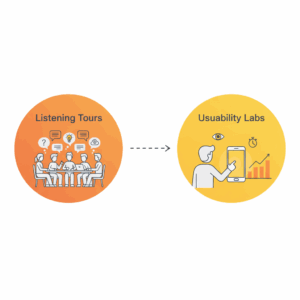
Why do leaders confuse listening tours with usability labs?
Executives chase insight but often mix up two very different instruments. A listening tour gathers narrative intelligence from stakeholders across the organisation to surface themes about culture, priorities, and operational friction. A usability lab examines how real users complete defined tasks with a product or service to expose interaction defects and opportunities. Both improve customer experience and service transformation, yet they answer different questions and operate on different evidence. A listening tour optimises understanding of people and context. A usability lab optimises the fit between a design and human performance. Clear choice delivers clear outcomes. Blurred choice wastes cycles and budgets. The Customer Science approach starts by naming the job, then matching the method to the job.
What is a listening tour and when does it add the most value?
A listening tour is a structured series of conversations where leaders meet people across levels to hear concerns, aspirations, and observed blockers. Done well, it builds trust, reveals blind spots, and accelerates alignment by elevating voices that rarely meet the C-suite. Practitioners stress broad sampling across executives, managers, and frontline teams, and the importance of anonymity when needed to reduce fear and signal respect. These tours help a new leader read the organisational room, map informal networks, and prioritise change without premature solutions. In short, a listening tour informs strategy and culture more than interface decisions. It works best at moments of transition, merger, turnaround, or when engagement signals show drift.¹²¹³
What is a usability lab and why is it different?
A usability lab is a research setting where a facilitator asks participants to complete specific tasks using a product or service while observers capture behaviours, errors, and time on task. The goal is to measure ease of use, learnability, efficiency, and satisfaction, and to diagnose where an experience breaks down. Moderated sessions allow real-time probing. Unmoderated sessions trade depth for speed and scale. Remote options replicate the lab through screen sharing and instrumentation when travel or facilities are impractical. These methods align to human-centred design standards that emphasise iterative cycles and direct engagement with users to reduce risk and improve quality. When you need evidence about interaction performance, choose a usability lab.³⁴⁵⁶⁷⁸
How do these methods support co-creation without overpromising?
Co-creation positions customers and stakeholders as active partners in generating value. In service-dominant logic, value is realised in use, not just at the point of exchange, which makes collaborative discovery essential. Listening tours create the conditions for co-creation by surfacing unmet needs, language, and constraints that shape viable options. Usability labs operationalise co-creation by inviting users to interact with prototypes and services, turning tacit knowledge into observable data. Together, they move organisations from guessing to learning. Use the listening tour to define the problem space and the usability lab to validate solution space choices through observed behaviour. This pairing respects the theory and practice of value co-creation while keeping decision rights clear.⁹¹⁰¹⁵
Where does each method shine across the transformation lifecycle?
Transformation moves through discovery, design, delivery, and scale. In discovery, listening tours surface strategic themes, cultural realities, and systemic obstacles that roadmaps must acknowledge. In design, moderated usability tests de-risk interface and service concepts through task-based evidence. In delivery, unmoderated or remote moderated sessions provide quick pulses to keep releases on track and accessible. In scale, lightweight listening refreshers test whether intent and impact still match, while ongoing usability benchmarking tracks quality. Government service manuals, academic programs, and practitioner guides agree on fitting research method to stage and question, not to trend. This discipline keeps teams from using narrative signals to fix interface problems or using lab metrics to solve cultural ones.⁴⁵⁶¹¹¹²¹⁶¹⁷¹⁸¹⁹
How do you design a listening tour that executives will trust?
Leaders set goals, define the audience, and publish the plan. Brief participants on purpose, scope, and confidentiality. Mix one-to-ones with small groups to balance candour and diversity. Ask consistent, open questions that probe what helps, what hinders, and what customers would notice if improved. Capture themes, not transcripts, and validate them with additional conversations to avoid bias. Close the loop by sharing what you heard, what you will act on, and what you will not, with reasons. This cadence earns permission for future change. Communications teams play a critical role in recruiting, enabling anonymity where appropriate, and translating findings into narratives leaders can use to drive change.¹²¹³¹⁶
How do you run a usability lab that product and service teams will use?
Teams define target users, priority tasks, and observable success metrics before recruiting. Moderated sessions benefit from small samples for qualitative discovery and can reveal over 80 percent of critical issues when you test iteratively with realistic participants. Remote moderated tests increase reach without sacrificing depth. Unmoderated tests help when you need larger samples or repeated measures at speed. Follow a human-centred design loop by analysing results, prioritising fixes, and retesting improvements. Document findings with clear problem statements, evidence clips, and recommended actions. Align with accessibility guidance so people with access needs can participate without friction. This discipline makes insights legible and actionable across engineering, design, and operations.³⁴⁵⁶⁷⁸¹⁰
What risks, biases, and failure modes should leaders avoid?
Two traps undermine both methods. The first is false signal. Listening tours can overweight confident voices or recent events, while lab sessions can mislead when tasks lack realism or when observers overgeneralise from a niche sample. The second is weak follow-through. Insights die when leaders do not close the loop or when product teams cannot resource fixes. Risk drops when you predefine questions, diversify participants, run pilot sessions, and publish how evidence will be used. Remote testing adds convenience but demands extra care with consent, environment control, and data security. Accessibility is not optional. Organisations must plan inclusive recruitment and accommodations to uphold quality and equity.⁴⁵⁶¹¹¹⁴
How should C-level teams choose between them for a given decision?
Match the method to the decision. If you must set priorities, rebuild trust, or understand systemic blockers, run a listening tour. If you must ship a feature, redesign a flow, or certify a service against usability and accessibility criteria, run a usability lab study. Many decisions require both. Start with a listening sprint to ground the vision, then instrument design choices through iterative testing. Customer Science typically integrates both streams in transformation programs so executives see culture, process, and interface evidence side by side. That pairing turns sentiment into action and turns action into measurable service quality.
What does good measurement look like after the studies?
Measurement connects insight to impact. For listening tours, track engagement, theme saturation, decision lead time, and the percentage of actions taken on tour findings. For usability labs, track task success rate, error rate, time on task, System Usability Scale, and accessibility conformance. Publish baselines and improvements over releases, then map changes to customer outcomes such as NPS, complaints, and first contact resolution. Treat measures as a feedback system, not a scorecard. When leaders measure what they change, transformation compounds and credibility grows.
What should you do next to activate both methods?
Start with a decision inventory. Identify which upcoming decisions are strategic, cultural, or interface specific. Commission a focused listening tour to inform the first category and a rolling usability test plan to inform the second and third. Resource a small insights nucleus to coordinate recruitment, standards, and reporting. Use simple templates that make evidence portable across teams. Work in the open, close loops publicly, and celebrate fixes. Customer Science can help you scope, run, and integrate both streams so your transformation moves with speed and shared conviction.
FAQ
How do listening tours differ from usability labs in customer experience programs?
Listening tours collect narrative intelligence about culture, priorities, and operational friction. Usability labs collect behavioural evidence about how users complete defined tasks with a product or service. Use tours to inform strategy and alignment. Use labs to validate interaction design and service quality.¹³⁴
What is the best time to run a listening tour during service transformation?
Run a listening tour at leadership transitions, during mergers, or when engagement and trust lag. Use it to surface themes and prioritise change before committing to solutions or roadmaps.¹²¹³
Which usability testing approach should I start with at enterprise scale?
Start with moderated usability tests for depth and diagnosis, then layer unmoderated or remote sessions for speed and breadth. Align the plan to human-centred design standards and retest after fixes.³⁴⁵⁶⁷
Why does human-centred design matter in usability labs?
Human-centred design reduces risk by iterating solutions with real users through defined activities such as understanding context of use, specifying requirements, producing designs, and evaluating against requirements. It is codified in ISO 9241-210.⁴⁶¹⁴
Who should be included in a listening tour to ensure credible insights?
Include executives, managers, and frontline employees. Protect anonymity where appropriate, and communicate purpose and follow-up actions to build trust and enable candour.¹²¹³¹⁶
What accessibility considerations apply to usability testing in government-grade services?
Plan inclusive recruitment, provide accommodations, and follow service manual guidance so people with access needs can participate effectively. Accessibility improves equity and data quality.⁴¹⁰
Which Customer Science services can integrate both methods for faster impact?
Customer Science integrates decision-focused listening tours with iterative usability testing, then links findings to measurable CX and service metrics so leaders can move from insight to action with confidence.
Sources
Workshop Blog. Jamie Bell. 2024. “What is a listening tour? (and how communications can affect its success).” https://useworkshop.com/blog/what-is-a-listening-tour/
Forbes Coaches Council. 2019. “Five Ways Listening Tours Make You A More Innovative Leader.” Forbes. https://www.forbes.com/councils/forbescoachescouncil/2019/12/20/five-ways-listening-tours-make-you-a-more-innovative-leader/
Nielsen Norman Group. 2018. “Usability Testing 101.” PDF. https://media.nngroup.com/media/articles/attachments/Usability-Testing-101_SizeA4.pdf
GOV.UK Service Manual. 2016. “Using moderated usability testing.” https://www.gov.uk/service-manual/user-research/using-moderated-usability-testing
Coursera. 2025. “What Is Usability? Designing for Ease.” https://www.coursera.org/gb/articles/what-is-usability-and-why-it-matters
ISO. 2019. “ISO 9241-210: Ergonomics of human-system interaction — Human-centred design for interactive systems.” https://www.iso.org/standard/77520.html
UserTesting. 2020. “Remote Moderated 101.” PDF. https://www.usertesting.com/sites/default/files/2023-06/UserZoom%20-%20Remote%20moderated%20101.pdf
GOV.UK Service Manual. 2016. “User research.” https://www.gov.uk/service-manual/user-research
Vargo, S. L., and Lusch, R. F. 2006. “Service-Dominant Logic: Reactions, Reflections and Refinements.” Marketing Theory. PDF. https://www.sdlogic.net/pdf/LuschVargo2006MT.pdf
Vargo, S. L., and Lusch, R. F. 2008. “On Value and Value Co-Creation: A Service Systems and Service Logic Perspective.” SSRN/ResearchGate Working Paper. https://www.researchgate.net/profile/Stephen-Vargo-2/publication/222399036_On_Value_and_Value_Co-Creation_A_Service_Systems_and_Service_Logic_Perspective/links/5b197b93a6fdcca67b63d43a/On-Value-and-Value-Co-Creation-A-Service-Systems-and-Service-Logic-Perspective.pdf
STX Next. 2024. “Moderated and Unmoderated Remote Usability Testing: What Is It, How to Run It, and What Are the Benefits?” https://www.stxnext.com/blog/moderated-unmoderated-remote-usability-testing
ReadySet GC. 2023. “The Power of a Listening Tour: A GC’s Guide to Building Relationships and Driving Impact.” https://www.readysetgc.com/post/the-power-of-a-listening-tour-a-gc-s-guide-to-building-relationships-and-driving-impact
Damien Faughnan. 2023. “How to Conduct a Listening Tour.” https://damienfaughnan.com/how-to-conduct-a-listening-tour/
ISO 9241-210. 2019. Public sample PDF. https://cdn.standards.iteh.ai/samples/77520/8cac787a9e1549e1a7ffa0171dfa33e0/ISO-9241-210-2019.pdf
Wikipedia. 2025. “Service-dominant logic.” https://en.wikipedia.org/wiki/Service-dominant_logic