
Launching a Digital Concierge
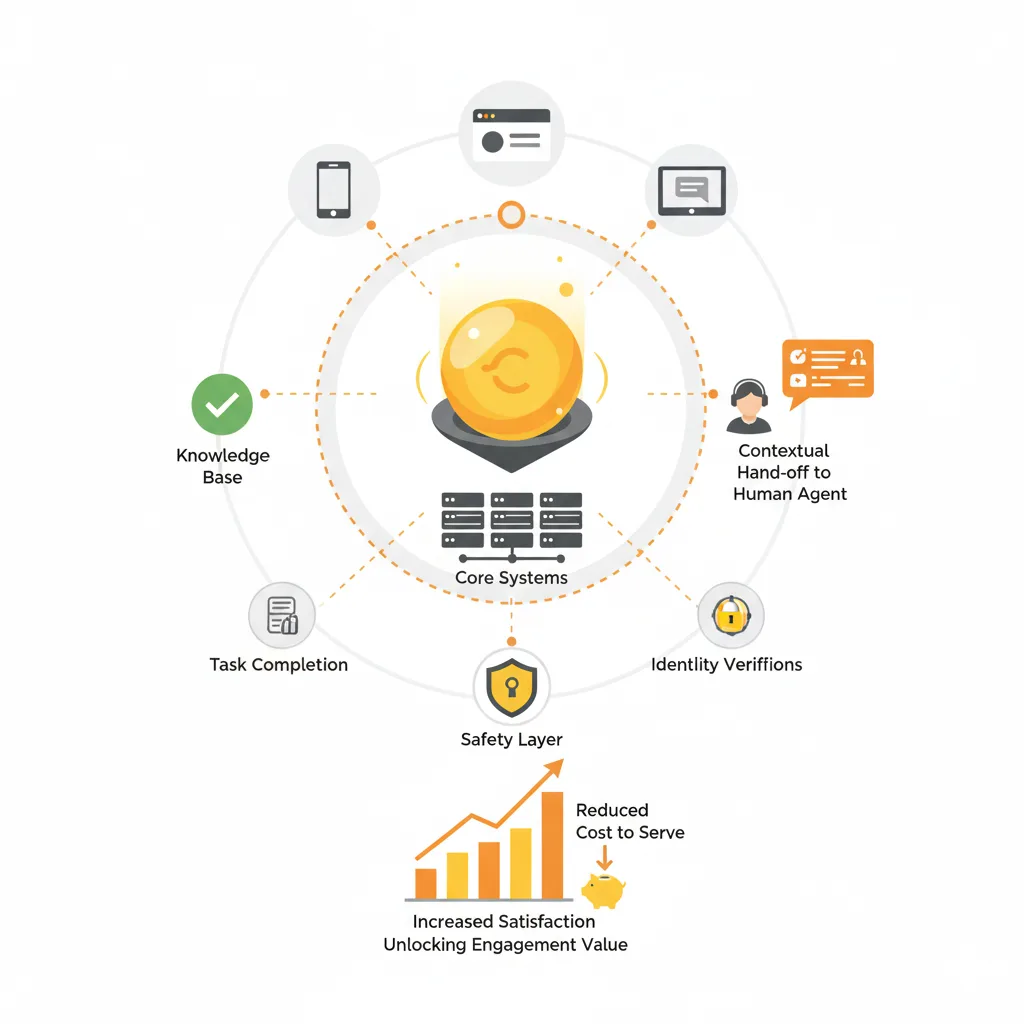
What is a digital concierge and why does it matter now?
A digital concierge simulates a knowledgeable service host who guides customers to outcomes across channels. The unit listens, understands intent, retrieves the right action, and completes the task end to end. Executives use the concept to unify self-service, orchestration, and assisted service into one experience. This structure differs from a static FAQ or a standalone chatbot. The concierge connects to core systems, triggers workflows, and gracefully escalates to humans when value or risk rises. McKinsey frames this evolution as AI-enabled service that increases satisfaction and unlocks engagement value when designed well.¹ Recent work on agentic AI signals a shift from scripted bots to goal-seeking assistants that plan, act, and learn across journeys.²
Where do most self-service models fail today?
Most self-service models fail at resolution, not intent capture. Customers often find answers but cannot complete transactions. Gartner reports that only a small share of customer service issues are fully resolved in self-service, reflecting design and integration gaps.³ Leaders also see a mismatch between investment and adoption when experiences feel brittle or isolated. The digital concierge addresses this gap by delivering task completion. The unit verifies identity, validates policy, and writes back to systems of record. The concierge treats escalation as a feature. It moves context to live agents with transcripts, history, and next best actions so the customer never repeats information.
How does a digital concierge actually work?
A digital concierge runs on five building blocks. The orchestration layer routes intents to services. The knowledge layer spans verified content, policies, and procedures. The action layer connects to APIs, RPA, and event streams to complete tasks. The safety layer governs identity, consent, data retention, and audit. The experience layer adapts voice, chat, and web with consistent patterns. Agentic capabilities add planning, tool use, and memory within guardrails.² The unit monitors signals such as customer state, value at risk, and sentiment to decide whether to self-serve, co-pilot an agent, or hand off cleanly. This mechanism prevents dead ends and reduces time to resolution in real conditions. Leaders design for outcomes first, then map intents and tools that deliver those outcomes.
What standards keep the concierge human-centred?
Human-centred design keeps the concierge trustworthy and usable. ISO 9241-210 defines principles and activities for human-centred interactive systems, including understanding context, specifying requirements, creating solutions, and evaluating against requirements.⁴ These activities create consistent discovery, prototyping, and validation cycles with actual users and frontline teams. Leaders apply the standard to define personas, scenarios, accessibility needs, and error recovery. They also use the standard to prove conformance to stakeholders who govern risk. Human-centred design does not slow delivery. It removes rework by testing the workflows that matter most before scale. Teams align research artifacts with service measures so design choices move KPIs that executives track.
How does a digital concierge compare to traditional chatbots?
Traditional chatbots answer questions and hand over links. A digital concierge resolves requests and updates records. Chatbots rely on static dialogue trees that break under ambiguity. The concierge uses intent recognition, retrieval, and tool use to navigate complexity. Chatbots treat escalation as failure. The concierge treats escalation as orchestration, preserving context across channels and roles. Market analysts note that generative and agentic capabilities now help conversational systems move beyond brittle flows toward measurable resolution.²,⁵ This shift raises the bar for governance, telemetry, and content operations. The result is a service model that behaves like a competent front-office operator, not a scripted widget.
Which use cases make the strongest first wave?
Executives should target high-volume, policy-bounded tasks with clear outcomes. Password resets, address changes, appointment scheduling, order status, claim lodgement, and simple plan changes deliver rapid value. These tasks share three traits. They have stable business rules. They touch a few core systems. They present clear success criteria. Leaders then expand to advisory use cases where the concierge compares plans, recommends actions, and simulates outcomes with transparency. McKinsey highlights contact centres that blend AI and human strengths to create this hybrid model at scale.⁶ The concierge provides the same hybrid benefit in digital channels. It resolves what it can and equips agents with concise context when it cannot.
What risks and controls protect customers and the business?
Risk management must move with design. The concierge enforces identity proofing proportional to risk. The unit logs tool use, prompts, data sources, and actions for audit. The team restricts training data and tunes retrieval to approved content. ISO 9241-210’s emphasis on context of use supports accessibility and equity by design.⁴ Leaders apply additional policies for fairness testing, prompt injection defences, and data minimisation. They also cap autonomous actions to pre-approved tools with clear rollback paths. Service owners test for failure modes such as hallucination, intent drift, and degraded speech recognition. These controls protect customers while enabling speed.
How do we measure success beyond containment?
Containment alone does not show value. Executives measure four layers. Journey outcomes track completion, time to resolution, and first-contact resolution across channels. Customer outcomes track satisfaction, effort, and trust on the specific task. Operational outcomes track deflection to digital, handle time reduction, and escalations avoided. Business outcomes track revenue protection, collections, churn reduction, and claim accuracy. Analysts emphasise that service models must balance efficiency with the value of human contact, which remains essential in complex or emotional journeys.⁶ A digital concierge increases both. It reduces friction for simple tasks and frees experts to focus on moments that matter.
What operating model sustains the concierge after launch?
The operating model treats the concierge as a product, not a project. A cross-functional squad owns backlog, quality, security, and performance. The team runs dual tracks of discovery and delivery. Discovery validates problem framing, content, and flows. Delivery ships small increments behind feature flags. Knowledge management becomes an engineering discipline. Owners define source of truth, content lifecycle, and governance gates. Observability spans prompt traces, tool latencies, and user outcomes. Analysts describe how AI service models create a cycle of better service and stronger engagement when paired with disciplined operations.¹ This discipline is the difference between a pilot and a production-grade concierge.
How do we launch in 90 days without cutting corners?
Leaders can stand up a safe, useful concierge in three waves. Wave one sets the foundation. The team establishes identity, consent, logging, and a reference architecture. The group delivers two high-value tasks end to end with human-centred design checkpoints and live guardrails.⁴ Wave two scales content and actions. The team builds connectors for top systems, adds five to ten intents, and instruments outcome analytics. Wave three tunes and governs. The team trains retrieval on approved content, adds agent assist, and formalises an ethics review. Market research suggests that generative capabilities now accelerate time to value when paired with strong governance and clear scope.⁵ This plan respects safety, delivers impact, and creates momentum.
What does “good” look like at steady state?
A mature digital concierge behaves like a reliable colleague. The unit understands who the customer is, predicts next steps, and acts with permission. The concierge adapts tone and guidance by context, device, and channel. The team continuously tests flows against updated policies and content. The product leads can show executives a clear line from design decisions to outcome movement. Customer Science calls this state service transformation. The model reduces effort, raises trust, and frees human experts to solve harder problems. Analysts point to a balanced future where AI and human service together form the new standard for customer care.⁶ Leaders who pursue this model now build an advantage that compounds over time.¹,²
What are the first three moves to make this real?
Executives should appoint a single owner with budget and authority. The owner secures a small, senior team and a narrow scope. The group picks measurable tasks and builds them end to end with human-centred design.⁴ The owner publishes a service charter that defines purpose, guardrails, escalation, and measurement. The team then socialises a playbook for content operations, prompt hygiene, and incident response. Finally, leaders commit to quarterly reviews that tie customer outcomes to strategic goals. Market evidence shows that a hybrid model outperforms either pure automation or pure human service.⁶ That posture turns the digital concierge from a tool into a durable capability.
FAQ
What is a digital concierge in Customer Experience and Service Transformation? A digital concierge is a service capability that understands intent, orchestrates knowledge and actions, and completes tasks across channels while handing off context to human agents when value or risk is high. It unifies self-service and assisted service into one experience.¹,²
How does a digital concierge improve self-service completion rates? The concierge connects identity, policy rules, and system write-backs to deliver task completion, not just answers. This design addresses the industry problem where only a small share of issues are fully resolved in self-service.³
Which standards guide human-centred concierge design? ISO 9241-210 provides principles and activities for human-centred interactive systems, including understanding context of use, co-design, and evaluation against requirements. Teams apply this to journeys, accessibility, and error recovery.⁴
Why choose a concierge over a traditional chatbot? Traditional chatbots rely on brittle scripts. A concierge uses intent recognition, retrieval, and tool use to resolve requests and escalate with context. Analysts highlight agentic capabilities that move systems beyond static flows toward measurable resolution.²,⁵
Which early use cases deliver fast impact for digital service models? High-volume, policy-bounded tasks such as address changes, appointment scheduling, order status, and simple plan changes deliver rapid value and clear success criteria. Hybrid models that blend AI with human expertise scale these benefits.⁶
What metrics prove impact to C-level stakeholders? Leaders track journey outcomes like completion and time to resolution, customer outcomes like satisfaction and effort, operational outcomes like deflection and handle time, and business outcomes like churn reduction and claim accuracy. Balanced AI and human service improves these measures in tandem.⁶
Which governance practices keep a concierge safe and compliant? Strong identity controls, consent management, restricted training data, retrieval over approved content, action whitelisting, audit logs, and fairness and robustness testing provide safety while enabling speed. ISO 9241-210’s process model anchors these practices.⁴
Sources
-
The next frontier of customer engagement: AI-enabled customer service - Sapru, Kaka, et al., 2023, McKinsey & Company. https://www.mckinsey.com/capabilities/operations/our-insights/the-next-frontier-of-customer-engagement-ai-enabled-customer-service
-
The future of customer experience: Embracing agentic AI - Galizzi, Lim, et al., 2025, McKinsey & Company. https://www.mckinsey.com/capabilities/operations/our-insights/the-future-of-customer-experience-embracing-agentic-ai
-
Gartner Survey Finds Only 14% of Customer Service Issues Are Fully Resolved in Self-Service - Gartner Press Release, 2024. https://www.gartner.com/en/newsroom/press-releases/2024-08-19-gartner-survey-finds-only-14-percent-of-customer-service-issues-are-fully-resolved-in-self-service
-
ISO 9241-210:2019 Ergonomics of human-system interaction - Part 210: Human-centred design for interactive systems - International Organization for Standardization, 2019. https://www.iso.org/standard/77520.html
-
The Forrester Wave: Conversational AI for Customer Service 2024 - Top Takeaways - CX Today summary of Forrester research, 2024. https://www.cxtoday.com/conversational-ai/the-forrester-wave-conversational-ai-for-customer-service-2024-top-takeaways/
-
The contact centre crossroads: Finding the right mix of humans and AI - Ghosh, Maman, et al., 2025, McKinsey & Company. https://www.mckinsey.com/capabilities/operations/our-insights/the-contact-center-crossroads-finding-the-right-mix-of-humans-and-ai