































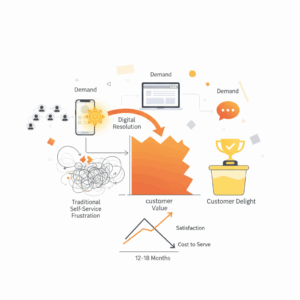
Why should leaders treat deflection as a growth play, not a cost play?
Executives often chase deflection to cut volume. Customers chase resolution to get time back. Smart self-service aligns both incentives. When leaders design self-service to solve the full job, deflection becomes delight. Digital journeys reduce avoidable contact, protect margins, and return human capacity to the moments that matter. Organizations that digitize end-to-end experience typically lift customer satisfaction by 15 to 20 percent and reduce cost to serve by 20 to 40 percent.¹ Customers, meanwhile, vote with their feet. In Microsoft’s global study, 95 percent said service influences brand choice and loyalty, and 61 percent reported switching due to poor service.² The message is clear. Customers want fast, intuitive self-service for common tasks and expert humans for the exceptions. Good deflection removes friction. Great deflection creates advocacy after an effortless fix.³
What is “smart self-service” in plain terms?
Smart self-service is a design pattern that delivers complete outcomes without handoffs. It combines clear intent capture, dynamic guidance, and straight-through processing. It uses policy, data, and workflow to remove effort rather than simply reroute it. The system infers need, authenticates once, and resolves in one flow. AI boosts the pattern by predicting next best steps, validating inputs, and preventing repeat contact. Done well, the same fabric powers virtual agents, authenticated portals, and proactive notifications. The goal is not containment at any cost. The goal is correct first time. Leaders should define smart self-service as any digital flow that fully resolves a request with zero recontact inside a defined time window. This clarity keeps teams focused on outcomes. It also anchors investment decisions to measurable value such as cost to serve, NPS, and revenue protection.⁴
Where do self-service flows break today?
Teams often ship digital fragments, not solutions. Customers hit knowledge pages that explain policy but fail to execute it. Bots ask for intent but cannot action it. Authentication repeats across steps. Data lives in silos that block verification. These gaps create the worst of both worlds: digital dead ends that force a channel switch and reset effort. Research on customer service underscores this pattern. As customers self-solve simple issues, the remaining live contacts grow in complexity, yet many reps lack the tools to handle them.⁵ Leaders must assume that every broken digital step creates two costs. The first cost is the repeated contact. The second cost is the trust erosion that drives switching after a single bad experience.³ Smart self-service solves the end-to-end job or fails fast to a human with context intact. Anything else is leakage.
How do we design flows that deflect and delight?
Start with high-volume intents that customers try first online. Map the job to be done from trigger to outcome. Write the canonical policy as executable steps. Remove any step that asks the customer to do internal work. Use progressive disclosure to keep each screen focused. Validate inputs at source using authoritative systems. Offer authenticated one-click actions for common changes, refunds, or reschedules. Build graceful exits that pass transcript, state, and verification to a human. Use decisioning to suggest the next best action and to prevent downstream failure. AI can score risk, propose resolution paths, and personalize guidance, which lifts satisfaction by 15 to 20 percent and cuts cost to serve by 20 to 30 percent when deployed across journeys.⁴ Treat content, UX, workflow, and policy as one unit. The unit resolves the job or it does not.
What operating model sustains smart self-service?
High performers run a product model. They group journeys into accountable domains with a business owner, a service designer, an engineer, a data partner, and a policy lead. The team holds a shared outcome such as digital resolution rate, repeat contact rate, and time to outcome. Intake flows through a triage that separates fixes, experiments, and structural changes. Weekly rituals review funnel friction, error codes, and verbatims. A central platform team provides reusable components such as authentication, payments, document capture, and decisioning. Contact centers become learning engines. They tag intents at the edge, surface policy mismatches, and validate AI suggestions. Leaders balance automation with human contact, since both forces shape modern care and must evolve together to protect trust.⁶ This operating model keeps self-service fresh, compliant, and pointed at measurable outcomes.
Which metrics prove that deflection equals delight?
Measure what the customer feels and what the business funds. Digital Resolution Rate shows how often the flow completes the job without human help inside a set window. Effort Score captures perceived friction during the flow. Repeat Contact Rate highlights hidden rework. Time to Outcome measures real speed. For value, track Cost to Serve, Revenue Saved from churn prevention, and Agent Capacity Released. Tie everything to a shared north star: Correct First Time. Leaders should also monitor the volatility that single bad experiences cause. More than half of customers will switch after one unsatisfactory interaction, so outlier prevention matters.³ Use distribution views, not just averages. Add guardrails such as maximum wait for a human callback and maximum steps to resolution. Metrics should inform design changes within a two-week cadence, not a quarterly report.
How do we pick the first three journeys?
Pick intents that hurt today and scale tomorrow. Use four filters. First, volume with pain. Second, policy clarity that can be codified. Third, data availability to verify identity and entitlement. Fourth, straight-through potential that avoids manual back-office choke points. Good starting candidates include password reset with step-up verification, delivery change with inventory check, and plan change with proration. Partner with the contact center to harvest language, failure reasons, and workaround paths. Validate your initial hypothesis with a short live-traffic experiment. Use feature flags to A/B test copy, sequence, and recovery options. Bring in a risk lead early to codify edge cases. Scale only after the core path shows uplift in digital resolution and reduction in repeat contact. Reinforce the win with training and coaching for agents who now handle the harder tail of demand.⁵
What are the risks and how do we mitigate them?
Three risks recur. First, silent failure creates hidden churn. Mitigate with real-time drop-off alerts and proactive follow-ups. Second, policy drift breaks automation. Mitigate with policy change control that pairs legal and product owners. Third, model bias harms vulnerable customers. Mitigate with fairness checks and human review on high-impact decisions. Leaders should also resist vanity containment. Deflecting a customer who needed a human is not success. It is failure and brand damage. Balance automation with clear escalation, since customers value quick AI support but still expect empathy for complex, emotional issues.⁶ Use opt-outs that are visible and stigma-free. Involve risk, compliance, and accessibility teams from the start. Hold a monthly ethics review that samples transcripts and outcomes across segments. Focus on safe, inclusive resolution for everyone.
How do we build an evidentiary layer that wins budgets?
Finance funds proof, not promises. Build a transparent ledger of cause and effect. Link each self-service release to a defined hypothesis, a test window, and a measured impact on resolution, effort, and cost. Use authoritative benchmarks to anchor expected gains. McKinsey finds that digitized experiences can cut cost to serve by 20 to 40 percent and lift satisfaction by 15 to 20 percent.¹ Case studies on AI-assisted next best actions show cost reductions of 20 to 30 percent alongside satisfaction gains.⁴ Use these ranges as planning priors, then replace them with your measured results. Share a living dashboard with product, finance, and operations. Close the loop by reinvesting a portion of the released capacity into complex care, agent coaching, and continuous journey improvement. This evidentiary layer turns deflection into a strategic flywheel.
What are the build blocks of a production-grade flow?
Leaders assemble five building blocks. Intent Understanding captures purpose using natural language and structured prompts. Identity and Trust verifies the customer with risk-based controls. Policy Engine translates rules into executable logic. Workflow and Integration executes transactions across core systems. Experience Layer delivers the UI and microcopy. A telemetry spine connects every block and enables rapid tuning. Teams should ground these blocks in platform components to reduce variance and speed change. Survey data from Zendesk shows organizations worldwide are scaling intelligent CX with broad participation from both consumers and service leaders, which points to the need for shared platforms and patterns.⁷ These blocks let you ship faster, fix faster, and prove value faster. They also make it easier to keep parity across chat, web, app, and proactive channels.
What impact should executives expect in year one?
Executives should target simple, defensible gains. Aim to move three needle metrics per journey: digital resolution up, repeat contact down, and time to outcome down. Back the targets with weekly fixes and monthly releases. Expect a virtuous cycle when customers see speed and reliability. Organizations that get this right typically see satisfaction lift, cost to serve drop, and conversion improve as effort falls away.¹ Treat the contact center as a design partner, not a cost center. Empower your agents to coach the product. Celebrate when a human saves the day and feed that learning back into the flow. The strategy is simple. Deflect with empathy. Resolve with finality. Prove with data. Protect trust, since more than half of customers will switch after one bad experience.³ This play builds loyalty while it earns productivity.
FAQ
How does Customer Science approach smart self-service for enterprise contact centers?
Customer Science uses a product model that pairs service design, engineering, data, and policy to deliver end-to-end digital resolution. The team targets high-volume intents, codifies policy into executable steps, and measures Digital Resolution Rate, Repeat Contact Rate, and Time to Outcome to prove value.
What metrics matter most for deflection without dissatisfaction?
Leaders should track Digital Resolution Rate, Effort Score, Repeat Contact Rate, Time to Outcome, and Cost to Serve. Use Correct First Time as the north star and add guardrails for maximum wait and maximum steps. Tie improvements to reinvestment in complex human care.
Why is “containment at any cost” the wrong goal for CX?
Containment without resolution creates silent churn. Smart self-service resolves the full job or fails fast to an agent with context. Good flows reduce avoidable contact while protecting trust with clear, stigma-free escalation paths.
Which journeys are best to automate first in Customer Science programs?
Start with intents that combine high volume and straight-through potential, such as password reset with step-up verification, delivery change with inventory check, or plan change with proration. Validate with live-traffic experiments before scaling.
How do AI and next best actions improve self-service outcomes?
AI predicts intent, validates inputs, and recommends resolution paths. Deployed across journeys, next best actions can lift satisfaction and reduce cost to serve, while freeing agents to focus on complex exceptions supported by context.
Who should own digital service models inside large enterprises?
Customer Science recommends accountable domain teams with a single owner for outcome metrics. A platform team provides shared components such as authentication and decisioning. Contact centers supply real-time insight from edge interactions.
Which industries benefit most from smart self-service with Customer Science?
Any sector with repeatable, policy-driven requests benefits. Telco, utilities, financial services, and government services see strong returns because the work suits straight-through processing and customers prefer fast, low-effort resolutions.
Sources
Service industries can fuel growth by making digital customer experiences a priority — McKinsey & Company, 2019, PDF. https://www.mckinsey.com/~/media/McKinsey/Business%20Functions/McKinsey%20Digital/Our%20Insights/Service%20industries%20can%20fuel%20growth%20by%20making%20digital%20customer%20experiences%20a%20priority/service-industries-can-fuel-growth-by-making-digital-customer-experiences-a-priority.ashx
Now available: the 2018 State of Global Customer Service Report — Microsoft, 2018, Blog. https://www.microsoft.com/en-us/dynamics-365/blog/business-leader/2018/08/30/now-available-the-2018-state-of-global-customer-service-report/
35 customer experience statistics to know for 2025 — Zendesk, 2025, Blog. https://www.zendesk.com/blog/customer-experience-statistics/
Next best experience: How AI can power every customer interaction — McKinsey & Company, 2025, Article. https://www.mckinsey.com/capabilities/growth-marketing-and-sales/our-insights/next-best-experience-how-ai-can-power-every-customer-interaction
Kick-Ass Customer Service — Dixon, Ponomareff, Turner, DeLisi, 2017, Harvard Business Review. https://hbr.org/2017/01/kick-ass-customer-service
The contact center crossroads: Finding the right mix of humans and AI — McKinsey & Company, 2025, Article. https://www.mckinsey.com/capabilities/operations/our-insights/the-contact-center-crossroads-finding-the-right-mix-of-humans-and-ai
CX Trends 2025: Surge ahead with human-centric AI — Zendesk, 2024, Report hub and methodology. https://cxtrends.zendesk.com/