































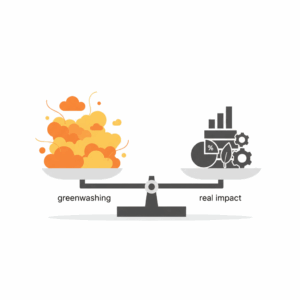
Why does greenwashing persist in service industries?
Service brands sell promises, not products, which makes environmental claims harder to verify and easier to inflate. Regulators call out “vague, misleading or unsubstantiated” claims as greenwashing, and they increasingly penalise it under consumer law.¹ In Australia, both the ACCC and ASIC have intensified enforcement, publishing practical tests and reporting dozens of interventions across 2023 and 2024.² The EU’s 2024 consumer law update explicitly bans generic claims like “eco-friendly” without proof and restricts offset-based “climate neutral” language that masks real emissions.³ The UK has also expanded enforcement powers for misleading green claims, including fines linked to global turnover.⁴ These moves reshape risk for service businesses that rely on brand trust and intangible value. The takeaway is simple. Regulators expect claims to match measured impact, and they now act when words outrun evidence.¹²³⁴
What is “real impact” for services?
Real impact means measured reductions in a provider’s material environmental footprint, validated against accepted standards. The greenhouse gas footprint framework that most enterprises use is the Greenhouse Gas Protocol. It defines Scope 1, Scope 2 and Scope 3 emissions and sets rules for transparent inventory accounting.⁵ Science Based Targets initiative guidance then links those inventories to time-bound decarbonisation targets aligned with climate science.⁶ For operations discipline, ISO 14001 provides the environmental management system blueprint that ties policy to planning, controls and continual improvement.⁷ These three anchors let service leaders define materiality, set targets and operationalise reductions. A claim is credible when it maps to these references, carries boundary and method detail, and shows year-on-year performance.
How do you diagnose greenwashing risk in services?
Leaders prevent greenwashing by testing every claim against four questions. First, does the claim map to a specific measurement method and boundary, such as location-based or market-based Scope 2 electricity?⁵ Second, does the claim report absolute and intensity metrics over time rather than a single point? Third, does the claim avoid offset-first language and focus on real reductions before compensation, in line with emerging EU norms?³ Fourth, does the claim disclose uncertainty and exclusions, especially in Scope 3 categories like purchased services and capital goods?⁶ Cross-functional review with Legal and Risk reduces ambiguity. The ACCC’s plain-language guidance adds practical checks for clarity, truthfulness and substantiation that service teams can adopt in marketing sign-off.¹
Where do service emissions really sit?
Service footprints often concentrate in purchased energy, buildings, travel and digital value chains. Data centre and AI workloads now influence this mix. The IEA estimates global data centres consumed about 415 TWh of electricity in 2024, roughly 1.5 percent of global use, and projects that demand could more than double by 2030 if current trends continue.⁸⁹¹⁰ For digital-first service providers, this makes vendor selection and workload efficiency a core emissions lever. Real impact comes from procurement clauses that require renewable supply matching, high utilisation, efficient architectures and transparent reporting. It also comes from disciplined travel policies, building efficiency, and supplier engagement on Scope 3, which SBTi requires when Scope 3 exceeds 40 percent of the total footprint.¹¹
How should CX and service leaders separate signal from noise?
Executives should treat sustainability statements like product features. Teams must define the unit of value, align on a measurable baseline and run controlled change. ISO 14001 helps leaders set objectives, competence requirements and operational controls that turn intent into outcomes.⁷ GHG Protocol inventories provide the data layer for decision quality.⁵ SBTi gives a target pathway that discourages short-termism and prefers structural reductions.⁶ These anchors stop green gloss from creeping in. They also make it easier to brief agencies and partners on what the brand can and cannot claim, which reduces compliance risk under ACCC, EU and UK regimes.¹³⁴
What proof points make service claims credible?
Service businesses earn trust when they publish method notes, boundaries and third-party standards alongside each claim. Leaders should show year-on-year absolute emissions, normalised intensities per service unit and progress to science-based targets.⁶ They should disclose residual emissions and the role of high-quality credits, if used, while avoiding claims the EU now restricts when based on offsetting.³ They should include operational evidence such as ISO 14001 certification and audit cadence.⁷ They should reference core methodologies like GHG Protocol for inventory quality and explain any material estimation.⁵ Finally, they should connect digital workloads to IEA-aligned power assumptions and efficiency metrics so statements about “green cloud” or “AI efficiency” remain testable.⁸⁹¹⁰
How do you design services for real impact instead of green spin?
Service design teams can embed sustainability into the blueprint. Start with a short list of high-leverage interventions that reduce energy, travel and materials. Prioritise channel shift with measured emissions benefits rather than assumed benefits, since digital is only cleaner if the workload and data centre energy are efficient and renewables-backed.⁸ Consolidate vendor spend with providers that publish location-based and market-based emissions, renewable match quality and data centre PUE ranges. Require reporting aligned with GHG Protocol and SBTi supplier guidance for Scope 3.⁵⁶ Rework journey maps to cut idle time and rework in contact centres, which reduces energy and hardware wear. Pair this with building and HVAC optimisation under the ISO 14001 control plan.⁷ Publish the logic so customers see how design choices produce measured outcomes.
How do regulations change the communication playbook?
Regulatory momentum is clear. Australia enforces misleading environmental claims under the Australian Consumer Law, and both ACCC and ASIC have issued guidance and acted on noncompliance.¹² The EU’s 2024 directive on empowering consumers for the green transition updates unfair commercial practices, bans certain generic environmental labels and sets clearer information duties.³ The European Parliament and Commission continue to advance a separate Green Claims Directive to standardise substantiation and verification of environmental claims.⁴ The UK’s Competition and Markets Authority now has direct enforcement powers to fine misleading claims.⁴ In the United States, the Federal Trade Commission’s Green Guides remain the reference for marketers, with updates under consideration and state activity filling gaps.¹⁴ Communication strategies should track these frameworks and use them as acceptance criteria for every claim.
How do you measure impact with service-ready KPIs?
Leaders measure three tiers of impact. Tier one tracks operational emissions across Scopes 1, 2 and 3 using the GHG Protocol and audits the inventory annually.⁵ Tier two tracks service efficiency metrics such as emissions per customer interaction, per hour of compute, per square metre, and per FTE. Tier three tracks outcomes, such as customer adoption of lower-carbon options and supplier compliance rates on renewable electricity. SBTi-aligned targets add timelines and interim checkpoints.⁶ IEA-aligned data and vendor attestations validate digital claims as AI workloads scale.⁸¹⁰ A concise impact dashboard that blends these tiers turns sustainability into a management system, not a marketing headline.
What is the practical roadmap for CX leaders?
Executives can deliver a 12-month plan that replaces greenwashing with measurable change. Month 0 to 3, set governance, choose standards, scope baselines and freeze a claims style guide aligned to ACCC, EU and FTC guidance.¹³¹⁴ Month 4 to 6, embed ISO 14001 controls into facilities, travel and procurement, and lock SBTi targets for near term and net zero.⁶⁷ Month 7 to 9, renegotiate digital and data centre contracts around renewable matching, workload efficiency and transparent reporting, grounded in IEA projections and vendor disclosures.⁸¹⁰ Month 10 to 12, publish a method note with boundary, assumptions and uncertainties, then iterate claims with Legal and Risk. This cadence creates audit-ready proof and builds brand trust.
What is the business impact of getting this right?
Service leaders increase growth when sustainability claims are specific, measured and comparable. Buyers reward clarity, while regulators reward diligence. The combination of GHG Protocol inventories, SBTi targets and ISO 14001 operations cuts compliance risk, aligns teams and clarifies investment priorities.⁵⁶⁷ The IEA’s outlook on data centre energy use adds urgency for digital service providers to act now on efficiency, capacity planning and energy sourcing.⁸⁹ Brands that move first will shape categories and set claim norms that competitors must follow. The result is simpler governance, stronger trust and a measurable path to decarbonisation.
What should you do next?
You should pick your anchor standards, baseline your footprint and publish a claims style guide that mirrors ACCC, EU and FTC expectations.¹³¹⁴ You should integrate ISO 14001 controls and set SBTi targets that cover Scope 3 where material.⁶⁷ You should renegotiate digital workloads against IEA-aware risk and commit to transparent reporting.⁸ Most of all, you should make every sustainability claim a testable statement that another expert could reproduce.
FAQ
What is greenwashing in services and why is it risky for CX leaders?
Greenwashing in services occurs when environmental claims are vague, misleading or unsubstantiated. Regulators like the ACCC, ASIC, the EU and the UK CMA now enforce against such claims, creating reputational and legal risk for brands that rely on trust.¹²³⁴
How should a service business substantiate sustainability claims?
A service business should align with the GHG Protocol for inventories, set SBTi-aligned targets, and operate an ISO 14001 environmental management system. Claims should disclose boundaries, methods and year-on-year performance.⁵⁶⁷
Which regulations shape environmental marketing for services in 2024–2026?
Key frameworks include the ACCC guidance and ASIC enforcement in Australia, the EU’s 2024 directive empowering consumers for the green transition, the evolving EU Green Claims Directive, the UK CMA’s expanded powers and the FTC Green Guides in the United States.¹²³⁴¹⁴
Why must digital and AI services address data centre emissions now?
IEA analysis shows data centres consumed around 415 TWh of electricity in 2024 and could more than double consumption by 2030, which makes workload efficiency and renewable matching material levers for service providers.⁸⁹¹⁰
Which Scope 3 rules matter most for service organisations?
When Scope 3 exceeds 40 percent of total emissions, SBTi requires near-term targets that cover at least two thirds of Scope 3. This typically captures purchased goods and services, travel and digital supply chains.¹¹
How can Customer Experience teams reduce the risk of greenwashing in communications?
CX teams can apply the ACCC’s plain-language checks, avoid offset-first claims restricted under EU rules, and attach method notes and baselines to every message.¹³
Which standards unlock audit-ready proof of real impact?
The combination of GHG Protocol inventories, SBTi targets and ISO 14001 operational controls provides the backbone for credible, auditable claims across service environments.⁵⁶⁷
Sources
Australian Competition and Consumer Commission. “A guide to making environmental claims for business.” 2023. ACCC. (ACCC)
Australian Securities and Investments Commission. “REP 791 ASIC’s interventions on greenwashing misconduct: 2023–2024.” 2024. ASIC. (ASIC)
European Parliament and Council. “Directive (EU) 2024/825 empowering consumers for the green transition.” 2024. EUR-Lex. (EUR-Lex)
Fieldfisher. “Greenwashing under scrutiny: the CMA’s new powers to tackle misleading environmental claims.” 2025. Fieldfisher Insight. (Fieldfisher)
World Resources Institute and WBCSD. “The Greenhouse Gas Protocol: A Corporate Accounting and Reporting Standard.” 2004, revised edition. GHG Protocol. (ghgprotocol.org)
Science Based Targets initiative. “Standards and guidance.” 2023. SBTi. (Science Based Targets Initiative)
International Organization for Standardization. “ISO 14001:2015 Environmental management systems.” 2025. ISO. (ISO)
International Energy Agency. “Energy demand from AI.” 2025. IEA. (IEA)
International Energy Agency. “AI is set to drive surging electricity demand from data centres.” 2025. IEA News Release. (IEA)
S&P Global Commodity Insights. “Global data center power demand to double by 2030 on AI surge: IEA.” 2024. S&P Global. (S&P Global)
Science Based Targets initiative. “SBTi Corporate Manual v2.1.” 2023. SBTi. (files.sciencebasedtargets.org)
Hogan Lovells. “Greenwashing: publication of the directive on empowering consumers for the green transition.” 2024. Hogan Lovells. (www.hoganlovells.com)
European Parliament Research Service. “‘Green claims’ directive.” 2024. EPRS At a Glance. (europarl.europa.eu)
Federal Trade Commission. “Green Guides.” 2024. FTC. (ftc.gov)