





























What is a self-service portal in 2025, and why does adoption lag?
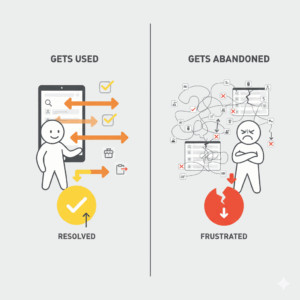
Executives define a self-service portal as a digital front door where customers find answers, complete tasks, and manage requests without agent intervention. The promise is simple, the execution is not. Customers still abandon portals when navigation hides answers, content feels stale, or escalation paths fail. Research underscores the gap. Harvard Business Review found that reducing customer effort is a stronger driver of loyalty than delight campaigns, which means a portal must make tasks easy, fast, and predictable.¹ Gartner’s 2024 survey reported that only 14 percent of customer service issues are fully resolved in self-service, even when customers describe issues as very simple, which explains why adoption often stalls despite heavy investment.² Leaders cannot rely on more features or more channels to fix this. Gartner advises leaders to rethink strategy around self-service outcomes rather than channel count.⁶
How do leaders define “get used” for a portal, not just “exists”?
Leaders anchor on measurable behaviors. A used portal earns repeat visits, resolves a rising share of top demand types, and shortens time to resolution for customers and agents. Adoption should be defined as the portion of eligible demand that completes digitally without assisted contact, not simple logins. Success also shows up in the assist layer. Agents handle fewer repetitive requests because knowledge is current and surfaced inside both the portal and the agent desktop. Zendesk’s recent trend work shows firms are reimagining journeys around intelligent service, with executives prioritizing AI that speeds answers and routes intents correctly.³⁴ When AI and content collaborate, deflection metrics become durable rather than seasonal, and customer effort drops in both digital and assisted journeys.¹
What customer problems must a high-performing portal solve first?
Portal programs win when they target the top five intents that drive the most pain and volume. A practical taxonomy groups intents by frequency, value at risk, and resolution complexity. Teams then design one frictionless path per intent. The experience should confirm identity, gather context, and present a single best next step, with relevant status, entitlements, and policy limits visible by default. Since only a small fraction of issues fully resolve in self-service today, teams should ruthlessly simplify documentation, forms, and handoffs.² When issues exceed self-service scope, the portal should hand off to chat or case creation with history preserved, not restart the story. This preserves the logic of “easy first, help when needed,” which aligns to the research on effort and loyalty.¹
What design mechanisms convert intent into completion?
Design teams build journeys around five mechanisms. First, intent detection routes customers to the correct flow using search, menu cues, and lightweight language models that map utterances to canonical intents. Second, progressive disclosure keeps pages focused, with relevant policy fragments appearing contextually rather than as long PDFs. Third, status transparency shows progress, service levels, and next actions, which reduces repeat contacts and improves trust. Fourth, escalation without rekeying gives customers a visible path to chat or callback with context intact. Fifth, continuous feedback helps teams watch abandonment points and content effectiveness. These mechanisms allow self-service to operate as a system, not a pile of pages, which is how leaders convert traffic into completed outcomes at scale.³
How should teams treat knowledge as product, not as articles?
Knowledge is a product that fuels both the portal and the agent desktop. Teams should define owners, update cadences, and retirement rules. Article templates should mirror how customers ask, not how the organisation is structured. Strong programs instrument knowledge with consumption, search, bounce, and assisted-contact correlation, then tune based on those signals. Vendor guidance is clear that knowledge base metrics must drive continuous improvement, not one-time migrations.⁵ When knowledge is treated as product, resolver accuracy and consistency rise in both channels. This keeps the portal credible and gives agents a reliable single source of truth, which in turn reduces escalations triggered by conflicting answers.¹⁵
Where does AI help today without overpromising?
AI accelerates three jobs. It improves retrieval by mapping messy language to structured intents and by ranking snippets that actually resolve tasks, which shortens search journeys. It summarises policy and history for customers and agents, which reduces context switching. It automates simple resolutions like password resets, appointment moves, or plan changes, with guardrails and audit trails. Market data shows leaders are already reimagining journeys with intelligent CX, and they report stronger outcomes when AI augments clear workflows rather than tries to replace them outright.³⁴ The lesson is pragmatic. Start where AI meaningfully reduces steps, then expand coverage as accuracy improves and content quality keeps pace.³
How do we measure success without gaming the metrics?
Executives set a tight set of outcome metrics and a broader set of diagnostic metrics. At the top, track digital completion rate for eligible intents, average time to resolution, customer effort score post-resolution, and case prevention, which is measured as avoided assisted contacts per intent.¹² Digital completion should correlate with effort reduction to confirm that resolution, not avoidance, is rising. Diagnostics include search reformulations, no-result queries, article helpfulness, and drop-off points by page. Vendor reports and support guides emphasise metrics that improve content, not vanity views, which helps teams correct course weekly rather than quarterly.⁵ Leaders also compare self-service resolution against older benchmarks to verify real movement, since past Gartner data placed complete self-service resolution as low as 9 percent, which shows how much headroom remains.⁷
What operating model keeps the portal truthful and current?
A durable operating model keeps decision rights close to the work. Product managers own intents and outcomes, knowledge leads own content quality, and engineering owns the platform. A cross-functional review meets weekly to approve schema changes, content retirements, and experiment results. Legal and risk partners participate through lightweight patterns and pre-approved clauses so updates move fast. This structure reduces cycle time from insight to change, which is the core constraint in most portal programs. When leaders treat the portal as a living product with sprint rituals, they can respond to new demand patterns within days, not months, which aligns with the industry’s shift toward intelligent, adaptive CX.³⁴
Which implementation blueprint delivers early value and compounding returns?
Teams ship value in three horizons. Horizon one stands up the portal shell, secure identity, and two to three high-volume intents with crisp flows, current knowledge, and assisted handoffs. Horizon two extends coverage to the top ten intents, adds status transparency, and embeds AI retrieval for search and chat. Horizon three industrialises governance, scales automation for simple changes, and personalises journeys based on profile and history. Each horizon includes a measurement plan that publishes intent-level completion, effort, and prevention. Publishing this evidence builds stakeholder trust and directs investment into the intents that move the most value. This is how leaders turn a portal from an IT deliverable into an enterprise growth and cost lever.¹²³
What risks matter, and how do we mitigate them?
Portal programs fail when teams confuse traffic with outcomes, when knowledge fragments, or when escalation breaks context. They also fail when AI hallucinates policy, when identity weakens security, or when governance slows updates. Mitigations are practical. Tie funding to completed outcomes per intent, not page counts. Establish a single knowledge source with enforced templates and ownership. Require context-preserving escalation and instrument it. Constrain AI responses to approved content, log prompts and outputs, and gate release through human review for regulated content. Maintain explicit service levels for content and flows, and include legal partners early through modular policy text. These moves directly reduce effort and close the gap between promise and reality that recent surveys continue to highlight.¹²³
How do we turn insight into action in the next 90 days?
Leaders can move now. Week one maps top intents by demand and value. Week two designs the gold-path flow for the highest-value intent. Week three updates knowledge to match customer language and introduces guardrailed AI retrieval for that intent. Week four ships the flow with instrumentation and context-preserving escalation. The next eight weeks repeat the cycle across four more intents, each with a hypothesis, an experiment, and an outcome target. Publish results biweekly to the executive team, and keep the backlog visible. This cadence prioritises clarity and speed, which aligns with the evidence that customer effort reduction converts into loyalty and lower service costs.¹
What evidence should executives track to stay honest?
Executives should keep a concise evidence board that includes three numbers by intent. First, percent of issues fully resolved in self-service, validated with post-resolution surveys and cross-checked against assisted contact fallbacks. Second, mean time to resolution in minutes, segmented by digital-only, digital plus assist, and assist-only. Third, customer effort score distributions with verbatims linked to specific steps. Add two supporting signals from vendor telemetry, which include search reformulations and article helpfulness. Recent industry reporting shows that leaders who reimagine journeys with intelligent service gain leverage, but only where content and governance keep pace.³⁴ This board forces attention on the system properties that make a portal get used, not just launched.²⁵⁶
FAQ
What is a self-service portal, and how does it reduce customer effort?
A self-service portal is a digital front door that lets customers resolve issues and complete tasks without agents. It reduces customer effort by simplifying steps, clarifying status, and preserving context during escalation, which aligns with research showing effort reduction predicts loyalty.¹
Why do many self-service portals fail to achieve high resolution rates?
Portals often fail because navigation obscures answers, knowledge is outdated, and escalation breaks context. Gartner’s 2024 survey found that only 14 percent of customer service issues are fully resolved in self-service, which highlights design and governance gaps.²
Which metrics matter most for portal adoption and business value?
Track digital completion rate for eligible intents, mean time to resolution, customer effort score after completion, and case prevention. Use diagnostics such as search reformulations and article helpfulness to tune content, as vendor guidance recommends.⁵
How should AI be used inside a self-service portal today?
Use AI to detect intent, retrieve the right content, summarise policy, and automate simple resolutions with guardrails. Industry trend reports show leaders are reimagining journeys around intelligent CX when AI augments clear workflows.³⁴
Who should own knowledge and portal outcomes in the operating model?
Product managers own intents and outcomes, knowledge leads own content quality, and engineering owns the platform. A weekly cross-functional review approves schema and content changes so the portal stays current and trustworthy.³⁵
Which evidence shows progress beyond vanity metrics?
Evidence includes the share of issues fully resolved digitally, segmented time to resolution, and effort score distributions tied to steps. Comparing these results to prior baselines, including older Gartner figures, helps validate real improvement over time.²⁷
Which steps can an enterprise take in the first 90 days?
Select the top five intents by volume and value, ship one gold-path flow with current knowledge each month, instrument completion and effort, and publish results biweekly. This cadence converts design into measurable adoption.¹²
Sources
Stop Trying to Delight Your Customers — Matthew Dixon, Karen Freeman, Nicholas Toman, 2010, Harvard Business Review. https://hbr.org/2010/07/stop-trying-to-delight-your-customers
Gartner Survey Finds Only 14% of Customer Service Issues Are Fully Resolved in Self-Service — Gartner Press Release, 2024, Gartner Newsroom. https://www.gartner.com/en/newsroom/press-releases/2024-08-19-gartner-survey-finds-only-14-percent-of-customer-service-issues-are-fully-resolved-in-self-service
AI ushers in era of intelligent CX, fuels massive industry transformation — Zendesk CX Trends 2024 Press Release, 2024, Zendesk Newsroom. https://www.zendesk.com/newsroom/press-releases/cx-trends-2024/
CX Trends 2025 — Zendesk, 2025, Research Landing Page. https://cxtrends.zendesk.com/
Using the metrics that matter to improve your knowledge base — Zendesk Support, 2023, Product Documentation. https://support.zendesk.com/hc/en-us/articles/4408838548250-Using-the-metrics-that-matter-to-improve-your-knowledge-base
Rethink your customer service strategy to drive self-service — Gartner Article, 2019, Gartner. https://www.gartner.com.au/en/articles/rethink-customer-service-strategy-drive-self-service
Gartner Says Only 9% of Customers Report Solving Their Issues Completely via Self-Service — Gartner Press Release, 2019, Gartner Newsroom. https://www.gartner.com/en/newsroom/press-releases/2019-09-25-gartner-says-only-9–of-customers-report-solving-thei