































Why does channel primacy matter now?
Executives choose channel primacy to concentrate investment, simplify governance, and accelerate measurable outcomes. A primary channel anchors design, data, and delivery decisions. The alternative is diffusion: duplicated roadmaps, fractured signals, and rising service costs with unclear ROI. Mobile adoption, changing privacy rules, and the reconfiguration of app stores and messaging ecosystems raise the stakes. Smartphone access remains near-universal in advanced economies, pushing service interactions into always-on moments.¹ Consumer tolerance for slow or confusing mobile experiences remains thin, which penalizes unfocused omnichannel builds.² Messaging platforms now carry billions of interactions each day and attract regulators, which increases both reach and risk for brands.³ ⁴
What do we mean by “App,” “Web,” and “Messaging”?
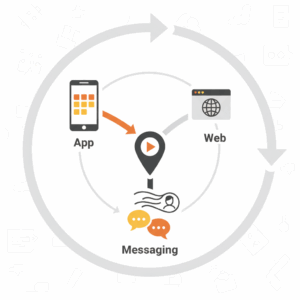
Leaders need crisp definitions to keep strategy clean. A native App is software installed from an app store that runs on a device OS and can use device capabilities like push, biometrics, and offline storage. A Web experience is a responsive site or progressive web app accessible through a browser and indexed for search. Messaging is a conversational service delivered inside a third-party channel such as WhatsApp, RCS, or similar platforms, often via verified business accounts and automation. Each unit solves the same customer jobs with different friction profiles, data access, and governance requirements. Messaging reach has climbed rapidly with official support and standards.⁵ ⁶ The differences matter because operating constraints drive cost-to-serve, consent management, analytics coverage, and speed of change.
How should leaders frame the decision?
Executives frame channel primacy as a four-variable system: Reach, Frequency, Friction, and Control. Reach determines how many target customers can access the service with minimal setup. Frequency measures recurring usage and the likelihood of habitual engagement. Friction captures steps, latency, authentication effort, and cognitive load. Control reflects ownership of UI, data, rules, and the change cadence. An app often wins on frequency and deep capability. The web typically wins on reach, searchability, and acquisition. Messaging often wins on low friction and immediacy. The correct primary channel is the one that best compresses time-to-value for your most frequent, high-stakes customer journeys while keeping governance workable across privacy and platform shifts. Messaging is drawing special interest as the audience scales and vendors add features and monetization.³ ⁷
Where do customers actually spend time?
Customers spend significant time inside mobile apps, particularly for habitual tasks, entertainment, and utilities. The global app economy continues to grow even when download volumes fluctuate, with consumer spend exceeding $120 billion across major stores.⁸ Continuous usage concentration favors brands that earn a permanent icon on the home screen. Native apps still anchor loyalty programs and complex service suites because they deliver offline capability, device-level security, and fast UI transitions. Web retains a discovery advantage because search and link sharing still start most new sessions. Mobile users also punish slow experiences at a remarkable rate, which means primary-channel speed has direct revenue impact.² Messaging’s gravity increases as platforms reach very large user bases, including official designations inside key markets that impose new obligations.⁴
What does regulation change for channel strategy?
Regulation changes how you weigh control and risk. Messaging platforms that surpass major-user thresholds in the EU face stricter obligations under the Digital Services Act. That status raises compliance expectations for safety, transparency, and data handling inside those ecosystems.⁴ Platform owners simultaneously introduce monetization and business tools, shifting economics and signaling longer-term product stability for enterprise use.³ Leaders should treat channel selection as a regulatory as well as a technical decision. For example, a messaging-first model may require new playbooks for consent, content moderation, and appeal processes. Web continues to align with standard privacy frameworks and first-party data strategies. Apps remain subject to evolving store policies, tracking rules, and review cycles that can slow iteration.
How do App, Web, and Messaging compare on critical CX levers?
Executives compare channels by CX levers that move service outcomes.
Acquisition and discovery. Web leads because search, deep links, and shareable URLs drop customers into tasks without install steps. Mobile site performance is decisive; slow pages lose over half of visitors within seconds.² Apps face install friction but can convert from web-to-app with smart prompts. Messaging converts when customers can start in-channel from QR, short links, or business profiles.
Engagement and retention. Apps win long-form engagement through speed, offline, and push notifications. App spend growth indicates ongoing customer willingness to transact in-app.⁸ Messaging wins “micro-engagement” through lightweight threads and proactive alerts, especially for status updates or simple changes. Verified sender IDs and rich messaging features strengthen trust and clarity.⁵
Service resolution and cost-to-serve. Messaging compresses handle time for simple intents by blending automation with quick human escalation. Modern customer engagement platforms report that AI plus messaging can lift satisfaction while protecting margins, when built with high-quality data and routing.⁹ Apps excel for authenticated self-service where customers perform multi-step workflows such as claims, onboarding, or configuration. Web remains a universal fallback and the best place for knowledge articles and SEO-driven deflection.
Data, governance, and iteration. Web provides immediate iteration with standard release pipelines. Apps offer deep telemetry but require store reviews and OS compliance. Messaging introduces third-party policies and evolving monetization, which affect frequency and format of outreach.³ ⁷ ¹⁰
When should an App lead as the primary channel?
An app should lead when your top journeys are high frequency, authenticated, and benefit from device capabilities. Financial services, mobility, health, and telco often fit this profile. If push notifications, biometrics, offline mode, and stored preferences materially improve outcomes, the app earns primacy. The investment case strengthens when customer lifetime value compounds with each session. App-led does not mean app-only. You still need a fast, accessible web layer for acquisition and compliance, plus messaging for alerts and quick actions. App primacy works best when you fund serious product operations and a release cadence that meets customer expectations for speed and stability. The broader app economy’s resilience suggests customers will keep transacting and subscribing inside apps that solve real problems quickly.⁸
When should the Web lead as the primary channel?
The web should lead when discovery, reach, and content velocity matter most. Retailers, government services, education, and information-heavy sectors often benefit from web-first because search funnels dominate entry points and because pages can be published and iterated without gatekeepers. Web advantages compound when mobile performance is tuned and when authentication flows minimize friction through passkeys and single sign-on. The abandonment penalty for slow mobile sites makes performance engineering a first-class product function.² A web-led model also supports accessibility mandates cleanly and simplifies legal disclosures. Messaging still adds value for notifications and quick confirmations, while an app can be optional for power users.
When should Messaging lead as the primary channel?
Messaging should lead when customers prefer conversational interactions, when tasks are simple and frequent, and when proactive updates reduce anxiety. Logistics, travel, banking alerts, field service, and appointment-based health services gain from a “thread-as-UI.” Messaging reach is now massive, with platforms crossing billion-user milestones and expanding rich features for businesses.⁵ ⁷ Recent platform moves show long-term commercial intent and regulatory scrutiny, which together signal durability for enterprise investment.³ ⁴ Treat messaging like an operating system for micro-interactions: verify your business identity, design structured prompts, and orchestrate bots with swift human failover. Leaders should still keep a performant web fallback and a targeted app for deep tasks.
How do we measure the decision with discipline?
Leaders measure with a two-tier system: customer outcomes and system health. For outcomes, track time-to-value, first contact resolution, repeat contact rate, and customer effort per journey. For system health, track release velocity, defect escape rate, opt-in rates for notifications, and reliability SLOs by channel. Mobile performance metrics deserve special focus because drop-offs are nonlinear with latency.² Customer engagement benchmarks show that leaders connect identity, preferences, and conversation history across channels to avoid repetition and improve personalization quality.⁹ Messaging programs should add platform-specific safety, reporting, and opt-out compliance to the scorecard.³ ⁴
What is a pragmatic roadmap to choose and activate a primary?
Executives move fast by running a three-sprint decision-and-activation plan:
Map value concentration. Identify the top five digital journeys by frequency and revenue or cost impact. Determine where customers currently start, and measure abandonment, resolution, and NPS by channel. Include messaging, app, and web entry points with equal rigor. Use external adoption data to sanity-check reach assumptions.¹ ⁵ ⁷
Prototype the lead channel. Build a thin end-to-end slice in the channel that best compresses time-to-value for those journeys. For web, prove sub-three-second loads on median mobile.² For messaging, prove verified sender, quick replies, and a bot-to-human policy. For apps, prove biometric login and reliable push.
Orchestrate the surround. Keep all three channels, but let one lead. Use the primary to initiate and complete most interactions. Use the other two to capture demand and handle exceptions. Connect identity and context so customers can move between channels without repeating themselves. Customer engagement leaders report better growth when they treat channels as one system rather than separate teams.⁹ ¹⁰
What impact should leaders expect within two quarters?
Leaders can expect faster resolution times for the journeys aligned to the primary channel, improved opt-in rates for notifications, and lower abandonment on mobile. Web-led programs typically show immediate gains from performance work because improved speed unlocks both conversion and SEO value.² Messaging-led programs usually show reductions in inbound calls for status and simple changes because answers arrive proactively in channel. App-led programs often see higher repeat usage and greater cross-sell once friction drops in authentication and navigation. Engagement research shows brands that integrate identity and personalization across channels outperform peers on revenue resilience and customer satisfaction.⁹ ¹⁰
FAQ
What is the best primary channel for regulated industries like banking and health?
App-led models usually win because biometrics, device security, and offline capabilities improve high-frequency, high-stakes tasks. Keep web for acquisition and disclosures, and use messaging for alerts and confirmations.⁸
How does mobile page speed affect conversion for customerscience.com.au visitors?
Mobile users leave slow experiences quickly. Empirical studies show more than half of users abandon pages that take longer than three seconds to load, which directly suppresses conversion and satisfaction.²
Why are enterprises betting on WhatsApp and RCS for service updates?
Messaging reach and features have expanded. WhatsApp now reports a user base exceeding three billion globally and faces EU VLOP obligations, which signals scale and regulatory maturity. RCS adoption has crossed the billion-user mark, improving rich business messaging viability.⁴ ⁵ ⁷
Which metrics prove that our chosen primary channel is working?
Track time-to-value, first contact resolution, repeat contact rate, opt-in rates for notifications, release velocity, and reliability SLOs by channel. Add platform safety and compliance checks for messaging programs.³ ⁴ ⁹
Who should own channel orchestration inside Customer Experience & Service Transformation?
A cross-functional unit should own orchestration: CX design, product, engineering, data, and operations. Align incentives to one scorecard that spans app, web, and messaging so teams optimize system outcomes rather than channel silos.⁹
How should Customer Science clients phase investment across app, web, and messaging?
Lead with the channel that compresses time-to-value on the top five journeys. Build a thin, provable slice in that channel, then integrate the other two around it. Maintain identity, consent, and context across all surfaces to avoid repetition and protect trust.⁹ ¹⁰
Which risks should executives watch when messaging is primary?
Watch compliance with platform rules and EU obligations, escalation to human agents, consent management, and the impact of platform monetization on cost-to-serve.³ ⁴
Sources
Mobile Fact Sheet — Pew Research Center, 2024, Research report. https://www.pewresearch.org/internet/fact-sheet/mobile/ (Pew Research Center)
Mobile Site Speed: The Guide to Performance — Think with Google, 2017, PDF playbook. https://www.thinkwithgoogle.com/_qs/documents/4290/c676a_Google_MobileSiteSpeed_Playbook_v2.1_digital_4JWkGQT.pdf (Google Business)
Meta brings ads to WhatsApp — Associated Press, 2025, News report. https://apnews.com/article/92a7e3f34e019f7bcc37e2b81a1bc21e (AP News)
WhatsApp faces EU tech rules after reaching Very Large Platform status — Reuters, 2025, News report. https://www.reuters.com/technology/whatsapp-faces-eu-tech-rules-after-reaching-very-large-platform-status-2025-02-19/ (Reuters)
Google Messages crosses 1B monthly active RCS users — PhoneArena, 2023, News article summarizing Google announcement. https://www.phonearena.com/news/google-messages-celebrates-one-billion-rcs-users-with-new-features_id153118 (PhoneArena)
RCS active users to surpass 1B in 2024 — Juniper Research, 2023, Press release. https://www.juniperresearch.com/press/rcs-active-users-to-surpass-1bn-2024 (juniperresearch.com)
WhatsApp now has more than 3 billion users a month — TechCrunch, 2025, News report. https://techcrunch.com/2025/05/01/whatsapp-now-has-more-than-3-billion-users/ (TechCrunch)
App downloads decline, consumer spend grows to $127B in 2024 — TechCrunch, 2024, News report. https://techcrunch.com/2024/12/18/app-downloads-decline-2-3-in-2024-but-consumer-spending-grows-to-127b/ (TechCrunch)
2025 State of Customer Engagement — Twilio, 2025, Research report landing page. https://www.twilio.com/en-us/state-of-customer-engagement (Twilio)
Zendesk CX Trends 2024 — Zendesk, 2024, Press release and report. https://www.zendesk.com/newsroom/press-releases/cx-trends-2024/ (zendesk.com)