









What problem are service leaders actually trying to solve?
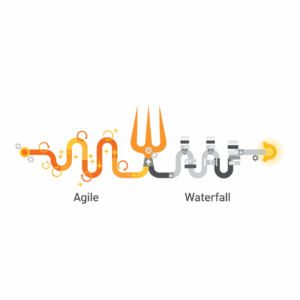
Service leaders face a dual mandate. They must reduce risk in regulated environments while speeding value delivery to customers who expect continuous improvement. Agile and Waterfall offer distinct governance models for this tension. Agile is an iterative method that delivers value in small increments with frequent feedback. Waterfall is a sequential method that locks scope and plans delivery in defined stages. Both can succeed when matched to the right service context and risk profile. PMI trend data shows that organizations using more adaptive approaches meet goals more often and waste less investment, which matters when services span multiple channels and complex policy constraints.¹ Leaders improve outcomes when they choose a delivery model based on variability, reversibility, and dependency structure rather than preference. McKinsey research also links agile operating models to faster innovation and higher customer satisfaction when applied where uncertainty is high.²
What is the practical definition of Agile and Waterfall in a service context?
Agile in services uses cross-functional teams to deliver working service increments every few weeks, guided by a product goal, a prioritized backlog, and short inspect-and-adapt cycles. The Scrum Guide codifies three roles, three artifacts, and five events to maintain empirical control and transparency, which fits service operations that change under real customer demand.³ Waterfall in services stages work into analysis, design, build, test, and release with formal signoffs and change control. This stage gating fits stable requirements and high regulatory traceability. Government digital standards recommend iterative discovery and delivery for public services because needs shift as evidence emerges, while still requiring gates for assurance.⁴ Both approaches can incorporate service design, journey mapping, and control points. The decisive factor is how quickly you can learn from real usage and how costly it is to reverse a decision once you deploy.² ⁴
Where does each model shine for Customer Experience and Service Transformation?
Waterfall shines when services involve fixed scope, heavy dependencies, or irreversible decisions. Examples include contact center telephony migrations with vendor-led milestones and compliance requirements that lock schemas and call recording retention. Formal acceptance criteria and traceability reduce audit risk. Agile shines when discovery dominates delivery. Examples include conversational AI tuning, digital self-service experiments, or frontline procedure changes that benefit from iterative testing with real customers. DORA research shows teams that ship in small batches with fast feedback outperform on reliability and lead time, which aligns with service operations that must adapt quickly to customer signals.⁵ The UK Service Manual also shows how discovery and alpha phases reduce waste before scaling, which is a service analogue to agile’s inspection and adaptation.⁴ When transformation spans both worlds, leaders often blend iterative discovery with gated release, balancing learning with assurance.² ⁴ ⁵
How do Agile and Waterfall handle risk, scope, and governance?
Agile treats scope as variable and time as fixed, using small increments to reduce risk through frequent validation. Scrum’s empiricism makes work visible through a transparent backlog, clear Definition of Done, and regular reviews.³ Waterfall treats scope as fixed and time as variable, using upfront requirements and change control to bound risk. PMI’s governance patterns highlight how predictive controls reduce variance when uncertainty is low, while adaptive controls reduce cost of change when uncertainty is high.¹ Government service standards add proportional assurance gates such as service assessments and spend controls that can coexist with iterative delivery.⁴ The decision is not binary. Leaders can fix safety, compliance, and data integrity constraints as non-negotiables while iterating user-visible service features. McKinsey’s operating model guidance describes this as stable backbone with dynamic capabilities, which is a practical frame for service transformation.²
How do teams plan and measure in each approach?
Agile planning sequences outcomes, not tasks. Teams set a product goal, break it into releases and sprints, and track throughput, lead time, and escaped defects. DORA metrics provide a simple, evidence-based set for service delivery: deployment frequency, change lead time, change failure rate, and time to restore service. High performers improve both speed and stability, which is critical in customer-facing services.⁵ Waterfall planning sequences tasks to a baseline schedule and measures earned value, milestone variance, and defect removal efficiency. PMI data shows that organizations with mature delivery practices, whether predictive or adaptive, waste less investment and achieve higher benefit realization.¹ In both models, leaders should connect measures to customer outcomes such as task completion, contact deflection, CSAT, and resolution time. Government guidance explicitly ties delivery stages to user needs and measurable service levels, which keeps governance focused on value.⁴ ¹
Which approach reduces cost and rework in complex service change?
Agile reduces rework by testing assumptions early. Short feedback loops surface policy conflicts, channel inconsistencies, and integration constraints before scale amplifies the cost. McKinsey synthesis finds that agile organizations cut decision times and accelerate time to market, which translates to lower transformation drag in service portfolios.² The Scrum Guide’s incremental delivery and continuous refinement keep work aligned with current knowledge, not outdated plans.³ Waterfall reduces rework by preventing uncontrolled change. Clear baselines, formal signoffs, and staged integration testing avoid expensive late surprises when services depend on legacy telephony, identity, or data flows. PMI’s research shows predictive control is efficient where variance is low and requirements are stable.¹ The question is not which method is universally cheaper. The question is where the cost of change is highest and whether early learning or early locking minimizes total lifecycle cost.¹ ² ³
What are the integration and dependency realities for service programs?
Service programs live in systems of systems. Contact platforms, CRM, knowledge, identity, and analytics create dependency webs. Agile handles these with cross-team planning, thin slices through vertical stacks, and enabling teams that provide shared capabilities. DORA’s findings support working in smaller batches with decoupled architectures to improve flow and reliability, which maps well to service platforms that support continuous configuration and release.⁵ Waterfall handles complex dependencies with master schedules, integration milestones, and shared test environments. This model suits vendor-led upgrades and infrastructure changes that cannot be sliced safely. Government blueprints recommend discovery to map dependencies and alpha to test integration approaches before committing to scale, which can then feed either iterative or staged delivery.⁴ Leaders who name and shape dependencies early reduce risk regardless of method. They align release cadences, strengthen change control, and agree on common readiness criteria.⁴ ⁵
How do you choose, blend, and sequence methods for a transformation?
Leaders decide with a simple triage. If requirements are stable, reversibility is low, and dependencies are tight, start with a gated plan and protect integration risk. If requirements are fluid, reversibility is high, and learning is essential, start with agile teams and protect discovery speed. Hybridize where needed. Many organizations run discovery and alpha with agile practices, then switch to heavier gating for late integration and migration cutovers.² ⁴ Preserve a stable backbone for compliance, data, and change management while enabling dynamic capabilities for experimentation.² Align measures from the start. Use DORA metrics and CSAT for iterative work, and schedule and quality metrics for gated work.⁵ ¹ Keep governance proportional. Use service assessments and risk-based controls so oversight scales with impact.⁴ Codify ways of working in a playbook that defines when to use each path, how to hand off, and how to measure value.¹ ² ³ ⁴ ⁵
What are the first three moves a CX or service leader should make?
Leaders can begin with a focused service and a clear outcome. First, map the service and identify the riskiest assumptions, the hardest dependencies, and the most irreversible decisions. Second, choose a default method per workstream using the triage of stability, reversibility, and dependency density. Third, install metrics that link delivery to customer outcomes, using DORA metrics for flow and reliability and journey metrics for experience quality.⁵ Publish a brief playbook and socialize it with vendors and risk partners. Use the Scrum Guide to shape iterative work and use PMI guidance to shape stage gates.¹ ³ Treat governance as an enabler. UK government practices show how to combine iterative delivery with proportionate assurance, even in high-stakes services.⁴ Leaders who start small, measure transparently, and scale what works move faster with less drama. The result is better service outcomes and a calmer operating rhythm.¹ ² ³ ⁴ ⁵
Evidence and comparators leaders can trust
Executives want credible benchmarks, not slogans. PMI’s Pulse of the Profession tracks delivery performance across industries and shows the payoff from mature practices, including agile adoption.¹ McKinsey’s research on agile organizations provides a tested model for stable backbone and dynamic capabilities, with case evidence of faster time to market and higher employee engagement.² The Scrum Guide is a concise and open reference for agile delivery.³ The UK Government Service Manual is a practical handbook for discovery, alpha, beta, and live operations in public services, and it demonstrates how to integrate assurance with iteration.⁴ The DORA State of DevOps research gives leaders a validated measurement framework that correlates with performance across speed and stability.⁵ These sources give a balanced evidence base that supports context-based choice rather than method wars. Leaders can use them to anchor decisions, governance, and communications.¹ ² ³ ⁴ ⁵
FAQ
What is the core difference between Agile and Waterfall for services?
Agile varies scope to learn from real customer usage through short cycles and feedback, while Waterfall fixes scope and manages change through staged governance and formal signoffs.³ ¹
Which approach should a contact center use for a major telephony migration?
A contact center should default to Waterfall for the migration cutover because dependencies and reversibility risks are high, while using Agile discovery for knowledge design, script testing, and self-service improvements.¹ ⁴
How do we measure success in Agile service delivery?
Teams should track DORA metrics such as deployment frequency, change lead time, change failure rate, and time to restore service, alongside CSAT and resolution time to link delivery to customer outcomes.⁵
Why do government digital standards recommend iterative delivery?
Government standards recommend iterative discovery and delivery because user needs change as evidence emerges, and early testing reduces waste before scaling to live services with proportionate assurance.⁴
Which governance model reduces risk in regulated environments?
Waterfall reduces risk when requirements are stable and reversibility is low through upfront requirements, traceability, and gated approvals, while Agile reduces risk in uncertain contexts by validating assumptions early.¹ ³
Who benefits most from Agile in service transformation?
Services with high uncertainty and high learning value benefit most, including conversational AI tuning, digital self-service, and frontline procedure experiments that require tight feedback loops.² ⁵
How should leaders blend methods across a portfolio?
Leaders should run discovery and alpha with Agile practices, apply proportional assurance throughout, and use gated controls for irreversible integrations and cutovers, supported by a shared playbook and aligned metrics.² ⁴ ¹
Sources
Pulse of the Profession 2020: Ahead of the Curve — Project Management Institute, 2020, PMI. https://www.pmi.org/learning/thought-leadership/pulse/pulse-of-the-profession-2020
The Five Trademarks of Agile Organizations — Aaron De Smet, Chris Gagnon, Elizabeth Mygatt, 2018, McKinsey Quarterly. https://www.mckinsey.com/capabilities/people-and-organizational-performance/our-insights/the-five-trademarks-of-agile-organizations
The Scrum Guide — Ken Schwaber, Jeff Sutherland, 2020, Scrum Guides. https://scrumguides.org/scrum-guide.html
Service Manual: Agile delivery — Government Digital Service, United Kingdom, ongoing, GOV.UK. https://www.gov.uk/service-manual/agile-delivery
DORA: Accelerate State of DevOps 2023 — Nathen Harvey, Dustin Smith, Jim Bird et al., 2023, Google Cloud. https://cloud.google.com/devops/state-of-devops/