































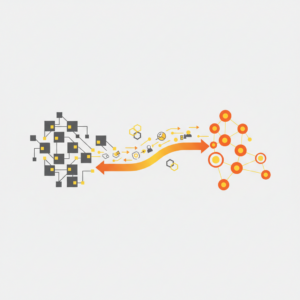
A hybrid workforce works best when “digital workers” handle repeatable, low-risk tasks and humans own judgement, empathy, and exception handling. The operating model must define roles, handoffs, controls, and measurement so automation improves customer outcomes and staff experience. Evidence from customer support deployments shows AI assistance can lift productivity while also improving quality when designed for augmentation.¹
What is digital workforce management in a hybrid workforce?
Digital workforce management is the discipline of planning, governing, and improving work performed by both people and software-based workers, including RPA bots, virtual agents, and agent-assist copilots. The goal is stable service at lower unit cost without damaging customer trust, compliance, or employee wellbeing. It treats automation as capacity that must be scheduled, monitored, and audited, rather than as a one-off IT project.
In contact centres, “human-AI collaboration in contact centres” means the AI supports the agent in the flow of work: retrieving knowledge, drafting responses, summarising interactions, and flagging risk. High-performing hybrids keep humans accountable for customer-impacting decisions and give digital workers constrained scopes with clear stopping rules.³
Why are contact centres prioritising human-AI collaboration now?
Hybrid work has increased operational variability: distributed teams, fluctuating demand, and higher dependence on digital channels. At the same time, customers expect fast, accurate responses across chat, voice, email, and messaging. Digital workers offer elastic capacity, but only if the organisation can coordinate them with human teams in real time.
Empirical evidence suggests that augmentation can improve both speed and outcomes. A large customer-support study found a 14% average productivity increase, with much larger gains for less experienced agents, and limited gains for highly experienced agents.¹ This matters operationally: the business case often depends on faster onboarding, consistent adherence to best practice, and reduced rework, not only on headcount reduction.
How do digital workers and human teams coordinate work safely?
A practical coordination model has five elements:
Role clarity: define which intents, transactions, and decisions digital workers can execute end to end, which they can assist with, and which must remain human-owned. This aligns with risk guidance that treats AI as a socio-technical system where context and use matter.³˒⁴
Handoffs and stopping rules: every digital worker needs a “handoff contract” that specifies when it escalates to a person, what context it passes, and what it must not do. The handoff should carry a short audit trail: source, confidence, and data used.
Knowledge discipline: AI assistance is only as good as the knowledge layer it can retrieve. Treat knowledge articles, scripts, and policy as controlled assets with ownership, versioning, and expiry. This reduces hallucination risk and lowers variability between agents.
Controls and assurance: use layered controls: guardrails at design time, monitoring at run time, and periodic assurance testing. This aligns to recognised risk-management frameworks.³˒⁴
Workforce design: redesign roles so humans spend more time on exceptions, retention, complaints, and vulnerable customers. This improves both CX and job quality when done intentionally, but can increase stress if exceptions become the whole job without support.⁹
What is the difference between RPA, copilots, and agentic AI?
RPA automates structured, rules-based steps across systems, such as copying data between CRM and billing or triggering refunds within limits. It is strongest where inputs are predictable and the process is stable.
Copilots are assistance tools embedded in the agent workflow. They draft, summarise, retrieve knowledge, and recommend next best actions, but the human remains the operator of record. This aligns to augmentation evidence where performance gains often come from transferring best practices to newer staff.¹˒²
Agentic AI goes further by planning and executing multi-step tasks. It can raise value, but it increases governance requirements because it may take actions that are harder to predict. If used, constrain it to bounded “missions” with explicit approvals, sandboxing, and strong logging.⁴
Where should you deploy digital workers first in contact centres?
Start where there is clear customer value, low ambiguity, and measurable outcomes:
High-confidence deflection with safe escalation
Deploy digital workers for common, low-risk intents: order status, password resets, appointment changes, and basic troubleshooting. Make escalation frictionless, pass full context, and label automation clearly to maintain trust.⁵
Agent-assist for speed and consistency
Use copilots to retrieve policy, draft compliant responses, and summarise after-contact work. In customer-support settings, generative assistance has been linked to faster resolution and improved quality metrics when embedded in workflows.¹˒²
Back-office orchestration to remove avoidable calls
Automate fulfilment steps that cause repeat contacts: address updates, billing corrections, entitlement checks, and proactive notifications. This reduces demand rather than only handling demand.
A useful pattern is “measure first, automate second”: establish baseline drivers of demand, recontact, and compliance risk, then apply digital workforce management to the top drivers. Customer Science product and service links referenced below are drawn from the provided link list.
For organisations that need a stronger measurement layer to prioritise automation and track outcomes, Customer Science Insights can support unified performance visibility across customers, channels, and teams: https://customerscience.com.au/csg-product/customer-science-insights/
What risks increase when humans and bots share customer conversations?
Hybrid models introduce four risk clusters:
Privacy, transparency, and data handling
If AI tools process personal information, privacy obligations apply. In Australia, guidance stresses governance over selection, configuration, and use of AI products, including understanding data flows and appropriat Strong privacy management also depends on transparent practices and policies under the Australian Privacy Principles.⁶
Security and third-party dependency
Digital workers often touch multiple systems and vendors. For regulated entities, expectations include maintaining resilient information security capability, and assuring controls for third parties.¹⁰ Align automation access to the principle of least privilege and treat bot credentials as high-risk identities.
Quality, safety, and unfair outcomes
AI can amplify bias, provide inconsistent advice, or act on incomplete context. Use risk assessment and testing tailored to AI systems, including monitoring drift and failure modes.³˒⁴
Psychosocial risks and burnout
When automation removes routine work, humans can be left with only the hardest interactions. Recognised guidance on psychosocial hazards emphasises identifying and controlling risks such as high job demands, poor support, and remote or isolated work.⁷˒⁹ Hybrid workforce design should explicitly manage workload, escalation intensity, and coaching.
How do you measure digital workforce performance without gaming KPIs?
Measurement must cover customer outcomes, operational efficiency, risk, and workforce health:
Customer outcomes
Track resolution quality, repeat contact, complaint rates, and customer sentiment. Evidence from real deployments uses industry-standard metrics such as resolution rate, NPS, and handle time to quantify impact.²
Operational efficiency
Measure end-to-end cycle time, not only average handle time. Separate “assisted” vs “unassisted” work and look for learning effects over time.¹
Risk and compliance
Audit automation decisions, privacy incidents, and policy adherence. Maintain logs that can reconstruct why the system suggested an answer or took an action.³
Workforce health
Track attrition, time to proficiency, quality coaching coverage, and psychosocial indicators. Use psychosocial hazard management practices as a governance input, not a separate HR initiative.⁷˒⁹
If you need managed support to design controls, implement automations, and run ongoing optimisation, Customer Science’s automation offering is here: https://customerscience.com.au/solution/automation/
What is a practical 90-day rollout plan?
Weeks 1–2: Scope and risk triage. Define the service journeys, data involved, and customer harm scenarios. Choose augmentation first where uncertainty is high. Align to recognised AI risk management practices.³˒⁴
Weeks 3–6: Build the operating model. Create bot runbooks, escalation rules, and ownership across Ops, IT, Risk, and CX. Establish your “golden sources” for policy and knowledge. Implement identity, logging, and monitoring controls consistent with your security obligations.¹⁰˒¹¹
Weeks 7–10: Pilot with instrumentation. Run an A/B or phased rollout. Measure customer outcomes, operational metrics, and agent experience weekly. Use targeted coaching to ensure people adopt the AI in a consistent way.¹˒²
Weeks 11–13: Scale and stabilise. Expand only when metrics hold and risks remain controlled. Establish a cadence for model updates, knowledge refresh, and incident review. Treat hybrid operations as continuous improvement, not implementation completion.
Evidentiary Layer
What governance artefacts should exist for a digital worker?
A minimum set includes a scope statement, data map, access list, escalation rules, control tests, monitoring dashboards, and an incident playbook. This mirrors the idea that trustworthy AI and automation require lifecycle governance, not only technical tuning.³˒⁴
FAQ
What is the simplest definition of digital workforce management?
Digital workforce management is how you plan, control, and improve work done by both humans and digital workers so service quality stays stable while costs and risks stay contained.
Does human-AI collaboration actually improve contact centre performance?
In large-scale customer-support deployments, AI assistance has been associated with improved productivity and quality outcomes, especially for less experienced agents.¹˒²
Where should a contact centre start with automation?
Start with low-risk, high-volume intents for deflection, then add agent-assist for knowledge retrieval and after-contact work, then automate back-office steps that drive repeat contact.
What are the biggest risks to manage first?
Privacy and transparency obligations, security and third-party controls, quality failures, and psychosocial risk from concentrating complex work on humans.⁵˒⁷˒¹⁰
How do we keep customer conversations secure when AI tools are involved?
Use clear data handling rules, minimise data sharing, apply strong access controls, and ensure vendor and third-party assurance is adequate for the data and systems the AI touches.⁵˒¹⁰˒¹¹
What Customer Science capability supports quality monitoring for communications?
Commscore AI supports communication quality and scoring use cases where consistency and compliance matter: https://customerscience.com.au/csg-product/commscore-ai/
Sources
Brynjolfsson, E. et al. “Generative AI at Work.” NBER Working Paper 31161 (2023). https://www.nber.org/papers/w31161
Brynjolfsson, E. et al. “Generative AI at Work.” The Quarterly Journal of Economics 140(2) (2025). https://doi.org/10.1093/qje/qjae044
NIST. Artificial Intelligence Risk Management Framework (AI RMF 1.0), NIST AI 100-1 (Jan 2023). https://doi.org/10.6028/NIST.AI.100-1
ISO/IEC 23894:2023, Artificial intelligence, Guidance on risk management. https://www.iso.org/standard/77304.html
OAIC. Guidance on privacy and the use of commercially available AI products (21 Oct 2024). https://www.oaic.gov.au/privacy/privacy-guidance-for-organisations-and-government-agencies/guidance-on-privacy-and-the-use-of-commercially-available-ai-products
OAIC. APP Guidelines, Chapter 1: APP 1 Open and transparent management of personal information (updated 3 Oct 2025). https://www.oaic.gov.au/privacy/australian-privacy-principles/australian-privacy-principles-guidelines/chapter-1-app-1-open-and-transparent-management-of-personal-information
Safe Work Australia. Model Code of Practice: Managing psychosocial hazards at work (Aug 2022). https://www.safeworkaustralia.gov.au/sites/default/files/2022-08/model_code_of_practice_-_managing_psychosocial_hazards_at_work_25082022_0.pdf
Comcare. Commonwealth Code of Practice 2024 announcement (13 Nov 2024). https://www.comcare.gov.au/about/news-events/news/commonwealth-code-practice-announced
ISO 45003:2021, Psychological health and safety at work, Guidelines for managing psychosocial risks. https://www.iso.org/standard/64283.html
APRA. Prudential Standard CPS 234 Information Security (July 2019). https://www.apra.gov.au/sites/default/files/cps_234_july_2019_for_public_release.pdf
ISO/IEC 27001:2022, Information security management systems, Requirements. https://www.iso.org/standard/27001
OECD. Using Artificial Intelligence in the workplace: main ethical risks (OECD, 2022). https://www.oecd.org/content/dam/oecd/en/publications/reports/2022/07/using-artificial-intelligence-in-the-workplace_a64ec8c9/840a2d9f-en.pdf
INFORMS (Management Science). “Engaging Customers with AI in Online Chats: Evidence from a Field Experiment” (2025). https://doi.org/10.1287/mnsc.2022.03920