



























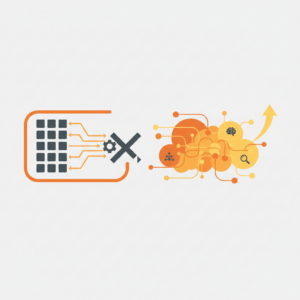
Rules-based RPA is still useful for stable, repetitive tasks, but it fails when work becomes messy, exception-driven, or compliance-sensitive. Intelligent automation combines RPA with AI, process intelligence, and governance so automation can handle variation, learn from outcomes, and stay auditable. For most enterprises, the future of robotic process automation is orchestration, not more bots.
Definition
What is rules-based RPA?
Robotic Process Automation (RPA) uses software “bots” to mimic human clicks and keystrokes across existing applications¹. It works best when inputs are structured, steps are consistent, and exceptions are rare². In practice, RPA is a UI-level overlay that can deliver quick wins without deep system integration¹.
What is intelligent automation?
Intelligent automation extends RPA by adding AI capabilities such as classification, language understanding, decision support, and continuous optimisation, while also strengthening process discovery and controls³. It aims to automate end-to-end outcomes, not just discrete tasks, and it is designed to cope with variation rather than avoiding it.
Context
Why are rules-based bots no longer enough?
Enterprise operations now face higher channel complexity, faster product change, and tighter regulatory expectations. When processes shift weekly, the automation must adapt without constant rework. RPA’s value collapses when it becomes a maintenance program instead of a productivity program¹˒².
What is changing in the market for automation?
Enterprises are moving toward “hyperautomation,” defined as orchestrating multiple automation technologies across processes, including AI, RPA, integration, and BPM⁴. At the same time, generative AI and related tools can automate or augment a large share of daily work activities⁵, which increases pressure to modernise automation beyond rules.
Mechanism
How does intelligent automation work in practice?
Intelligent automation typically uses four layers:
Process intelligence to identify what actually happens, using event logs and process mining to target high-value opportunities³.
Automation execution using RPA where UI steps remain the fastest path.
AI decisioning to interpret unstructured inputs, recommend actions, and route exceptions.
Orchestration and controls to enforce policy, track outcomes, and provide auditability⁷˒⁸.
This stack shifts automation from “do exactly this” to “achieve this outcome under these constraints,” which is the practical direction of the future of robotic process automation.
Why does adding process mining matter?
Process mining helps reduce guesswork in automation selection and improves lifecycle management by revealing variants, bottlenecks, and exception paths³. In many programs, this is the difference between scaling automation and scaling disappointment.
Comparison
What is the difference between RPA vs intelligent automation?
The most decision-useful differences are:
Inputs: RPA prefers structured, predictable data². Intelligent automation can handle unstructured text and language signals using AI.
Exceptions: RPA treats exceptions as failures or manual handoffs¹. Intelligent automation learns common exception patterns and designs controlled resolution paths⁷˒⁸.
Change tolerance: RPA is brittle when upstream forms, screens, or policies change¹˒². Intelligent automation reduces brittleness by combining orchestration, data-level integration, and monitored models⁷.
Risk posture: RPA risk is often operational, such as access control and bot identity¹. Intelligent automation adds model risk, privacy risk, and explainability requirements⁷˒⁸˒⁹.
Business outcome: RPA optimises task time. Intelligent automation optimises end-to-end cycle time, cost-to-serve, and service quality.
When should you still use rules-based bots?
Use RPA when the workflow is stable, the decision logic is explicit, and the goal is to remove low-value effort. It remains a strong tactical tool inside a broader intelligent automation operating model¹˒⁴.
Applications
Where does intelligent automation deliver the fastest CX impact?
High-return use cases combine volume, variability, and measurable customer outcomes:
Contact centre wrap-up and knowledge: Convert interaction signals into actionable knowledge updates and agent guidance, reducing avoidable repeats and rework. A practical option is an AI-powered knowledge layer such as Customer Science’s Knowledge Quest (
https://customerscience.com.au/csg-product/knowledge-quest/).Claims and service requests: Classify documents, extract entities, pre-fill forms, and route exceptions to specialists with clear reasons⁷˒⁸.
Collections and hardship: Use policy-constrained decision support to standardise outcomes while retaining human approval for high-risk cases⁹˒¹⁰.
KYC and onboarding: Use AI for document triage and discrepancy detection, with audit trails aligned to risk frameworks⁷˒¹².
These applications move beyond “faster data entry” into service consistency, compliance confidence, and reduced customer effort.
What does “future of robotic process automation” look like in operations?
It looks like fewer standalone bots and more managed automation capabilities: orchestration, model monitoring, access controls, and continuous improvement loops. RPA becomes one execution method among several, not the strategy itself⁴˒⁵.
Risks
What risks increase when you add AI to automation?
Intelligent automation raises new risk categories that rules-based RPA often avoids:
Model risk: drift, bias, and inconsistent outputs that can affect eligibility, fairness, and compliance⁷˒⁸.
Privacy risk: use of personal information in AI tools, including vendor-hosted services and prompt data leakage concerns⁹.
Explainability gaps: inability to justify decisions to customers, regulators, or internal assurance teams⁷.
Operational resilience: concentration risk when critical operations rely on automation without clear fallback paths¹⁰.
These risks are manageable, but only if governance is designed in, not bolted on later⁷˒⁸˒¹¹.
What governance controls should be non-negotiable?
At minimum: model and automation inventories, bot identity and least privilege, change control, outcome monitoring, incident response, and human-in-the-loop thresholds for high-impact decisions⁷˒⁸˒¹². For regulated industries, align operational resilience controls to prudential expectations where relevant¹⁰.
Measurement
How do you measure success beyond “hours saved”?
Measure outcome metrics that executives can defend:
Straight-through processing rate and exception rate, tracked by reason code.
Cycle time reduction from request to resolution.
Quality and compliance: defect rate, rework rate, and audit findings per 1,000 cases.
Customer metrics: cost-to-serve, repeat contact rate, and service consistency.
Automation health: bot failure rate, mean time to recover, and change-related incidents.
Tie these to structured risk management practices aligned to ISO-style principles for consistent evaluation and treatment of risk¹¹.
What should you monitor continuously?
For intelligent automation, monitor drift and outcome stability, not just uptime. The NIST AI RMF emphasises context-aware risk management and ongoing evaluation of AI impacts⁷. ISO/IEC 23894 similarly frames AI risk management as an organisational process that must be integrated and repeatable⁸.
Next Steps
What is a practical roadmap from RPA to intelligent automation?
A pragmatic migration plan avoids “rip and replace” and focuses on control plus value:
Segment processes by variability, impact, and regulatory sensitivity.
Stabilise the foundation with process standards, data definitions, and identity and access controls¹².
Add process intelligence to select use cases based on real operational data³.
Introduce AI where it reduces exceptions, starting with supervised decision support for high-impact steps⁷˒⁸.
Operationalise governance: monitoring, change control, and assurance routines.
Scale with a product mindset, funding the next tranche from validated savings and service outcomes⁵.
If you need external support to design and run this as an operating capability, Customer Science’s AI & Intelligent Automation solution page is here: https://customerscience.com.au/solution/automation/.
How do you avoid a second wave of automation sprawl?
Treat automation as an enterprise product with clear ownership, architecture standards, and a single measurement spine. This reduces duplicated bots, inconsistent decisions, and “shadow AI” adoption that creates hidden risk⁹.
Evidentiary Layer
What executive-level claims are supported by evidence?
Generative AI and related technologies have the potential to automate work activities that absorb a large proportion of employee time⁵, which increases the payoff from moving beyond task bots. Employer surveys also indicate broad AI adoption expectations in the near term⁶, making it a strategic capability question rather than an IT experiment. Risk frameworks from NIST⁷ and ISO⁸ provide practical structures to manage model and system risk without blocking value.
Sources
van der Aalst, W. M. P., Bichler, M., & Heinzl, A. (2018). Robotic Process Automation. Business & Information Systems Engineering, 60(4), 269–272. DOI: 10.1007/s12599-018-0542-4.
Syed, R., Suriadi, S., Adams, M., Bandara, W., Leemans, S. J. J., Ouyang, C., ter Hofstede, A. H. M., van de Weerd, I., Wynn, M. T., & Reijers, H. A. (2020). Robotic Process Automation: Contemporary Themes and Challenges. Computers in Industry, 115, 103162. DOI: 10.1016/j.compind.2019.103162.
El-Gharib, N. M., & Amyot, D. (2023). Robotic process automation using process mining. Data & Knowledge Engineering, 146, 102229. DOI: 10.1016/j.datak.2023.102229.
Gartner. (n.d.). Hyperautomation (IT Glossary).
Chui, M., et al. (2023). The economic potential of generative AI: The next productivity frontier. McKinsey & Company (report and PDF).
World Economic Forum. (2023). The Future of Jobs Report 2023 (report and digest).
NIST. (2023). Artificial Intelligence Risk Management Framework (AI RMF 1.0). NIST AI 100-1 (PDF).
ISO/IEC. (2023). ISO/IEC 23894:2023 Artificial intelligence: Guidance on risk management.
Office of the Australian Information Commissioner (OAIC). (2024). Guidance on privacy and the use of commercially available AI products.
Australian Prudential Regulation Authority (APRA). (2023). Prudential Standard CPS 230 Operational Risk Management (commences 1 July 2025).
Australian Government Department of Finance. (2020). Overview: Risk Management Process (referencing AS/NZS ISO 31000:2018).
ISO/IEC. (2022). ISO/IEC 27001:2022 Information security management systems.
FAQ
What is the simplest way to explain RPA vs intelligent automation?
RPA automates repetitive steps using explicit rules². Intelligent automation uses RPA plus AI and orchestration to handle variation, exceptions, and end-to-end outcomes³˒⁷.
Does intelligent automation replace RPA?
No. RPA remains a useful execution tool for stable tasks¹. The shift is that RPA becomes one component inside a governed automation stack⁴˒⁸.
What is the biggest operational risk when scaling bots?
Brittleness and uncontrolled change create disruption and hidden cost¹˒². At scale, resilience and recovery practices become as important as build speed¹⁰.
How do you manage privacy when AI touches customer data?
Apply privacy-by-design, minimise data, assess vendor handling, and maintain transparency about use and purpose⁹. Treat prompts, logs, and training data pathways as sensitive artefacts⁹.
What metrics should a contact centre leader prioritise first?
Repeat contact rate, cycle time to resolution, exception rate by reason, and automation health (failure rate and recovery time)³˒⁷. These connect directly to cost-to-serve and service consistency.
What Customer Science capability supports communication quality once automation increases throughput?
CommScore.AI can benchmark and improve customer communications quality at scale: https://customerscience.com.au/csg-product/commscore-ai/.