































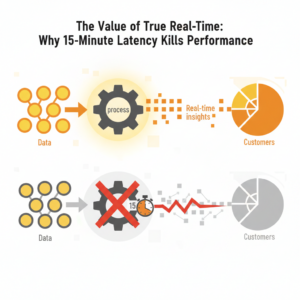
A 15-minute data delay breaks the management loop. Leaders act on stale signals, so small demand shifts become service failures, wasted labour, and avoidable risk. True real-time reduces time-to-detect and time-to-correct, stabilises performance, and improves customer outcomes. Research links stronger “real-time” operating capability with materially higher growth and margins, reinforcing real-time as a board-level priority.¹
Definition
What does “true real-time” mean in enterprise operations?
True real-time means information is processed and available within the decision window needed to control the process, not within a convenient reporting cadence. In safety and industrial contexts, “real time” is defined as computation occurring during the physical process so results can guide that process, rather than explaining it afterward.⁴ In modern digital operations, that same principle applies to customer journeys, contact centres, fulfilment, fraud, and service reliability.
A practical definition for executives is “data latency that is smaller than the time it takes performance to materially drift.” That drift threshold differs by domain. A web journey can drift in milliseconds, while a staffing plan can drift in minutes. The key is measurability: ISO quality models treat response time behaviour as a core performance attribute, meaning latency is not an implementation detail but a quality requirement.⁵
Context
Why is “15-minute latency” common, and why is it now a problem?
Fifteen minutes became normal because many operational systems were designed for batch reporting and interval-based workforce planning. Contact centre planning commonly uses 15-minute intervals to model peaks and troughs, which improves forecast granularity but also tempts organisations to accept 15-minute visibility delays.¹² That assumption held when channels were slower and changes were less abrupt.
Today, demand is more volatile and more correlated across channels. Arrival patterns vary sharply over short periods, and misestimation compounds quickly in many-server service systems. Research in service operations and workforce planning highlights time-varying demand and non-standard arrival processes as first-order realities, not edge cases.⁷˒⁹ When the environment moves faster than the reporting cadence, a 15-minute lag becomes a structural blind spot.
Mechanism
How does 15-minute latency turn into a performance leak?
Operational performance is a feedback system: observe, decide, act, and then observe the result. Delays in the feedback signal increase error, cause over-correction, and can create oscillation. Control research shows delayed feedback can induce instability and oscillations because the controller responds to the past rather than the present.¹¹ In business terms, leaders “fix” problems that have already moved, while new problems emerge unnoticed.
In service operations, the mechanism is compounding backlog. If arrivals spike for 10 minutes and you only see it after 15, you miss the window to deflect demand, rebalance queues, or adjust staffing. Queueing research frames call centres as time-varying stochastic systems where small mismatches between capacity and demand can produce large changes in waiting and abandonment.⁸ The cost is not only SLA misses. It is rework, escalations, avoidable overtime, and customer trust erosion.
Comparison
Real-time, near-real-time, and batch: what changes operationally?
Batch reporting optimises cost and simplicity but assumes decisions can wait. Near-real-time reduces delay but still relies on micro-batches, which can be acceptable for retrospective insight yet insufficient for control. True real-time is designed for continuous decisions and automated intervention, which is why standards and definitions tie “real time” to guiding a process as it transpires.⁴
A useful comparison is the difference between “explaining variance” and “preventing variance.” Near-real-time might explain why service level dropped in the last interval. True real-time enables detection and correction while the drop is forming. Evidence from digital performance experiments shows even sub-second delays change behaviour, with measurable impacts when pages slow by 100–400 milliseconds.⁶ That web example is not directly comparable to contact centre intervals, but it demonstrates the same principle: latency shifts outcomes because people and systems respond to what they experience now, not what you report later.
Applications
Where does true real-time create the most value?
True real-time delivers value when the decision window is short and the cost of drift is high. Common high-return domains include contact centre intraday management, digital self-service containment, real-time QA and compliance monitoring, proactive outage communications, and dynamic prioritisation of vulnerable customers. The unifying pattern is a closed loop: detect a change, choose an action, execute it, and measure the effect quickly.
For many organisations, the fastest path is to start with a unified operational view that connects demand signals, customer context, and performance outcomes into one decision layer. A practical example is consolidating channel demand, queue states, and customer intent into an actionable real-time dashboard and alerting fabric. Customer Science’s product and tools offering https://customerscience.com.au/csg-product/customer-science-insights/ can be positioned as that operational decision layer, so teams move from “reporting” to “intervening” using consistent, governed measures.
Risks
What can go wrong when you pursue real-time data?
The most common failure is confusing speed with usefulness. Real-time that lacks trust creates “fast noise.” NIST notes real-time decision making is necessary because data can be irregular and heterogeneous, which raises the bar for validation and governance.³ A second risk is local optimisation: improving one queue can degrade another if you do not manage system-wide constraints.
Security and resilience also matter. Real-time pipelines increase system coupling if not architected carefully, which can amplify outages. Clear definitions, service-level objectives for data timeliness, and disciplined data quality controls prevent “real-time debt.” ISO quality framing helps here because it treats time behaviour, capacity, and resource utilisation as measurable sub-characteristics, not subjective opinions.⁵
Measurement
How do you measure “real-time” in a way finance and risk teams accept?
Measure latency as an operational KPI with three layers: data freshness (event time to availability), decision latency (availability to decision), and execution latency (decision to action). The total is the control-loop time. Once measured, translate it into business impact: time-to-detect incidents, time-to-rebalance staffing, avoided abandonment, reduced recontacts, and improved digital containment. MIT CISR research provides an executive anchor by linking real-time operating capability to materially higher growth and margins, which supports ROI narratives that go beyond IT efficiency.¹˒²
Operationally, focus on leading indicators that respond inside the shift. For contact centres, that includes forecast error by interval, adherence variance, queue health, and deflection effectiveness. For digital journeys, use performance, error rates, and step-drop metrics. The point is consistency: one definition of truth, instrumented end to end, with clear ownership.
Next Steps
What is a pragmatic roadmap to “true real-time” without a platform rebuild?
Start by selecting two or three control loops where time-to-correct is under 30 minutes and outcomes are measurable. Then design “minimum viable real-time” around those loops: event capture, streaming or low-latency processing, decision rules, and a monitored intervention process. Workforce planning research shows call centre environments are complex socio-technical systems, so success depends on both models and operating discipline.⁷˒⁸
Next, formalise governance: define acceptable data staleness by use case, and treat breaches as incidents. Finally, scale through an operating model that blends CX, data engineering, and frontline leadership. If you need help designing the measurement system, intervention playbooks, and governance, Customer Science’s managed delivery and advisory capability via https://customerscience.com.au/service/cx-consulting-and-professional-services/ is a practical fit for making real-time sustainable, not just fast.
Evidentiary Layer
Why real-time capability correlates with better enterprise performance
Real-time is not only about dashboards. It is about operating capability: automated digitised processes, empowered teams, and governance that allows fast action without increasing risk. MIT CISR reports top-quartile real-time businesses achieved 62% higher revenue growth and 97% higher profit margins than bottom-quartile peers, which indicates real-time maturity is a strategic differentiator, not an IT feature.¹ The causal pathway is plausible: faster detection reduces loss, faster decisions improve conversion and service, and better control reduces costly variability.
The same logic appears in operations science. Information distortion and delays amplify variability in supply chains, creating the bullwhip effect where upstream decisions overreact to lagged signals.¹⁰ In service systems, time-varying demand and correlated arrivals require responsive staffing and operational control to stabilise performance.⁹ Real-time reduces the lag that drives over-correction, which is why delayed-feedback systems can oscillate while timely systems stabilise.¹¹
FAQ
What is the simplest way to explain why 15-minute latency is harmful?
It forces decisions to be made on old conditions, so interventions arrive after the situation has changed. That increases error, rework, and volatility in outcomes, consistent with delayed feedback effects.¹¹
Does every system need millisecond real-time?
No. The right target is “within the decision window.” Web journeys may need sub-second responsiveness, while staffing control may need minute-level visibility. The target should be set by how quickly performance drifts.⁵
How do we prove ROI without a long transformation program?
Start with one control loop, measure baseline control-loop time, then quantify improvements in time-to-detect and avoided loss. Use executive benchmarks that link real-time maturity to growth and margin performance.¹˒²
What data should be real-time first in a contact centre?
Queue health, arrivals, staffing state, and key customer context needed for prioritisation and deflection. Those variables shift quickly and drive waiting and abandonment outcomes in queueing models.⁸
How do we avoid “fast noise” and incorrect actions?
Treat data timeliness, quality checks, and governance as part of the product. Real-time decisioning requires trusted inputs because data can be irregular and heterogeneous.³
Which tooling helps teams operationalise real-time decisions, not just reporting?
Look for tools that combine low-latency insights with decision support and guided actions, including communication workflows. Customer Science’s https://customerscience.com.au/csg-product/commscore-ai/ is relevant where real-time communications and operational response need to be coordinated across channels.
Sources
MIT CISR. “Top Performers Are Becoming Real-Time Businesses.” 2024. Stable permalink: https://cisr.mit.edu/publication/2024_0801_RealTimeBusiness_WeillvanderBergBirnbaumdePlanta
MIT Sloan School of Management (Press). “New MIT CISR research reports leading ‘real-time’ businesses had 62% higher revenue and 97% higher profit margins.” 19 Aug 2024. https://mitsloan.mit.edu/press/new-mit-cisr-research-reports-leading-real-time-businesses-had-62-higher-revenue-and-97-higher-profit-margins
NIST. “Big Data Interoperability Framework, Volume 1: Definitions.” NIST SP 1500-1r1, 2019. PDF: https://nvlpubs.nist.gov/nistpubs/SpecialPublications/NIST.SP.1500-1r1.pdf
NIST CSRC Glossary. “real time” (source: NIST SP 800-82r3). https://csrc.nist.gov/glossary/term/real_time
ISO/IEC. “ISO/IEC 25010 Systems and software quality model” (performance efficiency and time behaviour). Overview: https://www.iso.org/obp/ui/ and explanatory mirror: https://iso25000.com/index.php/en/iso-25000-standards/iso-25010
Google Research. “Speed Matters.” 23 Jun 2009. https://research.google/blog/speed-matters/
Koole, G.M. “A Practice-Oriented Overview of Call Center Workforce Planning.” INFORMS Service Science, 2023. DOI: 10.1287/stsy.2021.0008
Koole, G., Mandelbaum, A. “Queueing Models of Call Centers: An Introduction.” Annals of Operations Research, 2002. DOI: 10.1023/A:1020949626017
Heemskerk, M., Mandjes, M., Mathijsen, B. “Staffing for many-server systems facing non-standard arrival processes.” European Journal of Operational Research, 2022. DOI: 10.1016/j.ejor.2021.07.046
Lee, H.L., Padmanabhan, V., Whang, S. “Information Distortion in a Supply Chain: The Bullwhip Effect.” Management Science, 1997. DOI: 10.1287/mnsc.43.4.546
Blondiaux, F., et al. “Erroneous Compensation for Long-Latency Feedback Delays as Origin of Essential Tremor.” Journal of Neuroscience, 2024. DOI: 10.1523/JNEUROSCI.0069-24.2024
Call Centre Helper. “12 Top Tips for Intraday Management in the Contact Centre.” 11 Oct 2017. https://www.callcentrehelper.com/12-top-tips-for-intraday-management-in-the-contact-centre-115275.htm