


















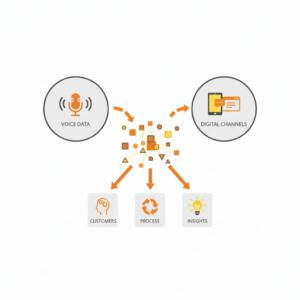
A practical way to break data silos is to treat Genesys voice interactions as a first-class customer journey event and integrate them with digital touchpoints through shared identity, consistent data quality rules, and governed pipelines. This enables reliable journey analytics, faster root-cause detection, better self-service containment, and stronger privacy and security outcomes under modern standards and Australian regulatory expectations.¹˒⁷
Definition
Breaking data silos means removing the structural and governance barriers that prevent voice and digital interaction data from being analysed together in a single customer journey view. In a Genesys contact centre, “voice data” typically includes call metadata (queue, agent, handle time, outcomes), recordings and transcripts, and analytics event logs.⁹˒¹⁰
Digital channel data covers web and app events, live chat, messaging, email, and self-service outcomes. When these datasets remain separate, leaders cannot measure true drivers of demand, repeat contact, or channel shift. The result is fragmented decision-making and avoidable cost linked to poor data quality.¹¹˒¹²
Why do Genesys voice and digital channels end up in silos?
Silos form for predictable reasons. Voice platforms and digital channels often use different identifiers and different time models. A phone call is usually tied to a dialled number and a contact centre conversation ID, while digital journeys may start from a cookie, device ID, or authenticated user ID.
Silos also form because teams optimise locally. Contact centre reporting focuses on operational metrics, while digital teams focus on conversion and task completion. Without shared definitions and shared governance, organisations create multiple versions of “the customer,” “the issue,” and “the outcome.” ISO’s data quality model highlights that consistency, completeness, and accuracy must be defined and measured, not assumed.⁵
For regulated industries, security and retention obligations add friction. Australian Privacy Principle 11 requires “reasonable steps” to protect personal information and to actively consider whether it should be retained.¹ That obligation becomes harder when data is copied into uncontrolled extracts and spreadsheets.
Mechanism
What is the minimum viable “integrated interaction record”?
The most reliable pattern is to build an integrated interaction record that can represent any channel as an event with common fields. ISO/IEC 25012 provides a practical foundation by treating data quality as a managed characteristic rather than an afterthought.⁵
At a minimum, the integrated record should include:
A stable customer identity key (or a governed identity resolution key)
A channel identifier (voice, chat, email, web, app, messaging)
A start time, end time, and time zone handling rule
An interaction ID (Genesys conversation identifiers where available)
A reason or topic field (from dispositions, intents, or text classification)
An outcome field (resolved, escalated, abandoned, complaint, sale, task completed)
Security classification and retention policy tags aligned to standards and policy
This structure reduces reporting debates and improves cross-channel comparability.
How do you connect Genesys conversations to digital journeys?
Genesys Cloud provides interaction recording and analytics capabilities that can be accessed through platform tooling and APIs, which makes it feasible to extract consistent conversation-level detail for integration.⁹˒¹⁰ Genesys also documents constraints that matter for design, such as query limits and the need for asynchronous jobs for older analytics conversation detail retrieval.¹⁰
Connection methods typically combine three approaches:
Deterministic linking: match on verified identity such as authenticated customer ID, case ID, or a token passed from digital to voice via IVR.
Probabilistic linking: controlled matching using phone, email, device hints, and timing windows, with confidence scoring and auditability.
Journey stitching rules: define “sessions” and “journeys” using time thresholds and intent continuity.
The critical control is to store link evidence so the organisation can explain why two events were joined. This is a governance requirement as much as a technical one.
What architecture breaks silos without creating new ones?
The goal is a governed integration layer that produces trusted datasets for analytics and operations. ISO 8000-61 positions data quality management as a repeatable organisational process, not a one-off remediation.⁶
In practice, leaders use a small number of patterns:
A central analytics store (warehouse or lakehouse) fed by governed pipelines
Streaming or near-real-time ingestion for operational use cases
A semantic layer that standardises definitions for metrics and dimensions
Role-based access and encryption controls aligned to an information security management system approach under ISO/IEC 27001.²
For Australian regulated entities, CPS 234 expectations on information security capability and control assurance push organisations toward stronger control evidence, vendor risk controls, and monitored access pathways.⁷
Comparison
Which approach is better: point-to-point integrations or a governed hub?
Point-to-point integrations appear faster but usually scale poorly. Each new channel adds another integration, another definition set, and another failure mode. The organisation then spends time reconciling inconsistencies rather than improving service.
A governed hub model is slower to start but faster to extend. It centralises identity rules, data quality checks, and retention enforcement. It also supports operational resilience because critical datasets and controls are visible and testable, which aligns more naturally with CPS 230 expectations around operational risk management and critical operations.⁸
A practical executive guideline is to treat point-to-point as a short-term bridge and to converge toward a governed hub for any metric that will influence investment, compliance, or workforce design.
Applications
Where does integrated voice and digital data create measurable value?
Integrated datasets let leaders act on causes, not symptoms. McKinsey reports that many consumers expect personalised interactions and will switch providers when experiences fall short, which increases the value of a unified customer view for service and retention decisions.¹³
Common high-return applications include:
Demand and failure demand reduction: identify digital task failures that trigger calls, then fix the upstream experience.
Channel containment with confidence: measure whether self-service truly resolves issues or only deflects them briefly.
Complaint and risk detection: detect patterns across channels, including repeat contact and escalation triggers.
Quality management at scale: connect call outcomes to digital context so coaching targets the full journey.
Journey-level service design: redesign end-to-end journeys rather than optimising one channel at a time.
Customer Science Insights can support unified cross-channel measurement and analysis when organisations need to connect contact centre and digital journey evidence into a single decision-ready view: https://customerscience.com.au/csg-product/customer-science-insights/
Risks
What can go wrong when combining voice recordings and digital data?
The main risks are privacy, security, and analytical distortion.
Privacy risk rises when organisations merge datasets without clear purpose limitation and retention discipline. APP 11 makes retention an active decision, not a default, and requires reasonable steps to secure personal information.¹ Security risk rises when copies are created outside controlled systems, or when broad access is granted for convenience rather than necessity.
Analytical risk rises when identity stitching is inaccurate or untested. False joins can lead to incorrect root cause conclusions, misdirected investment, and unfair agent performance interpretations. A NIST-aligned privacy risk management approach helps by requiring organisations to identify privacy risks, apply controls, and monitor outcomes as an enterprise risk discipline.¹⁴
The mitigation pattern is consistent: explicit governance, measurable data quality controls, auditable identity logic, and security controls aligned to ISO/IEC 27001 and CPS 234.²˒⁷
Measurement
How do you prove silo-breaking is working?
Executives should measure outcomes in three layers: data quality, operational performance, and risk control evidence.
Data quality measures should be defined and tracked against a recognised model. ISO/IEC 25012 supports creating measurable requirements for completeness, consistency, and credibility, which can be translated into weekly dashboards for integration health.⁵ ISO 8000-61 supports assessing maturity by treating data quality as a process capability, not a report.⁶
Operational measures should link directly to business value:
Reduction in repeat contact rate
Reduction in avoidable call drivers tied to digital failures
Improved first-contact resolution across the whole journey
Improved containment without post-deflection recontact
Lower cost-to-serve without increasing complaints
Risk and control measures should be explicit:
Access control reviews and logging coverage aligned to ISO/IEC 27001 control intent²
Evidence of security control assurance and third-party oversight consistent with CPS 234 requirements⁷
Documented critical operation dependencies consistent with CPS 230 expectations⁸
For organisations that need structured governance, operating model support, and delivery assurance, CX Consulting and Professional Services can provide a controlled pathway from integration design through to measurable adoption: https://customerscience.com.au/service/cx-consulting-and-professional-services/
Next Steps
What is a safe 90-day plan to integrate Genesys voice with digital channels?
A 90-day plan should focus on a limited scope that produces decision-grade evidence, not perfect completeness.
Weeks 1–3: Define the integrated interaction record and governance rules. Confirm identity strategy and retention rules. Align security classification to ISO/IEC 27001 and privacy risk thinking.²˒¹⁴
Weeks 4–7: Build ingestion for a small set of datasets: Genesys conversation-level metadata and one or two priority digital channels. Confirm platform constraints such as analytics query limits and design around them using asynchronous retrieval where required.¹⁰ Validate identity join rates and error patterns.
Weeks 8–10: Deliver two executive use cases, such as top digital failures that drive calls and true containment outcomes. Quantify business impact and define the next backlog.
Weeks 11–13: Operationalise data quality checks, access controls, and runbooks. Confirm CPS 234 control assurance expectations for entities in scope.⁷ Expand only after measurement is stable.
Evidentiary Layer
Breaking silos is not a technology purchase. It is an evidence program. The organisation must be able to show that integrated data is accurate, secure, and decision-ready.
Three evidence artifacts matter most:
A metric dictionary that defines each cross-channel measure, its owner, and its calculation logic
A data lineage and access map that shows how voice and digital data flows, who can access it, and how it is protected
A data quality and identity performance pack that quantifies join confidence, missingness, and drift over time
These artifacts improve operational performance while also strengthening compliance posture under privacy, security, and operational risk expectations.¹˒⁷˒⁸
FAQ
What is the quickest way to start integrating Genesys voice data with digital channels?
Start with conversation metadata and one digital channel, then prove value through one journey-level use case such as repeat contact reduction. Scale only after join accuracy and data quality measures are stable.
Do we need call recordings to break silos?
No. Most value starts with call metadata and outcomes. Add transcripts or recordings only when the use case requires them, and apply stricter access and retention controls.
How do we handle privacy when merging voice and digital data?
Apply purpose limitation, retention discipline, and “reasonable steps” security controls. Use explicit classification and role-based access aligned to privacy and information security standards.¹˒²
What should executives ask for in the first dashboard?
Ask for top cross-channel drivers, repeat contact rate by reason, true containment rates, and identity join confidence, plus a short list of data quality failures and actions.
How can knowledge management reduce calls after we integrate data?
Once demand drivers are visible across channels, you can target knowledge gaps and self-service failures with controlled improvements. Knowledge Quest is a practical option for operationalising knowledge uplift and reducing avoidable contact: https://customerscience.com.au/csg-product/knowledge-quest/
What does “good” look like after six months?
Good looks like fewer repeat contacts, fewer calls caused by digital failures, higher containment without recontact, and defensible governance evidence for privacy, security, and operational risk controls.
Sources
Office of the Australian Information Commissioner (OAIC). “Chapter 11: APP 11 Security of personal information.” Updated 3 Oct 2025. https://www.oaic.gov.au/privacy/australian-privacy-principles/australian-privacy-principles-guidelines/chapter-11-app-11-security-of-personal-information
ISO. ISO/IEC 27001:2022 Information security management systems. Publication date Oct 2022. https://www.iso.org/standard/27001
ISO. ISO/IEC 27701:2025 Privacy information management. Publication date Oct 2025. https://www.iso.org/standard/27701
Australian Prudential Regulation Authority (APRA). Prudential Standard CPS 234 Information Security. July 2019 (in effect 1 Jul 2019). https://www.apra.gov.au/sites/default/files/cps_234_july_2019_for_public_release.pdf
ISO. ISO/IEC 25012:2008 Data quality model. https://www.iso.org/standard/35736.html
ISO. ISO 8000-61:2016 Data quality management, process reference model. https://www.iso.org/standard/63086.html
National Institute of Standards and Technology (NIST). “NIST Privacy Framework, Version 1.0.” 16 Jan 2020. https://nvlpubs.nist.gov/nistpubs/CSWP/NIST.CSWP.01162020.pdf
APRA. Prudential Standard CPS 230 Operational Risk Management. Commences 1 Jul 2025. https://handbook.apra.gov.au/standard/cps-230
Genesys. “Call recording in Genesys Cloud overview.” https://help.mypurecloud.com/articles/recording-in-genesys-cloud/
Genesys. “Analytics Conversation Detail Endpoint API query change.” (Endpoint and historical query design constraints). https://help.mypurecloud.com/announcements/analytics-conversation-detail-endpoint-api-query-change/
IBM. “The true cost of poor data quality.” 23 Jan 2026. https://www.ibm.com/think/insights/cost-of-poor-data-quality
Gartner. “Data Quality: Best Practices for Accurate Insights.” (Cites average annual cost of poor data quality). https://www.gartner.com/en/data-analytics/topics/data-quality
McKinsey & Company. “Enhancing customer experience in the digital age.” (Personalisation expectation and switching risk). https://www.mckinsey.com/capabilities/growth-marketing-and-sales/our-insights/enhancing-customer-experience-in-the-digital-age