



























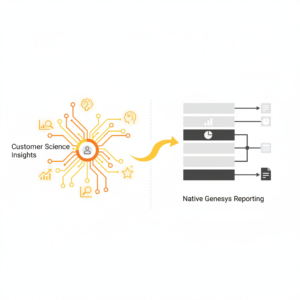
Customer Science Insights can extend native Genesys reporting by unifying contact centre data with CRM and digital channels, improving metric consistency, and enabling governed, near real-time operational decisions. Native Genesys dashboards are strong for in-platform queue and agent visibility, but enterprises often outgrow them when they need cross-system attribution, controlled KPI definitions, and auditable reporting for risk and executive governance.
What is Customer Science Insights?
Customer Science Insights is a contact centre analytics layer designed to connect Genesys Cloud data with other service and customer data sources, then surface operational visibility for action in the moment. The product positioning emphasises unified data across voice, digital, bots, CRM, and Genesys Cloud itself¹² while keeping the focus on operational control, not only retrospective reporting.
For executive stakeholders, the practical definition is simple. Customer Science Insights is a reporting and decision support layer that helps leaders standardise performance measurement across channels and teams, then operationalise those measures into daily management. That framing aligns with how service standards such as ISO 18295-1 describe the need for contact centres to deliver consistent, measurable service outcomes within an agreed framework¹.
What is “native Genesys reporting” in Genesys Cloud?
Native Genesys reporting typically refers to the built-in dashboards, views, and metric definitions available in Genesys Cloud for supervisors and operations leaders. Genesys Cloud provides real-time and historical dashboarding capabilities for queues, IVRs, and interaction performance, including volume, service level, and handle-time style metrics³.
A key strength of native Genesys reporting is that metrics are defined consistently inside the platform, with published definitions covering queue, agent, and flow-related measures such as service level, handle time, abandon rates, and IVR analysis outputs⁴. The operational benefit is fast visibility for day-to-day control, where speed and consistency inside the routing platform matters more than cross-enterprise reconciliation.
How do the two approaches work under the hood?
How does native Genesys reporting produce dashboards and metrics?
Genesys Cloud reporting is built around platform telemetry: conversations, queues, users, routing outcomes, and related events that the platform can observe directly. Dashboarding and reporting surface those metrics through curated views, and Genesys documents metric meanings so teams can interpret results consistently⁴.
This architecture works best when Genesys is the primary system of record for the performance question being asked. It becomes harder when the performance question requires data Genesys does not own, such as CRM case outcomes, customer value segments, complaints root-cause codes, or digital service completion events that live outside Genesys. In those cases, teams often end up reconciling multiple reports manually, which increases latency and disputes over “which number is right”.
How does Customer Science Insights extend reporting into an enterprise model?
Customer Science Insights positions itself as a unification layer that connects Genesys Cloud with wider CX and service data, including digital and CRM sources¹². The enterprise value is less about another dashboard and more about a governed performance model: consistent KPI definitions, repeatable transformations, and a shared layer that multiple functions can trust.
From a measurement governance perspective, this better supports the executive requirement for “one set of numbers” across operations, finance, digital, and customer teams. That aligns with the intent of ISO 18295-1, which frames contact centre service quality as something that must be managed against defined requirements and continuously improved, not interpreted ad hoc by each function¹.
Customer Science Insights vs native Genesys reporting: What is actually different?
Where is each strongest?
Native Genesys reporting is strongest when the question is operational and platform-bound: queue status, agent state, intraday service levels, or interaction handling performance that lives entirely in Genesys Cloud³⁴. It is also the quickest path to deployment because it is already part of the platform experience.
Customer Science Insights is strongest when the question is enterprise-wide: “Which customer segments are driving repeat contacts across channels?”, “Which complaint types are causing avoidable demand?”, or “How do service outcomes vary by digital journey step and agent action?”. The product positioning is explicitly about unifying Genesys Cloud data with CRM, bots, and digital channels so leaders can act with broader context¹².
Feature comparison by decision need
1) Data scope and blending
Genesys native reporting focuses on Genesys-observed interactions and platform metrics³⁴. Customer Science Insights is designed to blend Genesys data with other sources (CRM, bots, digital), which reduces dependence on manual reconciliation¹².
2) KPI governance and definitional control
Genesys provides published definitions for many platform metrics⁴, which supports internal consistency inside Genesys. Enterprises often still need a governed KPI layer that aligns operational metrics to business outcomes and service standards, particularly when reporting must satisfy audit and executive accountability expectations tied to service quality frameworks¹.
3) Time-to-action vs time-to-explain
Native Genesys dashboards optimise speed to visibility for supervisors³. A unification layer optimises speed to decision by reducing metric disputes and enabling context-rich interpretation, especially when multiple systems contribute to the customer outcome.
4) Risk, privacy, and auditability
When reporting involves personal information, Australian Privacy Principles and APP 11 require reasonable steps to secure that information and manage retention and access appropriately⁵. Any analytics approach that expands data movement across systems should be assessed against privacy guidance for analytics and de-identification, not only technical feasibility⁶.
What are the practical applications in a contact centre operating model?
What changes for frontline operations leaders?
The highest-value use case is daily performance control with fewer blind spots. With native Genesys reporting, leaders can manage intraday service and productivity with clear queue and agent metrics³⁴, ending the day with a reasonably complete view of what happened inside the platform.
With Customer Science Insights, the operating model can shift from “contact centre metrics” to “service outcome metrics” by connecting Genesys Cloud data to upstream and downstream signals (digital containment, CRM resolution codes, repeat contact drivers)¹². That enables more precise coaching, targeted deflection initiatives, and better alignment between WFM decisions and customer experience impacts.
What changes for executives and governance forums?
Executives typically want three things: consistent numbers, clear accountability, and defensible decisions. Contact centre standards emphasise structured requirements and continuous improvement expectations¹, which is difficult to achieve when each function uses a different dataset.
A unified reporting layer supports executive governance by enabling agreed definitions and repeatable measurement. That is also where security and monitoring controls matter. Government guidance on logging and system monitoring stresses the need for defined logging policies and active monitoring to detect malicious behaviour and support investigations⁷⁸, which becomes more important as analytics architectures integrate more systems.
For reference, the Customer Science product page for Insights is here: https://customerscience.com.au/csg-product/customer-science-insights/
What risks and trade-offs should you plan for?
Data privacy and retention risk
Any CX analytics expansion should treat privacy as a design constraint. OAIC guidance makes clear that analytics still falls under the Privacy Act framework where personal information is involved⁶, and APP 11 expects active security measures and consideration of whether the organisation is permitted to retain personal information⁵. The operational implication is that you should design role-based access, minimise data, and define retention explicitly as part of the reporting architecture.
These controls matter in practice because breach volumes remain high. OAIC’s Notifiable Data Breaches reporting shows hundreds of breach notifications per half-year in recent periods, with malicious or criminal attack a leading category⁹, which reinforces why reporting platforms must be built with security and auditability, not only usability.
Metric misuse and “dashboard theatre”
More dashboards do not automatically improve decisions. Research on customer experience management in the context of big data analytics highlights that organisations need structured capability and governance to convert data into strategy and outcomes¹⁰. If a comparison project becomes a dashboard rebuild without a measurement model, teams often end up with faster reporting but unchanged outcomes.
Automation bias in AI-enriched insights
If Insights programs incorporate speech analytics or NLP, organisations need to manage false positives, bias, and operational overreaction. Reviews of NLP in contact centres describe both benefits and challenges, including implementation complexity and organisational readiness considerations¹¹. The risk is not the model itself; it is deploying insights without control limits, calibration, and human review paths.
How should you measure success after implementation?
Success metrics should be defined as a small set of decision-quality outcomes, not a long list of platform metrics. Start with a governed measurement model aligned to service obligations and customer outcomes, then track operational movement.
Use three categories:
Decision latency: time from issue emergence to corrective action. Real-time operational visibility is a core benefit of Genesys dashboards³, and a unified layer should reduce delays caused by cross-system reconciliation.
Metric integrity: reduction in KPI disputes and rework. Metric definitions are a baseline inside Genesys⁴, but enterprises should measure whether all functions accept the same KPI computations across systems.
Risk and control maturity: evidence of logging, monitoring, and access governance. Australian cyber guidance describes the need for defined logging practices and monitoring policies to improve threat detection and resilience⁷⁸, which should be demonstrable in the analytics environment.
What are the next steps for an evidence-led comparison?
A credible feature comparison should end with a short proof process, not a slide deck debate. Run a two-stage evaluation.
First, pick 6–10 decisions your leaders make weekly (service level interventions, coaching, deflection, complaint root cause, digital containment). For each decision, define the minimum data required, the latency tolerance, and the privacy constraints using OAIC analytics guidance as the baseline⁶.
Second, score each approach against those decisions using the same test dataset, then validate with governance stakeholders (Operations, Digital, Risk, Privacy, Finance). The goal is to confirm whether you can meet ISO-style requirements for defined service outcomes and continuous improvement¹ while maintaining security controls that align to Australian monitoring guidance⁷⁸. The Customer Science product and service pages referenced in this article come from your provided internal link set .
If you want a structured assessment and implementation pathway, Customer Science’s services page is here: https://customerscience.com.au/service/cx-consulting-and-professional-services/
Evidentiary Layer
The key architectural insight is that native Genesys reporting is optimised for platform operations, while Customer Science Insights is positioned for enterprise CX performance management across multiple systems. Both can be “right” depending on the question being asked.
In practice, most mature organisations use native Genesys dashboards for intraday control and add a governed, cross-system reporting layer for executive and cross-functional decisions. That combination reduces operational friction, improves outcome accountability, and supports privacy and security obligations that become more material as analytics scope expands across channels and datasets.
FAQ
What is the simplest way to describe the difference?
Native Genesys reporting focuses on Genesys Cloud performance visibility for queues, agents, and interactions³. Customer Science Insights focuses on unifying Genesys data with CRM and digital sources so leaders can measure and act on service outcomes across the full journey¹².
Does native Genesys reporting support standard contact centre KPIs?
Yes. Genesys publishes metric definitions for common contact centre measures such as service level, handle time, abandons, and IVR analysis metrics⁴, which helps teams interpret performance consistently inside the platform.
When does an organisation usually outgrow native reporting?
Organisations commonly outgrow native reporting when executive questions require cross-system attribution, governed KPI definitions across functions, or integrated outcome data from CRM and digital services. Those needs align with service management frameworks that depend on defined requirements and continuous improvement¹.
What privacy obligations apply to contact centre analytics in Australia?
Analytics involving personal information remains subject to the Privacy Act and the Australian Privacy Principles⁶. APP 11 requires reasonable steps to protect personal information and active consideration of retention and permitted holding of data⁵.
What is a sensible starting point if we want more than reporting?
Start with a measurement model tied to weekly decisions and outcome accountability, then evaluate platforms against that model. If you also need knowledge and workflow support alongside reporting, consider: https://customerscience.com.au/csg-product/knowledge-quest/
Sources
ISO. ISO 18295-1:2017 Customer contact centres, Part 1: Requirements (standard overview). https://www.iso.org/standard/64739.html
Customer Science. Customer Science Insights product page. https://customerscience.com.au/csg-product/customer-science-insights/
Genesys Cloud Help. Historical analytics dashboards (Analytics add-on context and dashboards). https://help.mypurecloud.com/articles/analytics-add-on-historical-analytics-dashboards/
Genesys Cloud Help. Metric definitions. https://help.mypurecloud.com/articles/metric-definitions/
OAIC. Chapter 11: APP 11 Security of personal information. https://www.oaic.gov.au/privacy/australian-privacy-principles/australian-privacy-principles-guidelines/chapter-11-app-11-security-of-personal-information
OAIC. Guide to data analytics and the Australian Privacy Principles (2018). https://www.oaic.gov.au/privacy/privacy-guidance-for-organisations-and-government-agencies/more-guidance/guide-to-data-analytics-and-the-australian-privacy-principles
Australian Cyber Security Centre. Best practices for event logging and threat detection (PDF, 2024). https://www.cyber.gov.au/sites/default/files/2024-08/best-practices-for-event-logging-and-threat-detection.pdf
ASD Information Security Manual. Guidelines for System Monitoring (PDF, June 2024). https://www.cyber.gov.au/sites/default/files/2024-06/17.%20ISM%20-%20Guidelines%20for%20System%20Monitoring%20%28June%202024%29.pdf
OAIC. Notifiable data breaches report: July to December 2024 (PDF, published May 2025). https://www.oaic.gov.au/__data/assets/pdf_file/0021/251184/Notifiable-data-breaches-report-July-to-December-2024.pdf
Holmlund, M., et al. “Customer experience management in the age of big data analytics.” International Journal of Research in Marketing (2020). https://www.sciencedirect.com/science/article/pii/S0148296320300345
Shah, S., et al. “A review of natural language processing in contact centre…” Pattern Analysis and Applications (2023). https://link.springer.com/article/10.1007/s10044-023-01182-8
Pacella, M., et al. “An Assessment of Digitalization Techniques in Contact Centers…” Sustainability (2024). https://www.mdpi.com/2071-1050/16/2/714