































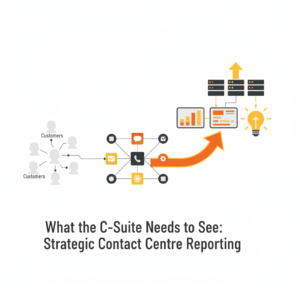
Strategic contact centre reporting should show the C-suite how service performance affects revenue, cost, risk, and trust. It must move beyond activity metrics to outcomes such as resolution, customer effort, vulnerability impact, and operational resilience. Executives need a small set of decision-grade indicators, a clear story of causes, and proof the data is reliable and compliant.
What is strategic contact centre reporting?
Strategic contact centre reporting is an executive view of customer service that connects day-to-day service delivery to business outcomes. It prioritises decision usefulness over operational detail. A practical definition is reporting that shows whether the contact centre is meeting customer needs, controlling unit costs, and operating within risk tolerances, while enabling accountable action.
This approach aligns with recognised service frameworks for contact centres that emphasise consistent service delivery, governance, and continual improvement. ISO 18295-1 defines requirements and guidance for customer contact centres, including what should be monitored to sustain service quality and customer outcomes.¹ Strategic reporting uses that discipline, but compresses it into an executive format.
Why does the C-suite care about contact centre reporting now?
Contact centres have become a front line for operational resilience, not just customer experience. In regulated industries, boards are increasingly expected to understand how critical operations perform under stress, including outsourced or technology-dependent service chains. APRA’s CPS 230 increases expectations for board oversight of operational risk, including clearer reporting on critical operations and material service providers.³˒⁴ This raises the bar for how service performance is evidenced, explained, and governed.
Customer expectations have also shifted toward fast, reliable resolution. In Australian benchmarking, average handle time increased from 507 seconds in 2023 to 543 seconds in 2024, indicating rising complexity or friction that can lift cost-to-serve and erode experience if not managed.¹² When complexity rises, executives need reporting that distinguishes “more work” from “better outcomes”, and that shows where investment reduces repeat contact and downstream cost.
How should executive reporting be built from contact centre data?
Executive reporting should be built as a chain: data → metric → insight → decision → action → impact. The chain only works when each step is explicit. Start with customer intents (billing, technical support, claims, hardship, fraud, complaints), then measure resolution quality and effort for each intent, then quantify cost and risk exposure.
A proven design principle is to treat resolution as the primary outcome and efficiency as a constraint, not the other way around. Empirical work links first call resolution (FCR) to caller satisfaction and shows it can mediate the value of knowledge management and CRM capability.⁷ This supports a shift from reporting “how fast” to reporting “how often we resolve”, then explaining what capabilities drive that resolution.
Reporting also needs a human-performance layer. Research in call centres shows employee and HR-related factors can shape customer satisfaction outcomes, which means executive reporting should include leading indicators such as coaching quality, knowledge usability, and schedule adherence stability, not only lagging indicators like CSAT.⁹ Language and communication quality matter as well. Large-scale evidence shows more concrete, specific language can lift customer satisfaction and spending by improving perceived listening.¹⁰ That is operationally actionable if you can measure it through quality monitoring or conversation analytics.
How is strategic reporting different from operational dashboards?
Operational dashboards optimise today. Strategic reports govern the system. Dashboards often focus on real-time volumes, queues, service levels, and handle times. Those are essential for supervisors, but they can mislead executives because they are easy to game and weakly linked to long-term outcomes.
Strategic reporting changes three things:
It frames measures around decisions (investment, risk, product fixes), not targets.
It uses causal narratives (drivers of repeat contact, top failure demand sources), not metric lists.
It includes assurance (definitions, sampling, audit trails) so leaders can rely on the numbers.
A useful comparison is to treat operational dashboards as instrumentation and strategic reporting as governance. For example, speed of answer is operationally important, but evidence from large-scale healthcare call centre data shows lower speed of answer is associated with worse perceptions of access.⁸ Executives do not need every interval’s performance, but they do need to know whether access is persistently degrading, why, and what it costs.
Which executive decisions should reporting support?
Strategic contact centre reporting should directly support the decisions executives actually make. Typical decision domains include cost, growth, risk, and trust.
In practice, this means your report should answer:
Where is demand avoidable, and which product or process defects create repeat contact?
Which intents have the highest unit cost and the lowest resolution, and what capability investment fixes them?
Which customer cohorts are most exposed to poor outcomes, including vulnerable customers and hardship cases?
Which service chains create resilience or compliance risk, including third parties and technology dependencies?
This is also where tools matter. To move from descriptive metrics to decision-grade insight, organisations often need an analytics layer that integrates telephony, CRM, QA, workforce data, and VoC. Customer Science Insights can be used as that integrated reporting and insights layer when the goal is executive-level visibility across channels and drivers: https://customerscience.com.au/csg-product/customer-science-insights/
What can go wrong with contact centre reporting?
The most common failure is rewarding the wrong behaviour. If average handle time is over-weighted, teams can shorten calls by increasing transfers, callbacks, or incomplete resolutions. This inflates future demand and can hide dissatisfaction until churn or complaints rise. Evidence that FCR is a stronger mediator of satisfaction than many operational inputs supports treating resolution as the anchor metric.⁷
The second failure is weak privacy and security discipline. Contact centres handle identity data and account access workflows, making them attractive targets for social engineering and credential abuse. In OAIC reporting, a very high proportion of notified breaches involved contact information, and identity information was also common, highlighting why frontline verification and data controls must be governed.⁵ Australia’s Notifiable Data Breaches scheme and related guidance underline the expectation to notify and manage breach risk.⁶
The third failure is lack of standard definitions. Without consistent definitions of “resolved”, “repeat”, “abandoned”, or “complaint”, executives cannot compare trends or hold leaders accountable. Standards such as ISO 18295-1 and complaint-handling guidance in AS ISO 10002 help reduce ambiguity and support continual improvement.¹˒²
Which metrics belong in a board-ready scorecard?
A board-ready scorecard should be small, stable, and outcome-led. A practical target is 8–12 measures, reported monthly with clear thresholds, trend lines, and named owners.
A balanced set typically includes:
Resolution rate (FCR or “resolved within policy”) as the primary outcome.⁷˒¹¹
Repeat contact within 7 and 30 days, by intent, as a failure-demand indicator.¹
Customer effort or friction proxy, such as transfers per case or rework time.¹
Speed of answer and abandonment as access controls, summarised as persistent performance, not interval noise.⁸
Unit cost-to-serve by intent and channel, including rework cost from repeat contact.
Complaint rate and upheld complaint themes, aligned to a documented complaints process.²
Workforce stability: attrition risk, shrinkage variance, and coaching coverage as leading indicators.⁹
Operational resilience: outage minutes impacting service, third-party incident exposure, and tolerance status for critical operations where applicable.³˒⁴
Data protection controls: identity verification failure rates, privacy incidents, and high-risk interaction volumes (for example, account changes).⁵˒⁶
Trust and quality: QA “must pass” compliance, plus a small number of behavioural drivers such as clarity or listening signals.¹⁰
How to implement strategic reporting in 90 days
Implementation works best as a phased build that delivers a usable executive report quickly, then improves fidelity. The first 30 days should lock definitions, owners, and a minimum viable scorecard. Use a single metric dictionary, define cohorts and intents, and agree on how to treat multi-contact cases, callbacks, and transfers. Standards-based definitions reduce debate and improve comparability.¹˒²
Days 31–60 should integrate the core data feeds and build driver views. Prioritise intent-level resolution, repeat contact, and unit cost, because these are most actionable for product and operations leaders. Add a small set of risk and resilience measures relevant to your industry obligations, especially where service delivery relies on third parties or critical platforms.³
Days 61–90 should harden governance and action loops. Establish a monthly “insight to action” forum that includes service, product, digital, risk, and finance. Assign owners to the top drivers of repeat contact and track benefits. If you need external support to accelerate design, integration, or governance, a managed approach through CX consulting and professional services can reduce time-to-value and lift assurance: https://customerscience.com.au/service/cx-consulting-and-professional-services/
How to prove the numbers are trustworthy
Executives rely on metrics when they are assured. Assurance starts with lineage: where the data comes from, how it is transformed, and how exceptions are handled. Every board metric should have: a definition, inclusion rules, exclusions, and a known error rate from sampling.
Quality assurance should include three controls. First, periodic reconciliation between source systems and reported values. Second, independent sampling of interaction outcomes to validate “resolved” and “repeat” labels. Third, monitoring for metric manipulation signals, such as sudden handle time drops paired with transfer increases or complaint spikes.
Security and privacy assurance should be treated as part of reporting design, not an afterthought. Using recognised information security management requirements supports consistent controls, access governance, and continuous improvement across the reporting pipeline. ISO/IEC 27001 provides the baseline structure for managing information security risk in systems that store or process customer service data.¹³
FAQ
What should the CEO see in a contact centre report?
The CEO should see outcome, cost, and risk: resolution, repeat contact, unit cost-to-serve, persistent access performance, and any breach of resilience or compliance tolerances.³˒⁷ The report should also name the few drivers creating the most avoidable demand.¹²
What is the minimum set of metrics for board reporting?
A minimum set is resolution, repeat contact, cost-to-serve by intent, access controls (speed of answer and abandonment), complaint trends, and a small set of resilience and data-protection indicators relevant to obligations.²˒³˒⁵
Why is first contact resolution more strategic than average handle time?
FCR links more directly to customer outcomes and can mediate satisfaction improvements driven by knowledge and CRM capability.⁷ AHT can improve while resolution worsens if work is shifted into transfers, callbacks, or rework.¹²
How do we include “quality” without making reporting subjective?
Use a small number of observable behaviours with clear rubrics and sampling. Evidence shows that concrete, specific language can improve perceived listening and customer satisfaction, which can be operationalised through quality monitoring and coaching.¹⁰
How should we treat complaints in executive reporting?
Complaints should be reported as a process measure and a learning system. AS ISO 10002 provides guidance for consistent complaint management, including analysis and continual improvement, which supports reliable executive reporting on complaint themes and closure quality.²
Which tools can help measure communication quality at scale?
Conversation analytics can measure clarity, sentiment signals, and communication behaviours across large volumes of interactions. Commscore AI is designed for that kind of scaled communications measurement in customer operations: https://customerscience.com.au/csg-product/commscore-ai/
Sources
ISO. ISO 18295-1:2017 Customer contact centres. https://www.iso.org/standard/64739.html
Standards Australia. AS ISO 10002:2022 Guidelines for complaint management in organizations (preview PDF). https://www.standardsau.com/preview/AS%2010002-2022.pdf
APRA. Prudential Standard CPS 230 Operational Risk Management (commencement 1 July 2025). https://handbook.apra.gov.au/standard/cps-230
APRA. CPS 230 Operational Risk Management (PDF). https://www.apra.gov.au/sites/default/files/2023-07/Prudential%20Standard%20CPS%20230%20Operational%20Risk%20Management%20-%20clean.pdf
OAIC. Notifiable Data Breaches Report (Jan–Jun 2021). https://www.oaic.gov.au/__data/assets/pdf_file/0013/2803/oaic-notifiable-data-breaches-report-jan-june-2021.pdf
Australian Cyber Security Centre. Data breaches and the Notifiable Data Breaches scheme. https://www.cyber.gov.au/threats/types-threats/data-breaches
Abdullateef AO, Mokhtar SSM, Yusoff RZY. The mediating effects of first call resolution on call centers’ performance. Journal of Database Marketing & Customer Strategy Management (2011). DOI: 10.1057/dbm.2011.4 https://link.springer.com/article/10.1057/dbm.2011.4
Griffith KN et al. Call Center Performance Affects Patient Perceptions of Access and Satisfaction (2019). PMCID: PMC8177735 https://pmc.ncbi.nlm.nih.gov/articles/PMC8177735/
Chicu D et al. Exploring the influence of the human factor on customer satisfaction in call centres. Business Research Quarterly (2019). DOI: 10.1016/j.brq.2018.08.004 https://www.sciencedirect.com/science/article/pii/S2340943618300136
Packard G, Berger J. How Concrete Language Shapes Customer Satisfaction. Journal of Consumer Research (2021). DOI: 10.1093/jcr/ucaa038 https://academic.oup.com/jcr/article/47/5/787/5873524
SQM Group. Call Center FCR Benchmark 2024 Results by Industry (published 2025). https://www.sqmgroup.com/resources/library/blog/call-center-fcr-benchmark-2024-results-by-industry
ACXPA. Call centre metrics and Australian benchmarks including AHT trend (2024). https://acxpa.com.au/popular-call-centre-metrics/
ISO. ISO/IEC 27001:2022 Information security management systems requirements. https://www.iso.org/standard/27001