





























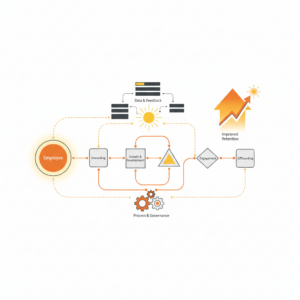
Employee experience mapping helps organisations understand how employees interact with systems, managers, policies, and workplace culture across the entire employment lifecycle. When done well, it exposes hidden friction, reduces avoidable turnover, and gives leaders a structured way to improve retention, engagement, and performance. It turns assumptions into evidence and provides a governance framework for workforce improvement.
What Is Employee Experience Mapping?
Employee experience mapping is the process of documenting and analysing every significant interaction an employee has with an organisation, beginning with recruitment and extending through onboarding, development, career progression, and exit.
An employee experience (EX) journey map visualises these interactions from the employee’s perspective. The map identifies expectations, emotions, barriers, service gaps, and moments that influence engagement and retention. Unlike traditional HR process documentation, employee experience mapping focuses on what people actually experience rather than what policies intend them to experience.
Research consistently shows that employee experience strongly influences retention, discretionary effort, productivity, and organisational commitment¹˒². Yet many organisations continue to measure isolated events rather than the complete employee journey.
Why Is Employee Retention Becoming Harder?
Labour markets remain competitive across many sectors. Employees now compare workplace experiences in the same way customers compare brands.
Gallup reports that engagement remains a significant predictor of retention and organisational performance³. At the same time, burnout, limited career development, poor communication, and inconsistent management continue to drive voluntary turnover⁴.
Many organisations respond by increasing compensation. Sometimes that works. Often it doesn’t.
Because turnover decisions rarely stem from a single event. They emerge from accumulated friction across dozens of interactions. A confusing onboarding process. Delayed access to systems. Poor manager communication. Limited recognition. Small issues compound over time.
Employee experience mapping makes these patterns visible.
How Does Employee Experience Mapping Work?
The process starts by identifying employee lifecycle stages and critical moments that shape perceptions of the organisation.
What Should an EX Journey Map Include?
A comprehensive EX journey map normally captures:
- Recruitment and candidate experience
- Onboarding and induction
- Learning and development
- Performance management
- Internal mobility
- Leadership interactions
- Workplace communications
- Technology and digital tools
- Recognition and rewards
- Exit and alumni experience
Each touchpoint is evaluated through qualitative and quantitative evidence. Employee interviews, surveys, behavioural data, operational metrics, and service interactions are combined to create a complete picture.
The outcome is not simply a diagram. It is an evidence-based management tool that helps leaders prioritise investment where it will have the greatest workforce impact.
What Makes Employee Experience Mapping Different From Traditional HR Reviews?
Traditional reviews often examine functions separately. HR assesses onboarding. IT measures service tickets. Managers conduct performance discussions.
Employees do not experience organisations in separate departments.
They experience one connected journey.
Employee experience mapping connects operational silos and reveals where breakdowns occur between teams. This creates a shared view of workforce reality and supports stronger governance decisions.
For example, onboarding dissatisfaction may appear to be an HR issue. Mapping often reveals that technology access delays, unclear communications, and manager preparedness contribute equally to the problem.
That broader view helps organisations avoid solving the wrong problem.
Applications of Employee Experience Mapping
Organisations use employee experience mapping to improve retention, workforce planning, culture programs, leadership effectiveness, and organisational change initiatives.
One common application involves identifying early warning indicators of turnover. Research suggests that employee intent to leave can often be detected through engagement patterns, manager relationships, career stagnation, and workload concerns before resignation occurs⁵.
Another application involves workforce transformation. When organisations introduce new technologies, restructures, or operating models, EX journey maps help leaders understand where employees may encounter uncertainty or resistance.
For organisations seeking deeper workforce insights, Customer Science Insights provides structured experience measurement and evidence-based decision support for employee and customer programs:
https://customerscience.com.au/csg-product/customer-science-insights/
What Risks Can Employee Experience Mapping Reveal?
Employee experience mapping often uncovers issues that standard reporting misses.
Common findings include:
- Inconsistent management practices
- Communication breakdowns
- Poor role clarity
- Excessive administrative burden
- Technology frustration
- Career development barriers
- Low trust in leadership
- Recognition gaps
Some organisations discover that turnover is concentrated around specific lifecycle moments. Others find that employee dissatisfaction stems from cumulative friction rather than compensation concerns.
And sometimes the findings are surprising.
A well-funded employee wellbeing program may have little effect if workload expectations remain unrealistic. A new learning platform may fail if managers do not actively support development conversations.
Mapping helps separate symptoms from root causes.
How Should Organisations Measure Success?
Measurement should combine employee perception metrics with operational outcomes.
Key indicators often include:
- Employee retention rate
- Voluntary turnover rate
- Employee Net Promoter Score (eNPS)
- Engagement scores
- Internal mobility rates
- Time-to-productivity
- Absenteeism
- Manager effectiveness measures
- Learning participation rates
The strongest programs connect employee experience measures with business outcomes. Studies show that organisations with stronger employee engagement often achieve better productivity, customer outcomes, and financial performance³˒⁶.
Because of this, retention improvement should not be viewed as an isolated HR objective. It should be measured as a business performance outcome.
Organisations requiring structured workforce and business improvement support often combine experience measurement with consulting and governance frameworks:
https://customerscience.com.au/solution/business-consulting/
What Governance Model Supports Employee Experience Mapping?
Governance determines whether journey mapping becomes a one-time exercise or a sustainable management capability.
Effective governance usually includes:
Executive Ownership
Senior leaders establish accountability, priorities, and funding.
Cross-Functional Participation
HR, operations, technology, communications, and business leaders contribute evidence and improvement actions.
Continuous Measurement
Employee journeys change over time. Measurement must remain ongoing rather than project-based.
Decision Frameworks
Insights should feed directly into workforce planning, service improvement, technology investment, and leadership development decisions.
Without governance, journey maps often become static documents. With governance, they become active decision-making tools.
What Are the Next Steps for Organisations?
Most organisations already possess large amounts of employee data. The challenge is connecting it into a coherent story.
A practical starting point includes:
- Define lifecycle stages.
- Identify critical employee moments.
- Gather qualitative and quantitative evidence.
- Map pain points and success factors.
- Prioritise improvements based on business impact.
- Establish measurement and governance processes.
- Review outcomes regularly.
The organisations achieving the strongest retention outcomes typically treat employee experience as a managed business discipline rather than a standalone HR initiative.
Evidentiary Layer
Employee experience mapping is supported by a growing body of evidence linking workforce experience to engagement, retention, productivity, wellbeing, and organisational performance¹˒²˒³˒⁶.
ISO guidance on human capital reporting highlights the importance of workforce measurement and organisational capability development⁷. Research from government and academic institutions also shows that workplace culture, leadership quality, and employee wellbeing have measurable effects on retention and organisational outcomes⁸˒⁹.
Employee experience mapping provides a structured method for translating those findings into practical action.
FAQ
What is employee experience mapping?
Employee experience mapping is a structured process that documents and analyses employee interactions across the employment lifecycle to identify factors affecting engagement, performance, and retention.
What is an EX journey map?
An EX journey map is a visual representation of employee experiences, touchpoints, emotions, expectations, and barriers throughout their relationship with an organisation.
How does employee experience mapping improve retention?
It identifies friction points, management issues, communication gaps, and career barriers that contribute to employee turnover, allowing organisations to address root causes before employees leave.
How often should employee journey maps be updated?
Most organisations benefit from annual reviews supported by continuous employee feedback and operational measurement.
Who should own employee experience mapping?
Ownership should be shared across executive leadership, HR, operations, communications, and business functions to ensure organisation-wide accountability.
Can technology support employee experience mapping?
Yes. Modern analytics and insight platforms help collect, analyse, and interpret employee feedback at scale while supporting governance and reporting.
What tools can support employee experience improvement?
Knowledge management, employee insight platforms, communication analytics, and structured governance programs can all contribute. One example is:
https://customerscience.com.au/csg-product/knowledge-quest/
Sources
- IBM Institute for Business Value & Globoforce Workforce Institute. The Employee Experience Index.
https://www.ibm.com/thought-leadership/institute-business-value/report/employee-experience-index - Morgan, J. (2017). The Employee Experience Advantage. Wiley.
https://www.wiley.com/en-au/The+Employee+Experience+Advantage-p-9781119321628 - Gallup. State of the Global Workplace Reports.
https://www.gallup.com/workplace/349484/state-of-the-global-workplace.aspx - World Health Organization. Burn-out an Occupational Phenomenon.
https://www.who.int/teams/mental-health-and-substance-use/mental-health-in-the-workplace - Hom, P. W., Lee, T. W., Shaw, J. D., & Hausknecht, J. P. (2017). One Hundred Years of Employee Turnover Theory and Research. Journal of Applied Psychology.
https://doi.org/10.1037/apl0000103 - Harter, J. K., Schmidt, F. L., & Agrawal, S. The Relationship Between Engagement at Work and Organizational Outcomes.
https://www.gallup.com/workplace/321032/employee-engagement-meta-analysis-brief.aspx - ISO 30414:2018. Human Resource Management Guidelines for Internal and External Human Capital Reporting.
https://www.iso.org/standard/69338.html - Safe Work Australia. Workplace Mental Health and Psychological Safety Resources.
https://www.safeworkaustralia.gov.au/topic/mental-health - OECD. How’s Life at Work? Employee Wellbeing and Productivity.
https://www.oecd.org/employment/how-s-life-at-work.htm - Australian Public Service Commission. Employee Engagement and High Performance.
https://www.apsc.gov.au - CIPD. Employee Experience Factsheet.
https://www.cipd.org/uk/knowledge/factsheets/employee-experience-factsheet - Deloitte. Global Human Capital Trends.
https://www2.deloitte.com/global/en/pages/human-capital/articles/introduction-human-capital-trends.html - McKinsey & Company. The Employee Experience: What Matters Most.
https://www.mckinsey.com/capabilities/people-and-organizational-performance/our-insights