































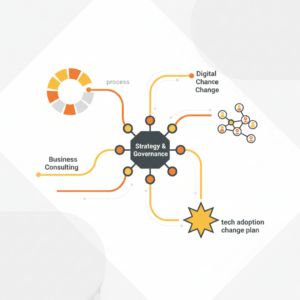
A digital transformation change strategy provides the structure, governance, communication, and leadership needed to turn technology investments into business outcomes. Organisations that pair digital programs with formal change management practices achieve higher adoption rates, faster value realisation, and lower project risk. Success depends on leadership alignment, workforce readiness, measurable objectives, and continuous feedback.
What Is a Digital Transformation Change Strategy?
A digital transformation change strategy is a structured approach used to guide people, processes, and technology through organisational change. It combines business strategy, governance, communication, capability development, and adoption planning into a single framework.
Technology alone rarely changes organisational performance. Employees must understand why change is occurring, how their work will be affected, and what support is available. Research from Prosci shows that projects with effective change management are significantly more likely to meet objectives than projects with weak change practices¹.
For executive teams, a digital transformation change strategy acts as a bridge between business goals and operational execution. It converts strategic intent into practical actions that employees, managers, vendors, and stakeholders can follow.
Why Do Digital Transformation Programs Fail?
Many digital initiatives begin with strong business cases and modern technology platforms. Yet adoption remains a common problem.
Studies by McKinsey indicate that organisational challenges, rather than technical limitations, are among the leading causes of transformation failure². Common issues include:
- Unclear ownership
- Weak executive sponsorship
- Poor communication
- Limited employee involvement
- Inadequate training
- Undefined success measures
And sometimes the technology works exactly as designed. Staff simply continue using old processes.
That gap between deployment and adoption is where a structured change strategy becomes essential.
Context: The Growing Need for Structured Change
Organisations face increasing pressure to modernise customer experience, automate workflows, improve data quality, and strengthen operational performance.
Cloud platforms, artificial intelligence, analytics, automation tools, and digital service channels continue to reshape how work is performed. Gartner reports that workforce acceptance remains one of the strongest predictors of digital transformation outcomes³.
Business leaders now need more than project management. They need governance models that coordinate people, policy, process, and technology across multiple business units.
Without that coordination, digital programs often create fragmented experiences, duplicated effort, and inconsistent adoption.
How Does a Digital Transformation Change Strategy Work?
A successful digital transformation change strategy operates through several interconnected components.
Strategic Alignment
Executive leaders establish a clear business case linked to measurable outcomes. These may include productivity gains, customer satisfaction improvements, cost reduction, compliance enhancement, or revenue growth.
Every initiative should connect directly to organisational priorities.
Change Governance
Governance defines decision rights, accountability structures, reporting processes, and escalation pathways.
Effective governance creates visibility across programs and helps maintain momentum when priorities compete.
Stakeholder Engagement
Stakeholder mapping identifies affected groups and assesses their influence, concerns, and readiness levels.
Early engagement reduces resistance and improves ownership.
Communication Planning
Communication should explain:
- Why the change is happening
- What is changing
- When changes will occur
- How support will be provided
Consistent communication builds trust and reduces uncertainty.
Capability Development
Training programs help employees develop the skills needed to operate within new systems and processes.
Learning should be role-specific, practical, and delivered close to implementation milestones.
What Makes Change Management Different from Project Management?
Project management focuses on delivering outputs.
Change management focuses on achieving adoption.
A project manager may oversee software implementation, vendor coordination, budgets, and timelines. A change leader focuses on employee engagement, behavioural shifts, communication, training, and performance outcomes.
Both functions are necessary.
Project success does not automatically produce business success. Organisations achieve lasting value when technical delivery and human adoption work together.
Applications Across Digital Transformation Programs
Digital transformation change strategies can support a broad range of initiatives:
- Customer experience modernisation
- Contact centre transformation
- CRM deployment
- Enterprise resource planning systems
- Digital workplace programs
- Artificial intelligence implementation
- Process automation projects
- Data governance initiatives
- Omnichannel service delivery
For organisations seeking deeper customer and employee insight before major transformation programs, Customer Science Insights can help identify behavioural drivers, experience gaps, and adoption risks before implementation begins:
This evidence-led approach helps leaders make informed decisions before significant investment occurs.
Risks and Challenges
Every transformation program carries risk.
Resistance to change remains one of the most persistent barriers. Employees often fear loss of control, increased workload, skill gaps, or uncertainty regarding future roles.
Other risks include:
- Leadership inconsistency
- Poor data quality
- Technology complexity
- Resource shortages
- Vendor dependency
- Competing organisational priorities
Because digital transformation typically spans multiple departments, risk management should be continuous rather than event-based.
Small warning signs often emerge long before performance metrics deteriorate.
How Should Success Be Measured?
Measurement should extend beyond technical deployment.
A mature digital transformation change strategy tracks both implementation and adoption indicators.
Common measures include:
Adoption Metrics
- Active user rates
- System utilisation
- Feature adoption
- Training completion
Employee Metrics
- Readiness scores
- Engagement levels
- Confidence assessments
- Behavioural change indicators
Business Metrics
- Productivity improvements
- Customer satisfaction scores
- Revenue outcomes
- Cost reduction
- Compliance performance
Continuous measurement allows organisations to identify emerging issues before they become large-scale adoption problems.
For ongoing consulting support, governance design, and transformation execution, organisations often engage specialist advisory services:
Next Steps for Building a Tech Adoption Change Plan
A practical tech adoption change plan begins with assessment rather than implementation.
Start by evaluating:
- Current organisational readiness
- Leadership alignment
- Stakeholder impacts
- Workforce capability gaps
- Existing communication channels
- Success measurement frameworks
Next, establish a governance structure that clearly defines ownership and accountability.
Then develop communication, training, and engagement plans tailored to each stakeholder group.
And finally, create feedback mechanisms that allow rapid adjustment throughout the transformation lifecycle.
Change strategies perform best when treated as living programs rather than static project documents.
Evidentiary Layer
Multiple studies continue to show a strong relationship between organisational change management and transformation success.
Prosci research found that projects with excellent change management practices are substantially more likely to achieve objectives¹.
McKinsey’s analysis of digital transformations highlights leadership engagement, employee capability building, and organisational alignment as recurring success factors².
Gartner research identifies workforce acceptance and behavioural adoption as critical drivers of transformation outcomes³.
The Project Management Institute also reports that organisations with stronger change capabilities achieve higher rates of project success and business value realisation⁴.
Taken together, the evidence suggests a consistent pattern. Technology creates potential value. People create realised value.
FAQ
What is a digital transformation change strategy?
A digital transformation change strategy is a structured framework that guides people, processes, governance,
Message delivery timed out. Please try again.
Retry
Digital Transformation Change Strategy | Strategy & Governance / Business Consulting / Digital Change | “digital transformation change strategy”, “tech adoption change plan”
SEO Title Tag:
Digital Transformation Change Strategy for Tech Adoption
Meta Description:
Build a practical digital transformation change strategy that improves technology adoption, reduces resistance, and delivers measurable business outcomes.
Recommended URL Slug:
digital-transformation-change-strategy
Primary Keyword:
digital transformation change strategy
Digital transformation succeeds when people change how they work, not when technology is simply deployed. A strong digital transformation change strategy connects business objectives, leadership behaviours, workforce readiness, governance, communication, and measurement into a single operating model. Organisations that actively manage change are significantly more likely to meet project objectives and achieve sustained technology adoption rates.¹
What Is a Digital Transformation Change Strategy?
A digital transformation change strategy is a structured framework that guides how an organisation prepares, supports, and sustains behavioural change during technology, process, and operating model transitions. It combines governance, leadership alignment, workforce engagement, communication planning, capability development, and performance measurement.
Many organisations invest heavily in new platforms, automation tools, customer experience systems, analytics environments, and digital services. Yet technology alone rarely delivers expected outcomes. Research consistently shows that employee adoption, executive sponsorship, and organisational readiness have a direct impact on transformation success rates.²
A well-designed tech adoption change plan ensures that people understand why change is occurring, what is expected of them, how success will be measured, and where support will be available throughout the journey.
Why Do Digital Transformation Programs Fail?
Technology projects often struggle because business leaders focus on implementation milestones while underestimating behavioural change requirements.
Common failure points include:
- Weak executive sponsorship
- Poor communication of business value
- Limited employee involvement
- Inadequate training programs
- Misaligned governance structures
- Lack of performance measurement
- Competing organisational priorities
McKinsey research found that transformations with strong leadership engagement and employee participation achieve materially higher success rates than those driven primarily through technical delivery teams.³
And the pattern is remarkably consistent. Organisations frequently launch new systems on schedule and within budget but fail to achieve intended usage levels months later. Adoption stalls. Legacy processes reappear. Benefits forecasts remain unrealised.
How Does a Digital Transformation Change Strategy Work?
Leadership Alignment and Governance
Every successful digital transformation change strategy begins with leadership alignment.
Executives must establish a shared vision, define measurable outcomes, allocate resources, and communicate priorities consistently across the organisation. Governance structures then provide accountability for decision-making, risk management, and progress monitoring.
Governance frameworks should define:
- Strategic objectives
- Executive sponsors
- Change ownership
- Escalation pathways
- Performance indicators
- Risk controls
Without clear governance, change initiatives often become fragmented, creating conflicting priorities and stakeholder confusion.
Organisational Readiness Assessment
Before implementation begins, organisations need a realistic understanding of current capability, culture, technology maturity, and change capacity.
Readiness assessments identify barriers such as:
- Skills gaps
- Leadership resistance
- Process inefficiencies
- Communication weaknesses
- Technology literacy concerns
This evidence-based approach helps organisations target interventions where they will generate the greatest impact.
Solutions such as Customer Science Insights can provide structured measurement of employee sentiment, organisational readiness, and stakeholder engagement during transformation programs. See Customer Science Insights: https://customerscience.com.au/csg-product/customer-science-insights/
Change Communication and Engagement
Communication is not a single announcement. It is an ongoing process of building understanding, trust, and participation.
High-performing organisations communicate:
- The business rationale for change
- Expected benefits
- Project milestones
- Individual impacts
- Available support mechanisms
Messages should be tailored to specific stakeholder groups rather than distributed as generic organisation-wide updates.
Employees often support change when they understand how it improves their work, reduces friction, or creates new opportunities.
What Makes a Strong Tech Adoption Change Plan?
Capability Development
Technology adoption depends on competence and confidence.
Training programs should move beyond system demonstrations and focus on practical application within real operational contexts. Employees need opportunities to practise new workflows, solve common scenarios, and access support after deployment.
Learning interventions work best when they are:
- Role-specific
- Scenario-based
- Available on demand
- Reinforced through coaching
- Supported by performance feedback
Knowledge management platforms help maintain organisational learning after implementation and reduce dependence on informal knowledge transfer.
Stakeholder-Centred Design
Employees, customers, partners, and leaders experience transformation differently.
Stakeholder mapping identifies:
- Influence levels
- Adoption risks
- Communication needs
- Training requirements
- Potential resistance factors
This approach allows organisations to prioritise resources where adoption challenges are most likely to occur.
Because not every stakeholder group requires the same intervention. A frontline contact centre team, for example, may need practical workflow coaching, while executives require performance dashboards and governance reporting.
Digital Transformation Change Strategy vs Traditional Project Management
Project management focuses on delivering outputs.
Change management focuses on achieving outcomes.
A project team may successfully deploy a customer relationship management platform, automate a service workflow, or launch a digital portal. Yet if employees fail to use the solution consistently, expected business benefits remain unrealised.
| Project Management | Change Strategy |
|---|---|
| Focuses on delivery | Focuses on adoption |
| Tracks milestones | Tracks behaviours |
| Manages scope | Manages people impacts |
| Controls budget | Builds engagement |
| Measures completion | Measures value realisation |
Both disciplines are necessary. Neither is sufficient on its own.
Where Is a Digital Transformation Change Strategy Most Effective?
Applications commonly include:
Enterprise Technology Modernisation
Large-scale platform replacements often affect multiple business units simultaneously. Structured change planning reduces disruption and accelerates adoption.
Customer Experience Transformation
Customer-facing changes require alignment between technology, process design, employee capability, and service standards.
Automation Programs
Automation initiatives often create uncertainty regarding roles, responsibilities, and workflows. Transparent communication and capability planning help maintain workforce engagement.
Data and Analytics Programs
Data-driven operating models require behavioural change as much as technical change. Teams must trust, understand, and routinely use new insights within decision-making processes.
Organisations undertaking these initiatives often engage specialist business consulting teams to design governance frameworks, stakeholder strategies, operating models, and transformation roadmaps. Learn more about Business Consulting services: https://customerscience.com.au/solution/business-consulting/
What Risks Should Organisations Manage?
Digital transformation carries operational, cultural, and strategic risks.
Common risks include:
- Employee resistance
- Change fatigue
- Leadership inconsistency
- Productivity disruption
- Skills shortages
- Data governance issues
- Benefit realisation gaps
ISO guidance highlights the importance of structured change governance and continual improvement practices to reduce implementation risk.⁴
Risk management should remain active throughout the transformation lifecycle rather than being treated as a project initiation activity.
How Should Success Be Measured?
Measurement should extend beyond deployment metrics.
Effective indicators include:
Adoption Metrics
- Active system usage
- Feature utilisation
- Process compliance
- Training completion
Employee Metrics
- Change readiness scores
- Engagement levels
- Confidence assessments
- Sentiment tracking
Business Metrics
- Productivity improvements
- Customer satisfaction
- Cost reduction
- Revenue growth
- Service performance
Advanced communication analytics solutions can also help organisations evaluate workforce engagement and message effectiveness throughout transformation programs. Explore CommScore AI: https://customerscience.com.au/csg-product/commscore-ai/
What Are the Next Steps for Building a Change Strategy?
A successful digital transformation change strategy follows a disciplined sequence:
- Define business outcomes.
- Establish governance and sponsorship.
- Assess organisational readiness.
- Identify stakeholder impacts.
- Develop communication plans.
- Build capability programs.
- Deploy technology in stages where appropriate.
- Measure adoption and business outcomes.
- Refine interventions based on evidence.
- Embed continuous improvement practices.
Organisations that treat change as a strategic capability rather than a project activity create stronger adoption outcomes and generate greater long-term value from technology investments.
Evidentiary Layer
Prosci benchmarking studies show projects with excellent change management practices are substantially more likely to meet objectives than those with poor change management performance.¹
McKinsey analysis identifies leadership commitment, employee engagement, and capability building as major predictors of transformation success.³
The OECD and public-sector digital transformation studies continue to demonstrate that organisational culture and workforce readiness influence digital maturity as much as technology investment itself.⁵
These findings reinforce a consistent conclusion. Technology implementation is only one part of transformation. Sustainable business value emerges when people adopt new behaviours, processes, and ways of working.
FAQ
What is a digital transformation change strategy?
A digital transformation change strategy is a structured approach for managing the people, process, governance, and communication activities required to achieve successful technology adoption and business outcomes.
Why is technology adoption important?
Technology investments generate value only when employees consistently use new systems, workflows, and capabilities as intended.
What is included in a tech adoption change plan?
A tech adoption change plan typically includes governance, stakeholder analysis, communications, training, leadership engagement, readiness assessments, risk management, and performance measurement.
How long should a change strategy remain active?
Change management should continue before, during, and after implementation. Adoption and value realisation often require sustained support beyond system go-live.
How can organisations measure change success?
Success can be measured through adoption rates, employee readiness, engagement levels, customer outcomes, productivity gains, and business performance indicators.
What tools support digital transformation governance?
Platforms that provide workforce insight, communication analytics, knowledge management, and stakeholder measurement help organisations manage transformation more effectively. Knowledge Quest provides structured knowledge and learning support for ongoing organisational capability development: https://customerscience.com.au/csg-product/knowledge-quest/
Sources
- Prosci, Best Practices in Change Management, https://www.prosci.com
- Kotter, J.P. Leading Change. Harvard Business Review Press. ISBN: 9781422186435
- McKinsey & Company, Successful Transformations, https://www.mckinsey.com
- ISO 9001:2015 Quality Management Systems, https://www.iso.org/standard/62085.html
- OECD Digital Government Review Framework, https://www.oecd.org/digital
- Australian Public Service Commission, Change Management Resources, https://www.apsc.gov.au
- Project Management Institute, Pulse of the Profession Reports, https://www.pmi.org
- Journal of Organizational Change Management, DOI: https://doi.org/10.1108/JOCM
- Government Digital Service (UK), Service Transformation Guidance, https://www.gov.uk/service-manual
- MIS Quarterly, Digital Transformation Research Collection, https://www.misq.org
- Harvard Business Review, Digital Transformation Studies, https://hbr.org
- International Journal of Information Management, Digital Transformation Research, https://www.sciencedirect.com/journal/international-journal-of-information-management