




























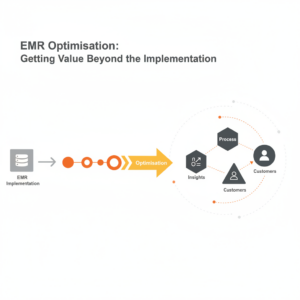
EMR optimisation means moving from “system installed” to “system improves care”. It focuses on usability, workflow fit, data quality, interoperability, and governance so clinicians spend less time navigating screens and more time delivering care. The fastest gains usually come from fixing high-friction workflows, tightening decision support, improving training, and tracking benefits with a disciplined value management approach.
Definition
What is EMR optimisation?
EMR optimisation is the structured, ongoing improvement of an electronic medical record so it reliably supports clinical work, safety, and operational performance after go-live. It includes redesigning workflows, simplifying documentation, improving templates and order sets, and correcting configuration that creates unnecessary clicks and cognitive load. Optimisation also covers data standards, reporting, interoperability, and security controls that keep the EMR safe and usable as services change.¹˒⁸
What outcomes should leaders expect from EMR optimisation?
Leaders should expect measurable improvements in clinician efficiency, patient flow, coding completeness, medication safety controls, and data quality for decision-making. These outcomes depend on addressing usability and workload drivers that persist after implementation. Studies show low perceived usability after go-live is associated with burnout and turnover intent, making optimisation a workforce stability issue, not just an IT activity.¹˒²
Context
Why does value often stall after EMR go-live?
Go-live usually completes technology delivery but not clinical performance improvement. Health services often lock configuration to stabilise operations, defer workflow redesign, and under-invest in continuous training. At the same time, new inbox volumes, documentation burdens, and navigation complexity accumulate across roles. Reviews of EHR-related burnout repeatedly identify documentation load, clerical burden, messaging, and usability complexity as prominent contributors.³˒⁴
What does “digital health” policy imply for EMR programmes in Australia?
Australian digital health policy emphasises consistent standards, interoperability, and safe handling of health information. National standards coordination and guidance from the Australian Digital Health Agency highlight the need for alignment across systems and technologies, not isolated optimisation inside one hospital.⁵˒⁶ In practice, this means optimisation must include standards-based integration, reliable identifiers, privacy-by-design, and consistent information governance across the care network.
Mechanism
How does EMR optimisation create value in health and care?
Optimisation creates value through four linked mechanisms. First, it reduces friction by aligning screens, templates, and tasks to real clinical sequences, which reduces time-on-task and cognitive load.¹˒⁷ Second, it improves safety by making decision support and order sets more consistent and clinically relevant, reducing workarounds. Third, it improves data quality by standardising documentation and coding inputs so downstream reporting is trustworthy. Fourth, it increases adoption and skill by shifting training from feature walkthroughs to workflow-based competence, reinforced by in-the-moment support.²˒³
What role does human-centred design play?
Human-centred design formalises how you discover user needs, test prototypes, and evaluate usability in real contexts. ISO 9241-210 frames human-centred design as a lifecycle discipline, not a one-off usability review, and it supports repeatable improvement cycles for complex systems like EMRs.⁸ When applied to EMR optimisation, it reduces “configuration by committee” and replaces it with evidence from observation, task analysis, and usability testing that predicts adoption and safety risk.
Comparison
EMR implementation vs EMR optimisation: what changes?
Implementation focuses on deploying software, migrating data, and training staff to complete baseline tasks. Optimisation focuses on outcomes and removes barriers that only appear under live operational load. Implementation success is often reported as uptime, ticket closure rates, and training completion. Optimisation success is reported as reduced documentation time, fewer high-severity workflow incidents, improved coding completeness, safer medication processes, and better patient flow.¹˒¹² The governance model also changes: optimisation requires clinical product ownership, prioritisation based on measurable value, and a backlog managed like a continuous improvement programme.
When is interoperability part of optimisation?
Interoperability becomes optimisation when care depends on information moving safely across settings, including ED, inpatient, community, and virtual care. HL7 FHIR is a widely used standard for exchanging healthcare information electronically and increasingly underpins modern API-based integration patterns.⁹ Interoperability work should be treated as a clinical safety and efficiency enabler, because missing results, delayed discharge summaries, or duplicate documentation often come from integration gaps rather than user training.
Applications
What should a practical EMR optimisation roadmap include?
A practical roadmap starts with high-frequency, high-friction workflows: medication reconciliation, discharge, referrals, clinical documentation, and results acknowledgement. It then stabilises decision support by removing low-value alerts and strengthening high-risk pathways. Next, it standardises templates and order sets using clinical governance, not personal preference. Finally, it strengthens the data layer by aligning definitions, reporting logic, and integration standards so operational leaders trust the metrics they use daily.⁵˒⁹
How do you prioritise optimisation work without overwhelming clinicians?
Use a simple value triage model: (1) patient safety risk, (2) workforce friction and burnout drivers, (3) flow and capacity constraints, and (4) revenue integrity and compliance. Validate priorities using short observational studies and task timing, then test improvements with small groups before scaling. Evidence from post-implementation studies shows disruption and workload can persist at one year when issues are not acknowledged and systematically resolved, so prioritisation must be transparent and clinician-led.²
Customer Science can support this operating model through EMR value discovery, workflow measurement, and insight reporting using Customer Science Insights: https://customerscience.com.au/csg-product/customer-science-insights/
Risks
What can go wrong with EMR optimisation?
The most common failure is treating optimisation as ticket management rather than clinical performance improvement. That approach increases local fixes, inconsistent build, and workflow variation that undermines safety and analytics. A second risk is “alert inflation” where decision support grows without governance, increasing override behaviour and cognitive load.³˒⁴ A third risk is privacy and security drift when integrations expand faster than controls, increasing exposure of sensitive health information that receives stronger protections under Australian privacy law.¹⁰
How should privacy and security shape optimisation decisions?
Optimisation should embed privacy-by-design and security-by-design. The Australian Privacy Principles are the foundation of privacy obligations under the Privacy Act and shape collection, use, disclosure, and storage expectations for personal information, including sensitive health information.¹⁰ ISO/IEC 27001 defines requirements for an information security management system and provides a structured way to manage security risk as systems evolve.¹¹ Together, they imply that every optimisation change should include access review, auditability checks, retention logic, and integration risk assessment, not just functional testing.
Measurement
What KPIs prove EMR optimisation is working?
Use a balanced scorecard across four domains. For clinician efficiency, track time-in-chart per encounter, clicks per core workflow, and after-hours documentation. For safety, track high-severity workflow incidents, medication reconciliation completeness, and alert acceptance for high-value rules. For flow, track ED-to-ward transfer time, discharge by midday, length of stay variability, and theatre start-time reliability where relevant. For data and finance, track coding completeness, problem list quality, and reporting accuracy. Evidence-based digital health evaluation frameworks emphasise explicit benefit definitions and consistent methods to quantify outcomes, not anecdotal satisfaction alone.¹²
How do you quantify value without creating measurement overhead?
Use benefits realisation management to define intended benefits, assign accountable owners, baseline performance, and track realised change over time. Benefits realisation management is designed to identify, measure, and track value derived from transformation initiatives, but it is often under-reported in practice.¹³ Automate measurement where possible using existing audit logs, operational systems, and analytics pipelines, and reserve surveys for targeted questions about usability and burden.¹
Next Steps
What should executives do in the next 90 days?
Start by establishing clinical product ownership for the EMR with a single prioritised optimisation backlog. Run a rapid discovery sprint focused on two or three priority workflows, combining observation, task timing, and incident review. Align optimisation governance to standards and security expectations, including interoperability patterns that support future digital health initiatives.⁵˒⁶˒⁹ Then publish a benefits register with baseline metrics and named owners so the organisation can see value realisation as a managed discipline, not an aspiration.¹³
For structured benefits governance and value tracking, Customer Science can support health services through Value Management Consulting: https://customerscience.com.au/solution/value-management-consulting/
Evidentiary Layer
What does research say about usability, burden, and post-go-live performance?
Peer-reviewed evidence shows usability problems can remain widespread months after go-live and correlate with burnout, insomnia, and turnover intention.¹ Qualitative work also reports disruptive experiences and persistent stress at one year when training and support do not address real workflow issues.² Reviews continue to link EHR burden to documentation and clerical load, inbox demand, and cognitive strain, reinforcing the need for targeted workflow optimisation rather than generic retraining.³˒⁴ Human-centred design standards provide a formal method to run these improvements as a lifecycle practice, which is better suited to the evolving nature of clinical work and digital ecosystems.⁸
FAQ
How long does EMR optimisation take to show benefits?
High-friction workflow fixes often show measurable improvements within weeks when baselines exist and changes are tightly scoped. Sustainable improvements typically require quarterly cycles that include design, testing, training reinforcement, and measurement.¹³
What is the first workflow to optimise in a hospital EMR?
Medication reconciliation, discharge, and results acknowledgement usually create the largest combined safety and time burden, so they often deliver the fastest value when simplified and standardised.¹˒²
How do you reduce clinician burnout linked to the EMR?
Focus on usability and workload drivers: reduce unnecessary documentation steps, streamline inbox handling, remove low-value alerts, and provide workflow-based training that reflects real clinical sequences.¹˒³˒⁴
How do standards like FHIR affect optimisation priorities?
FHIR supports API-based exchange of healthcare information and can reduce manual re-entry, missing information, and fragmented workflows when integrations are designed as clinical enablers rather than technical connectors.⁹
How do we keep privacy compliant while optimising the EMR?
Apply the Australian Privacy Principles to every change that affects collection, access, disclosure, and storage, and manage security risk through an ISMS-aligned approach such as ISO/IEC 27001.¹⁰˒¹¹
Which Customer Science capability helps teams sustain optimisation governance?
Knowledge Quest supports structured knowledge capture, governance, and operational learning so optimisation decisions remain consistent as teams change: https://customerscience.com.au/csg-product/knowledge-quest/
Sources
Salgado TM, et al. “Usability of an electronic health record 6 months post go-live…” BMJ Health & Care Informatics. 2024;32(1):e101200. https://informatics.bmj.com/content/32/1/e101200
“For the first time…I am seriously fighting burnout”: clinician experiences 1-year post EHR implementation. JAMIA Open. 2024;7(3):ooae067. https://academic.oup.com/jamiaopen/article/7/3/ooae067/7713901
Burnout Related to Electronic Health Record Use in Primary Care (review). Journal of Primary Care & Community Health. 2023. https://journals.sagepub.com/doi/10.1177/21501319231166921
Impact of Electronic Health Record Use on Cognitive Load and Burnout (review). JACC: Advances. 2024. https://www.sciencedirect.com/science/article/pii/S2291969424000413
Australian Digital Health Agency. National Framework for Digital Health Standards (Standards Framework). https://www.digitalhealth.gov.au/standards
Australian Institute of Health and Welfare. “Digital health” (Australia’s Health). https://www.aihw.gov.au/reports/australias-health/digital-health
ScienceDirect. A qualitative study exploring electronic health record optimisation processes. International Journal of Medical Informatics. 2025. https://www.sciencedirect.com/science/article/pii/S1386505625000851
ISO. ISO 9241-210:2019 Ergonomics of human-system interaction, Part 210: Human-centred design for interactive systems. https://www.iso.org/standard/77520.html
HL7. FHIR Overview (Specification). https://fhir.hl7.org/fhir/overview.html
Office of the Australian Information Commissioner. Australian Privacy Principles. https://www.oaic.gov.au/privacy/australian-privacy-principles
ISO. ISO/IEC 27001:2022 Information security management systems. https://www.iso.org/standard/27001
Coiera E, et al. Digital health benefits evaluation frameworks (Australia, My Health Record context). Medical Journal of Australia. 2019;210(6). https://www.mja.com.au/system/files/issues/210_06/mja250034.pdf
BMJ Open Quality. Identifying value in healthcare transformation initiatives: benefits realisation management. 2023;12(4):e002349. https://bmjopenquality.bmj.com/content/12/4/e002349