





















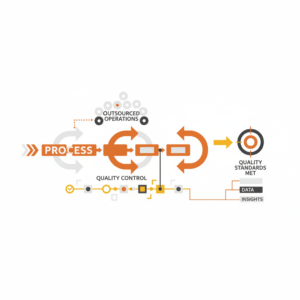
Maintaining quality control in outsourced operations requires a single, shared definition of “good”, tight controls over external delivery, and a closed-loop improvement system that links monitoring to coaching and process fixes. A strong outsourced QA framework aligns contracts, scorecards, calibration, and customer outcomes, while managing BPO quality risks like drift, data exposure, and inconsistent decisioning across sites and vendors.
What is an outsourced QA framework?
An outsourced QA framework is the operating system that defines, measures, and improves service quality when a third party delivers work on your behalf. It translates your brand promise into observable behaviours, verified outcomes, and enforceable controls. In practice, it combines four elements: service requirements, monitoring design, governance cadence, and corrective action.
For executive teams, the purpose is not higher scores. The purpose is predictable customer outcomes at scale, with clear accountability across organisational boundaries. ISO standards emphasise that organisations remain responsible for conformity even when processes are externally provided.¹ This is the core mindset shift needed to manage outsourced delivery without over-managing the vendor.
Why does service quality drift after outsourcing?
Service quality drift occurs when operational reality diverges from the client’s intent. Common drivers include ambiguous definitions, inconsistent coaching, vendor incentives that favour speed over resolution, and weak feedback loops between front-line interactions and upstream process owners. Research on outsourcing performance shows benefits are achievable, but outcomes vary based on governance choices and what is treated as “core” versus “non-core”.⁹˒¹⁰
Contact centre and customer-contact standards reinforce that service requirements must be explicit, measurable, and continuously improved, regardless of whether the centre is captive or outsourced.² When requirements are unclear, quality becomes subjective, and calibration collapses into opinion. That is when “managing BPO quality” becomes a weekly escalation cycle rather than a controllable system.
How do you define “quality” in outsourced operations?
Define quality as a balanced set of customer, compliance, and operational outcomes, supported by observable behaviours. Start with a hierarchy:
Customer outcomes: resolution, effort, trust, and satisfaction measurement.⁵
Risk outcomes: security, privacy, and regulated obligations.³˒⁴˒⁸
Operational outcomes: accuracy, timeliness, and process adherence.¹˒²
Then build a “definition of done” for each transaction type, including what must be said, done, recorded, and escalated. ISO 18295-1 is useful as a reference point because it frames contact centre service requirements and performance expectations for both in-house and outsourced models.² This prevents vendor-specific interpretations from becoming the default.
How should monitoring and sampling work in an outsourced QA framework?
Monitoring is credible only when sampling is statistically defensible, repeatable, and tied to risk. A practical design uses a three-layer model:
Baseline sampling: representative coverage of key queues and agents, sized to detect meaningful change rather than to “check a box”.¹¹
Targeted sampling: higher coverage for high-risk transactions, new hires, or known defect areas, aligned to external provider controls.¹
Automated signals: speech or text analytics for breadth, validated against manual scoring to avoid automation bias.⁶
This structure avoids two failure modes: sampling that is too small to be reliable, and sampling that is so heavy it becomes a cost centre that still fails to drive improvement.
What’s the difference between ISO, COPC, and internal scorecards?
Standards and frameworks serve different purposes:
ISO 9001 sets the expectation that externally provided processes must be controlled so outputs conform to requirements.¹ It strengthens supplier governance and corrective action discipline.
ISO 18295-1 focuses on service requirements for customer contact centres, including consistency and performance expectations.²
ISO/IEC 27001 provides requirements for an information security management system, which matters when vendors handle sensitive data.⁴
COPC provides a performance management system and benchmarking approaches commonly used in contact centres, including QA program design and maturity patterns.⁶˒⁷
Internal scorecards translate those expectations into your specific brand, products, and regulatory environment. The best approach is to anchor scorecard logic to standards, then tailor the behaviours and thresholds to your customer journeys.
What does “managing BPO quality” look like in daily operations?
Operationally, managing BPO quality means running quality like production, not like auditing. The minimum effective cadence includes:
Daily defect triage: top failure modes, customer impact, and containment actions.
Weekly calibration: align interpretation of criteria across client QA, vendor QA, and team leaders to protect inter-rater reliability.⁶
Fortnightly coaching impact review: confirm coaching changes behaviours, not just attendance.
Monthly joint governance: link quality to root causes, process owners, and investment decisions.¹
Where multi-vendor or multi-site models exist, the governance model must normalise performance data and compare like with like. Governance research shows multiple configurations can work, but only when roles, decision rights, and measurement are coherent.¹⁰
Applications: how to implement an outsourced QA framework that scales
Implementation should follow a controlled rollout:
Standardise the quality contract
Convert the scorecard into a contractual artefact: definitions, evidence required, scoring logic, sampling rules, dispute handling, and remediation timelines. Pair it with explicit controls for externally provided processes, consistent with ISO 9001 supplier control principles.¹
Build a calibration system before you scale monitoring
Run calibration on a fixed interaction set, track inter-rater agreement, and only then expand volumes. This avoids scaling disagreement. COPC benchmarking material is useful for common QA operating patterns and sampling considerations.⁶
Close the loop to upstream fixes
Quality insights must trigger process changes, knowledge updates, and product policy clarifications. Complaints handling and customer satisfaction measurement standards provide a structure for converting feedback into improvement actions.⁵˒¹²
To accelerate consistency across outsourcers and internal teams, Customer Science’s CommScore AI can support QA measurement, interaction insights, and coaching workflows: https://customerscience.com.au/csg-product/commscore-ai/
Risks: what can break outsourced quality control?
Cross-border data and privacy exposure
If personal information is disclosed offshore, Australian entities remain accountable for how the overseas recipient handles it, with limited exceptions.³ This is often underestimated when outsourcing includes QA access to recordings, transcripts, and screen captures. Tie QA tools and permissions to a security management system approach aligned with ISO/IEC 27001.⁴
Metric gaming and false confidence
If incentives reward speed without resolution, quality can improve “on paper” while customer outcomes degrade. Use a balanced metric set and validate QA scores against customer satisfaction and complaints signals.⁵˒¹²
Multi-vendor inconsistency
Different vendors can meet SLA while producing different customer experiences. Standardise definitions, normalise sampling, and apply governance that compares performance consistently across providers.¹⁰
Hidden organisational costs
Research highlights that vendor errors and customer mistreatment dynamics can create downstream costs in joint service delivery models.¹³ Treat workforce wellbeing, escalation load, and rework as part of the quality cost model.
Measurement: how do executives know the framework is working?
Use a measurement stack that links QA activity to business outcomes:
Quality validity: inter-rater agreement trend, dispute rate, and calibration stability.⁶
Customer outcomes: customer satisfaction monitoring and measurement discipline, plus complaints themes and rates.⁵˒¹²
Risk outcomes: privacy controls for offshore disclosure scenarios and security control effectiveness.³˒⁴
Financial outcomes: rework volume, repeat contacts, and defect containment cost.
A strong sign of maturity is when quality issues are tracked as defect categories with owners, due dates, and verified closure, similar to a production incident model. ISO 9001 reinforces the need for corrective action and control over external providers as part of a quality management system.¹
If you want structured support to set governance, scorecards, and operating cadence, Customer Science CX Consulting and Professional Services can help: https://customerscience.com.au/service/cx-consulting-and-professional-services/
Next steps: a 30–60 day plan for stabilising outsourced quality
In the first 30 days, focus on definition and control: agree the scorecard, sampling logic, and escalation pathways; then run calibration to stabilise scoring. In days 31–60, focus on closure: establish defect triage, coaching verification, and root-cause workflows that connect vendor findings to client process owners.
Where regulated data or payment data is involved, align vendor controls to recognised security requirements and auditability. PCI DSS provides a baseline of technical and operational requirements for protecting payment account data, which commonly intersects with contact centre workflows.⁸ Pair this with ISO/IEC 27001-style risk management so the QA program does not create a new exposure path.⁴
Evidentiary Layer
Quality control in outsourced operations improves when organisations (1) treat service requirements as explicit and measurable, (2) apply external provider controls consistent with quality management expectations, (3) use defensible sampling and calibration to maintain scoring integrity, and (4) close the loop from monitoring to coaching and upstream fixes. Standards for contact centres, customer satisfaction monitoring, complaints handling, and information security provide a stable reference set for building an outsourced QA framework that scales.¹˒²˒⁴˒⁵
FAQ
How many interactions should we monitor per agent?
Use a risk-based approach: baseline sampling sized to detect meaningful change, then targeted sampling for high-risk work and new staff. Validate automated signals against manual scoring to maintain credibility.⁶˒¹¹
Who owns quality when a BPO runs the operation?
The client retains accountability for requirements and outcomes, while the vendor is accountable for execution within agreed controls. Supplier control principles require the client to ensure externally provided services conform to requirements.¹
How do we stop vendor QA and client QA disagreeing?
Calibrate on a shared interaction set, use clear evidence rules, track inter-rater agreement, and lock scoring definitions before scaling monitoring volumes.⁶˒²
What should we include in a quality clause in the outsourcing contract?
Define the scorecard, sampling, calibration cadence, dispute process, remediation timelines, and data access controls, including cross-border disclosure safeguards where relevant.¹˒³
How do we prove QA improves customer outcomes?
Link QA defect categories to customer satisfaction measurement and complaints themes, then verify closure reduces repeat contacts, rework, and complaint recurrence over time.⁵˒¹²
For executive-ready reporting that connects QA defects to CX outcomes, Customer Science Insights can help consolidate performance signals across vendors and channels: https://customerscience.com.au/csg-product/customer-science-insights/
Sources
ISO. ISO 9001:2015 Quality management systems — Requirements. https://www.iso.org/standard/62085.html
ISO. ISO 18295-1:2017 Customer contact centres — Part 1: Requirements for customer contact centres. https://www.iso.org/standard/64739.html
Office of the Australian Information Commissioner (OAIC). APP Guidelines, Chapter 8: APP 8 Cross-border disclosure of personal information. https://www.oaic.gov.au/privacy/australian-privacy-principles/australian-privacy-principles-guidelines/chapter-8-app-8-cross-border-disclosure-of-personal-information
ISO. ISO/IEC 27001 (Information security management systems). https://www.iso.org/standard/27001
ISO. ISO 10004:2018 Customer satisfaction — Guidelines for monitoring and measuring. https://www.iso.org/standard/71582.html
COPC Inc. Global Benchmarking Series: Contact Center Quality Assurance (report landing page). https://www.copc.com/lp/global-benchmarking-series/
COPC Inc. Global Benchmarking Series 2022: Contact Center Quality Assurance (PDF). https://cx.copc.com/hubfs/Global%20Benchmarking%20Series%202022_Contact%20Center%20Quality%20Assurance.pdf
PCI Security Standards Council. PCI SSC Document Library (PCI DSS and related standards). https://www.pcisecuritystandards.org/document_library/
Lahiri, S. et al. Performance implications of outsourcing: A meta-analysis. Journal of Business Research (2022). https://doi.org/10.1016/j.jbusres.2021.10.061
Yan, A. Effective Outsourcing Governance: A Configurational Approach. PACIS 2018 Proceedings (AIS eLibrary). https://aisel.aisnet.org/pacis2018/147/
Select Statistical Services. Using Statistical Sampling for Monitoring Call Centre Quality (case study). https://select-statistics.co.uk/case-studies/using-statistical-sampling-for-monitoring-call-centre-quality/
Standards Australia. AS 10002:2022 Guidelines for complaint management in organizations (preview PDF). https://www.standardsau.com/preview/AS%2010002-2022.pdf
O’Brady, S., Doellgast, V., & Blatter, D. The high costs of outsourcing: Vendor errors, customer mistreatment, and well-being in call centers. Industrial Relations (2024). https://doi.org/10.1111/irel.12338