































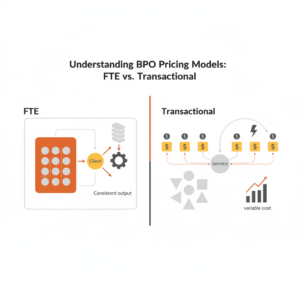
Choosing between FTE and transactional pricing comes down to who carries demand risk, how predictable your work is, and how tightly you can define “done”. FTE models buy capacity and control, but can hide productivity loss. Transactional models buy outputs and scale, but can create quality shortcuts unless controls and data are strong. Australian wage pressures and regulatory expectations make transparent visibility, governance, and measurement essential.⁴
Definition
What are the main call centre pricing models in BPO?
In BPO, “pricing model” means how you convert work into a chargeable unit, and how risk is shared between client and provider. In contact centres, the two common commercial baselines are:
FTE (or “per seat”) pricing: you pay for dedicated labour capacity, typically per agent per month (often with defined skill bands and hours). This looks like hiring, with the provider managing employment and operations.
Transactional pricing: you pay per completed unit of work, such as per call handled, per case closed, per chat, or per email processed. This looks like buying outputs, with the provider optimising staffing, tooling, and process design to deliver the units.
Both can be built to align with service requirements and customer outcomes, including for outsourced centres, as reflected in ISO 18295-1’s service framework.¹
What does “BPO cost structure Australia” mean in practice?
For Australian-based delivery, cost structure is heavily influenced by labour rates set through industrial instruments and market pressures. The Contract Call Centres Award defines the coverage and pay framework for many contract call centre roles.³ At the macro level, wage inflation affects baseline operating cost over time, and the ABS Wage Price Index provides a consistent view of wage movement across the economy.⁴ For offshore or blended delivery, additional cross-border, privacy, and governance obligations can become material cost drivers.⁸˒⁹
Context
When do enterprises prefer FTE pricing?
FTE models are usually chosen when demand is variable but the organisation wants stable capacity and tighter control over day-to-day operations. This often applies to complex voice work, regulated conversations, or knowledge-heavy support where training and quality assurance are substantial. In these contexts, the value is not only “contacts handled” but consistency, compliance, and coaching, which are easier to manage when you are buying capacity rather than outputs. ISO 18295-2 also frames client responsibilities in setting expectations and managing arrangements with contact centres, which becomes operationally clearer when roles and hours are explicit.²
When does transactional pricing work best?
Transactional pricing fits best when work is definable, measurable, and repeatable, such as straightforward service requests, back-office case steps, or digital interactions with standard handling paths. It is especially attractive when you have strong forecasting, clean demand data, and consistent definitions for what counts as a completed transaction. Transaction-based pricing is commonly discussed in BPM and contact centre outsourcing contexts as a way to decouple revenue from headcount and encourage provider productivity.⁵
Mechanism
How is an FTE price built up?
An FTE rate typically rolls together base wages, on-costs, leave, supervision, WFM, technology overhead, facilities, and provider margin. In Australia, the wage floor and entitlements matter because small changes in wage settings compound across large FTE bases.³˒⁴ FTE models also need clear “included services”, such as hours per week, languages, channels, training time, shrinkage assumptions, and how after-call work is treated.
A hidden driver is availability. Contact centre staffing must account for queueing dynamics and service-level targets, where occupancy and waiting time are non-linear. Classic call centre operations research shows that small changes in load or staffing can produce large changes in delay and service performance.⁶ If the contract buys “people” but not “availability at the right interval”, you can overpay while still missing service levels.
How is a transactional price built up?
Transactional pricing starts with a unit definition, then prices the expected cost-to-serve per unit, including variability buffers. The provider carries more volume risk and is incentivised to automate, standardise, and redesign. That can be positive, but only if quality and customer outcomes are contractually protected.
A practical warning is metric gaming. If you pay “per call”, you may create incentives to shorten calls, increase transfers, or avoid complex issues. Good governance designs avoid single-metric traps by pairing transaction units with quality, compliance, and resolution measures. Evidence from BPO performance research suggests outcome controls can be more effective than process controls, but capability risks on both sides moderate performance.⁷ This points to a simple truth: transactional pricing needs stronger measurement capability than FTE pricing.
Comparison
FTE vs transactional pricing: who carries the risk?
FTE shifts utilisation risk to the client. If demand drops, you still pay for the capacity unless the contract has flex bands. Transactional shifts utilisation risk to the provider. If volumes spike, you pay more, but you do not fund idle time.
Quality risk can invert. With FTE, you can mandate coaching, QA coverage, and training time. With transactional, you must explicitly pay for or enforce these behaviours, or they will be squeezed out by unit economics.
Which model is more transparent for cost control?
FTE is transparent for budget planning but can be opaque for productivity. Transactional is transparent for unit economics but can be opaque for quality unless you build measurement discipline.
For Australian leadership teams, the most useful lens is “controllability”. If you can control demand drivers, standardise work, and define completion, transactional gives cleaner economics. If you cannot, FTE or hybrid models reduce operational fragility.
Applications
What’s a practical way to choose the right model?
Use a segmentation approach across interaction types:
High complexity, high risk, high judgement: lean FTE with strong governance and quality investment.
Medium complexity, repeatable with clear completion: hybrid, such as base FTE plus per-transaction bands.
Low complexity, high volume, stable definitions: transactional with strong outcome and quality controls.
To make this real, build an “interaction bill of materials” for each segment: handle time distribution, after-call work, rework rate, knowledge requirements, and escalation paths. The goal is to prevent a commercial model that fights the operating model.
To quantify and manage the drivers, operational analytics and interaction intelligence tools can expose where time and cost actually go across call types, channels, and failure demand. A practical starting point is Customer Science Insights: https://customerscience.com.au/csg-product/customer-science-insights/
Risks
What can go wrong with FTE pricing?
The core risk is paying for time, not outcomes. You can end up funding avoidable work, rework, or poor channel shift. If WFM assumptions are weak, you may buy FTE but still miss service levels due to shrinkage, schedule fit, or skill routing constraints. Queueing effects and staffing sensitivity are well-established in the call centre literature, which is why modelling discipline matters.⁶
Another risk is complacency. If the contract does not tie a portion of value to measurable service outcomes, continuous improvement can stall, even when governance meetings look healthy.
What can go wrong with transactional pricing?
The core risk is unit definition errors. If “transaction” is not tightly defined, you will get disputes, reclassification, and distorted incentives. Another risk is that providers may optimise for unit throughput at the expense of customer outcomes unless you explicitly price or penalise failure demand, repeat contacts, and low resolution.
In regulated sectors, outsourcing also introduces privacy, security, and governance exposure. Australian Privacy Principles guidance highlights ongoing obligations for organisations handling personal information, including in outsourced arrangements.⁸ APRA CPS 234 reinforces that regulated entities remain responsible for information assets managed by third parties.⁹ ASIC has also highlighted governance gaps in offshore outsourcing and the expectation of stronger oversight.¹⁰
Measurement
What should you measure to compare models fairly?
Measure both unit economics and customer outcomes, using the same definitions across internal and outsourced delivery.
Core cost measures:
Fully loaded cost per resolved case (not per contact)
Avoidable contact rate and rework rate
Cost of quality, including QA coverage and coaching time
Core service measures:
Service level and response time by channel
First contact resolution and repeat contact rate
Customer effort and complaint drivers
Governance measures:
Compliance defect rate and privacy incidents
Provider change velocity and automation adoption
Where possible, anchor the contract to outcome controls, because empirical BPO research finds outcome control can outperform process control in driving performance, subject to capability risks.⁷ In public and regulated contexts, evidence also suggests outcome-focused contracting can outperform process or output-based approaches when incentives and goal design are done well.¹¹
For measurement design and governance operating rhythms, professional support can accelerate the setup and avoid misaligned KPIs: https://customerscience.com.au/service/cx-consulting-and-professional-services/
Next Steps
How should you structure a contract to avoid surprises?
Start with a short commercial principles schedule: unit definitions, included activities, excluded activities, flex bands, and a change mechanism. Then build a measurement appendix that defines data sources, audit rights, sampling, and dispute resolution.
For FTE:
Define productive hours, shrinkage assumptions, and how training time is treated.
Tie a portion of fee to outcomes that matter, not vanity metrics.
For transactional:
Define “done” and “not done” with examples.
Add a quality gate and rework policy so the provider cannot invoice for failed work.
Use a hybrid cap and collar to control volatility while still rewarding productivity.
Evidentiary Layer
What evidence supports choosing one model over the other?
The operational science underpinning contact centres shows that staffing, occupancy, and delay behave non-linearly, which is why capacity decisions in FTE models can be costly if not modelled properly.⁶ International standards provide a shared language for service quality and for client responsibilities in outsourced contact centre arrangements.¹˒² Australian wage movements and award frameworks shape baseline delivery economics and therefore influence BPO pricing in local delivery scenarios.³˒⁴ Finally, empirical outsourcing research supports the use of outcome controls, but highlights that capability and governance quality influence realised performance.⁷˒¹¹
FAQ
Which pricing model is cheaper for Australian contact centres?
Neither is automatically cheaper. FTE can look cheaper on paper but hide idle time and rework. Transactional can reduce waste but may raise unit prices to cover provider risk and quality investment. Wage growth trends matter for both models.⁴
Is per-call pricing a good idea for complex service work?
Per-call pricing is risky for complex work because it can reward short calls and discourage full resolution. Use per-resolved-case or hybrid structures and enforce quality gates and rework rules.⁷
How do you stop a transactional model from reducing quality?
Define completion tightly, add quality thresholds, penalise rework, and measure outcomes like repeat contact and complaints. Align incentives to customer outcomes, not just throughput.¹¹
What governance is expected when outsourcing offshore?
You remain accountable. Privacy obligations continue under Australian privacy guidance, and regulated entities must manage third-party information security under APRA CPS 234 where applicable.⁸˒⁹ ASIC has also warned about governance gaps in offshore outsourcing.¹⁰
What tooling helps validate transaction definitions and cost drivers?
Interaction intelligence and operational analytics help validate demand drivers, rework, and avoidable contacts across channels so that “transactions” reflect real work and real outcomes. Commscore AI is one example for conversation-level insight: https://customerscience.com.au/csg-product/commscore-ai/
Should we choose a hybrid model by default?
For many enterprises, yes. A base FTE layer protects quality and capability, while transactional bands drive productivity and handle variability. The key is measurement discipline and clear change control.²
Sources
ISO. ISO 18295-1:2017 Customer contact centres, Part 1: Requirements. https://www.iso.org/standard/64739.html
ISO. ISO 18295-2:2017 Customer contact centres, Part 2: Requirements for clients using customer contact centres. https://www.iso.org/standard/64740.html
Fair Work Ombudsman. Contract Call Centres Award [MA000023] summary. https://www.fairwork.gov.au/employment-conditions/awards/awards-summary/ma000023-summary
Australian Bureau of Statistics. Wage Price Index, Australia, latest release (Sep 2025 quarter referenced). https://www.abs.gov.au/statistics/economy/price-indexes-and-inflation/wage-price-index-australia/latest-release
ISG. Dynamics of emerging pricing models in business process management (report). https://isg-one.com/docs/default-source/default-document-library/dynamics-of-emerging-pricing-models-in-bpm.pdf?sfvrsn=0
Gans, N., Koole, G., Mandelbaum, A. Telephone Call Centers: Tutorial, Review, and Research Prospects. Manufacturing & Service Operations Management, 2003. DOI: 10.1287/msom.5.2.79.16071
Liu, S., Wang, L., Huang, W. Effects of process and outcome controls on business process outsourcing performance. European Journal of Operational Research, 2017. DOI: 10.1016/j.ejor.2017.01.020
Office of the Australian Information Commissioner. Australian Privacy Principles Guidelines. https://www.oaic.gov.au/privacy/australian-privacy-principles/australian-privacy-principles-guidelines
APRA. Prudential Standard CPS 234 Information Security. https://handbook.apra.gov.au/standard/cps-234
ASIC. Media release 25-234MR: ASIC flags risks in offshore outsourcing after review identifies governance gaps (10 Oct 2025). https://asic.gov.au/about-asic/news-centre/find-a-media-release/2025-releases/25-234mr-asic-flags-risks-in-offshore-outsourcing-after-review-identifies-governance-gaps/
Journal of Public Administration Research and Theory. Performance of Performance-Based Contracting in Public Outsourcing (advance article, 2025). DOI: 10.1093/jopart/muaf037