
























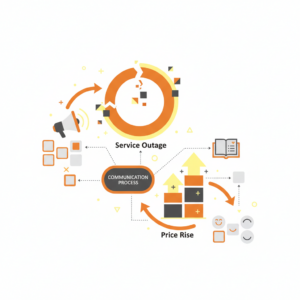
When service fails or prices rise, customers judge your organisation less by the event and more by clarity, timing, and fairness of your response. Use a single accountable voice, publish frequent updates with known facts, explain customer impact in plain language, and offer practical next actions. For price rises, lead with transparency, options, and an easy exit path where relevant.
Definition
What does “bad news” mean in CX communications?
Bad news is any message that changes a customer’s expected value from your service. In practice, that includes a service outage, a security incident, a policy shift, or a price rise. The common feature is perceived loss of control. Customers move quickly from “What happened?” to “What does this mean for me?” and “Can I trust you next time?” That pattern is predictable in service recovery research and crisis communication theory, which is why repeatable playbooks outperform improvised messages.⁹˒¹⁰
What outcomes should leaders optimise for?
The objective is not “a perfect explanation.” The objective is stable trust. That means customers receive timely, accurate, accessible information, and the organisation demonstrates procedural fairness. Complaint handling and recovery evidence consistently links fairness, respect, and clear process to stronger satisfaction and lower negative word of mouth.¹⁰˒¹¹
Context
Why do customers react so strongly to outages and price rises?
Outages create uncertainty and immediate operational risk. Price rises trigger perceived unfairness, especially if customers believe they are subsidising others or being trapped by contract terms. Regulators also expect pricing information to be clear and not misleading, including the reasons given for changes.¹ In regulated sectors, additional obligations may apply to notifying customers of price changes.²
When does a communications issue become a governance issue?
When your message affects safety, financial hardship, or access to essential services, communications becomes governance. In Australia, major telecommunications outages have explicit expectations for keeping customers and the public informed with regular, accessible updates across channels.⁴ That expectation reflects a broader standard across resilience and incident response frameworks: communicate early, coordinate internally, and keep improving.⁵˒⁷
Mechanism
How do trust, fairness, and responsibility attribution shape outcomes?
Customer responses cluster around three drivers:
First, attribution. If customers think the organisation caused the issue or acted carelessly, reputational threat rises and “rebuild” strategies, such as apology plus corrective action, become necessary.⁹
Second, fairness. Evidence shows customers evaluate recovery through distributive fairness (what they receive), procedural fairness (how decisions are made), and interactional fairness (how they are treated).¹⁰
Third, participation. Allowing customers to choose an option, change plans, defer charges, or access alternatives increases perceived control and can improve recovery outcomes.¹²
How do standards translate into practical communications discipline?
Resilience and incident management standards emphasise prepared roles, escalation, stakeholder communication, and lessons learned.⁵˒⁶˒⁷ In cybersecurity, current guidance frames incident response as an ongoing capability aligned to risk management, including communication during recovery.⁷˒⁸ The practical implication is simple: communications quality is a capability you design, not a script you write on the day.
Comparison
What is different about outage messages vs price rise messages?
Outage communications must prioritise speed, accuracy, and update cadence. Customers accept incomplete information when you label it clearly as “known” versus “under investigation,” then close gaps through frequent updates. Australian telco guidance and rules reinforce timely, up-to-date, accessible communications through a mix of direct and public channels.⁴
Price rise communications must prioritise transparency, options, and contractual fairness. The risk is less “we did not update fast enough” and more “we sounded evasive, manipulative, or unclear.” Regulators emphasise clear and accurate pricing information and avoiding misleading explanations.¹˒²
What is the shared structure that works for both?
Both scenarios perform best with a single structure:
Acknowledge the event
State customer impact plainly
Explain what you know now and what you are doing next
Provide customer actions and support paths
Commit to the next update or next decision point
This structure reduces cognitive load and increases perceived procedural fairness.¹⁰˒¹¹
Applications
How do you build “service outage communication templates” that scale?
A scalable template is modular, not verbose. Use the same headings every time, with short fields your team can fill quickly.
Operational status update template
What’s happening: one sentence, no internal jargon
Who is affected: segments, locations, products
Customer impact: what customers can and cannot do
Workaround: steps, alternatives, safety notes
What we’re doing: actions, not speculation
Next update: exact time, plus where updates appear
Support: self-serve link, contact options, priority cohorts
If you operate in Australian telecommunications, align cadence and accessibility with outage communications expectations, including disability and culturally and linguistically diverse needs.⁴
What should “writing price increase letters” include to reduce churn?
Price increase letters succeed when they avoid three failure modes: vague justification, hidden conditions, and hard-to-find alternatives.
A practical structure:
Clear headline: “Price change effective [date]”
What changes: old price, new price, frequency, taxes or fees included where relevant
Why it changes: specific cost drivers, not generic “increasing costs” language, and do not over-claim
What customers can do: change plan, reduce features, defer or negotiate in hardship settings, or cancel
Where to get help: a single path, with wait-time expectations if possible
Confirmation: how customers will see the change on the next bill
This aligns with the expectation that price information and reasons are not misleading.¹ In sectors like energy, there are explicit reminders about notifying customers and providing clear information to support informed choices.²
How do you operationalise the playbook across channels?
Most failures are coordination failures. Make one team accountable for customer-facing facts, and one team accountable for internal decision logs. Align updates across status pages, email, SMS, IVR, app banners, and frontline scripts.
For organisations that want to standardise drafting, readability, and channel consistency, tools like https://customerscience.com.au/csg-product/commscore-ai/ can support faster, more consistent CX communications workflows.
Risks
What are the most common mistakes that amplify customer harm?
The highest-risk mistakes are predictable:
Overpromising restoration times and then slipping
Mixing cause speculation into customer messages
Using legal or technical language that hides impact
Offering compensation without a clear eligibility rule
Making cancellation or plan change difficult, which escalates unfairness risk in variation scenarios.³
Complaint handling guidance also shows that customers escalate when they cannot find a clear process, a timeframe, or a decision owner.¹¹
How do you manage regulatory and reputational exposure without sounding defensive?
Use “facts, impact, actions, next update” language, and keep any legal framing separate from customer empathy. Where you must reference obligations, describe what customers will receive, not what you are “allowed” to do. For outages in sectors with specific rules, treat communications compliance as part of resilience, not a PR add-on.⁴˒⁵
Measurement
What should you measure to prove your communications reduced damage?
Measure outcomes at three layers:
Customer layer
Contact deflection: % of customers served by status updates before contacting
Trust signals: post-incident sentiment, complaint rate per 1,000 customers
Churn and downgrade rates after price rise notices (by segment)
Operational layer
Time to first customer update and update cadence consistency⁴
Accuracy: corrections issued per incident, and time to correction
Channel alignment: script drift between frontline and digital surfaces
Governance layer
Post-incident reviews completed and actions closed, consistent with continuous improvement expectations in incident response guidance.⁷˒⁸
For organisations that need structured measurement and governance support, a managed CX communications approach such as https://customerscience.com.au/solution/cx-communications/ can help standardise metrics, templates, and operating rhythms.
Next Steps
How do you implement this in 30 days without slowing delivery teams?
Week 1: define severity tiers, message owners, and approval thresholds.
Week 2: create templates for the top five incident types and one price rise pack.
Week 3: run a simulation with real channels and frontline scripts, then run a retrospective.⁷
Week 4: publish a single source of truth for customer updates and link every channel back to it.
The most important discipline is deciding, in advance, who can publish what, at which severity. Standards-based resilience programs treat this as a core capability, not optional documentation.⁵
Evidentiary Layer
What does the evidence say about what works?
Crisis response evidence shows that matching response strategy to perceived responsibility improves reputational outcomes, especially when corrective action and empathy are appropriate.⁹
Service recovery evidence shows that perceived justice is a reliable predictor of satisfaction and downstream behaviour, making fairness-oriented communications a direct lever on churn and negative word of mouth.¹⁰
Complaint handling guidance converges on the same idea: customers need a clear process, respectful tone, and timely resolution updates to reduce escalation and improve trust.¹¹
In Australia, outage communications expectations in telecommunications explicitly require regular, timely, accessible updates and a mix of direct and public channels, which validates the “cadence plus clarity” approach as an enforceable standard, not a preference.⁴
FAQ
What is the minimum message you should send during a major outage?
Send an acknowledgement, customer impact, immediate workarounds, and the next update time, then keep cadence stable.⁴
Should you apologise in a price increase letter?
Use a brief acknowledgement of impact, but prioritise transparency and options. An apology without options can increase perceptions of unfairness.¹⁰
How often should you update customers during an outage?
Set an update cadence based on severity and stick to it, even if the update is “no change.” Timely, up-to-date updates are a stated expectation in major outage communications guidance in Australia.⁴
Do you need to explain the technical root cause during an incident?
Explain customer impact and operational actions first. Share cause only when confirmed, and separate “known” from “investigating” to avoid corrections that erode trust.⁷
What options reduce churn after a price rise?
Offer plan alternatives, a downgrade path, and clear cancellation steps. Customers value participation and control, which is linked to improved recovery outcomes.¹²
How can you keep templates and scripts current across teams?
Use a controlled knowledge base with versioning, ownership, and rapid publishing workflows. Platforms such as https://customerscience.com.au/csg-product/knowledge-quest/ can support governed distribution of outage scripts, price packs, and frontline decision trees.
Sources
Australian Competition and Consumer Commission. “Pricing” (guidance for businesses and consumers). https://www.accc.gov.au/business/pricing (accessed Jan 2026).
Australian Energy Regulator. “Communicating pricing changes” (Compliance bulletin, May 2023). https://www.aer.gov.au/system/files/AER%20_%20ACCC%20-%20Compliance%20bulletin%20-%20Communicating%20pricing%20changes%20-%20May%202023%20-%20PDF.pdf
Australian Government, consumer.gov.au. “Unfair contract terms” (ACL guide, PDF). https://consumer.gov.au/sites/consumer/files/2016/05/0553FT_ACL-guides_ContractTerms_web.pdf
Australian Communications and Media Authority. “Rules for significant and major outages” and guidance on customer communications. https://www.acma.gov.au/rules-significant-and-major-outages
International Organization for Standardization. ISO 22301 Business continuity overview (PUB100442, PDF). https://www.iso.org/files/live/sites/isoorg/files/store/en/PUB100442.pdf
ISO/IEC 27035-1:2023 Information security incident management (standard page). https://www.iso.org/standard/78973.html
National Institute of Standards and Technology. NIST SP 800-61 Rev. 3 “Incident Response Recommendations and Considerations” (2025, PDF). https://nvlpubs.nist.gov/nistpubs/SpecialPublications/NIST.SP.800-61r3.pdf
NIST. “Cybersecurity Framework (CSF) 2.0” (2024, PDF). https://nvlpubs.nist.gov/nistpubs/CSWP/NIST.CSWP.29.pdf
W. Timothy Coombs. “Protecting Organization Reputations During a Crisis: The Development and Application of Situational Crisis Communication Theory.” Corporate Reputation Review (2007). DOI: 10.1057/palgrave.crr.1550049
Gelbrich, K. “A Meta-Analysis of Organizational Complaint Handling and Customer Responses.” Journal of Service Research (2011). DOI: 10.1177/1094670510387914
Commonwealth Ombudsman. “Better Practice Complaint Handling Guide” (2021, PDF). https://www.ombudsman.gov.au/__data/assets/pdf_file/0025/288241/Better-Practice-Complaint-Handling-Guide-2021.pdf
Van Vaerenbergh, Y. et al. “Customer Participation in Service Recovery: A Meta-Analysis.” Marketing Letters (2018). DOI: 10.1007/s11002-018-9470-9