



























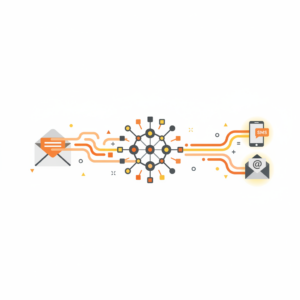
A paper-to-digital migration succeeds when it preserves legal certainty, improves readability, and protects customers who cannot or will not go digital. The practical path is to redesign letter content into channel-ready “message units”, apply consent and identity rules by message type, and measure outcomes across delivery, comprehension, and contact drivers. Done well, email and SMS reduce cycle time and complaints while increasing trust and accessibility.
What does “digital customer correspondence” mean?
Digital customer correspondence is the set of formal, customer-facing messages that historically shipped as paper letters and now must work across email, SMS, and in-app delivery while keeping the same intent and evidentiary value. In regulated environments, a “letter” is not a channel. It is a decision record and a customer instruction set that must remain attributable, readable, and provable.
Digitising customer correspondence is therefore not a simple format conversion. It is a controlled redesign of content, governance, and delivery controls so that key obligations remain satisfied in new channels, including accurate sender identification¹, functional unsubscribe facilities for commercial messages¹, and privacy-safe handling of personal information under the Australian Privacy Principles³.
Why are organisations moving from paper letters to email and SMS now?
Paper letters are slow, expensive, and often misaligned with modern expectations for real-time service. Digital channels reduce latency and enable customers to act immediately, which can reduce inbound contacts triggered by delays, missing context, or unclear instructions. At the same time, the move increases exposure to security, privacy, and accessibility risks that paper did not create at scale.
The context has shifted because internet access is close to universal for many Australians, but not for all. Evidence on digital inclusion shows persistent gaps by income, region, disability, and age, even when access levels are high overall¹³. A paper to digital migration strategy that ignores these gaps can increase complaints, create hardship, and raise remediation costs later through manual exceptions and dispute handling obligations⁹.
How should leaders define scope and governance for a paper to digital migration strategy?
Scope should be defined by message purpose, not by the current template library. Most organisations mix at least four message classes inside “letters”: service and fulfilment updates, compliance or enforcement notices, financial and billing communications, and marketing or cross-sell. The class determines consent rules, retention, and what “good” looks like.
Governance should set a single source of truth for content, rules, and approvals. This is especially important where one message contains both factual information and promotional material. The distinction matters because commercial electronic messages must meet consent and unsubscribe expectations¹˒², while many purely service messages are generally not spam when they contain no advertising and are operational in nature⁶. A governance model should therefore include a “promotion test” as a mandatory step in content approval¹˒⁶.
How do you redesign a paper letter into channel-ready content?
The practical mechanism is to decompose the letter into reusable message units: decision summary, reason, customer actions, deadlines, evidence references, help and escalation paths, and preferences controls. These units should be written once in plain language and then rendered differently by channel constraints, rather than rewriting from scratch for each channel.
Plain language is not a stylistic preference. It is a performance control that improves comprehension and reduces error rates. Randomised evidence shows that plain language versions can materially improve understanding and usability in high-stakes information contexts¹². For regulated communications, this directly reduces avoidable contacts and improves procedural fairness, because customers can more reliably identify what happened, why, and what to do next.
Email and SMS versus paper: what changes in risk and performance?
Email supports structured explanation, deep links, attachments where appropriate, and richer accessibility patterns than SMS. It also introduces deliverability and spoofing risks that must be engineered out. Domain-based email authentication and policy controls such as DMARC define how receivers validate mail using SPF and DKIM alignment¹⁴. Treat this as a control, not an IT configuration task, because failed authentication can quietly divert critical notices to spam folders.
SMS is high-attention but low-context. It performs best as a prompt that references a clear next step, such as “view notice”, “confirm receipt”, or “contact us”. Evidence from trials shows that SMS can improve participation in some settings, but results vary by audience and design, so testing is essential⁵. SMS should rarely carry the full reasoning of a complex decision. It should carry only what is safe, necessary, and actionable, with an immediate route to the canonical message record.
What does compliant email and SMS look like in Australia?
Commercial messages must include accurate sender information¹ and a functional unsubscribe facility¹, and organisations should be able to evidence consent when asked². These requirements apply even when a third party sends on your behalf², which makes vendor oversight and auditability part of the correspondence operating model.
Privacy compliance must be designed into templates and journeys. Direct marketing controls under APP 7 require organisations to respect opt-out requests and manage how personal information is used for marketing³. Separately, the Notifiable Data Breaches scheme sets expectations for notification when an eligible breach is likely to result in serious harm⁴. In practice, this means minimising personal data in message bodies, using secure links for sensitive content, and ensuring rapid incident response runbooks exist for correspondence systems that handle customer identity and contact details⁴.
How do you make digital correspondence accessible and inclusive?
Accessibility is a core quality gate because digital letters are now part of essential service delivery. WCAG 2.2 defines testable success criteria for perceivable, operable, understandable, and robust content⁵. Australian guidance recommends WCAG 2.2 conformance at Level AA as a baseline⁷, which affects headings, link purpose, focus order, text alternatives, and authentication friction.
Inclusion requires more than accessibility conformance. It requires channel choice. The Australian Digital Inclusion Index highlights that access, affordability, and digital ability vary significantly across cohorts¹³. The operational implication is a managed “equivalence pathway”: customers must be able to receive paper or assisted digital options without penalty, and staff must have tooling to see what was sent, when, and in what form to avoid rework and dispute escalation⁹.
Applications
A robust application pattern is to treat digitising customer correspondence as a product system: content design, orchestration rules, preference management, evidence capture, and measurement. Start with the highest-volume templates that drive the most calls and complaints, then move to high-risk notices where timeliness and proof of delivery matter. Field evidence from large-scale letter experiments shows that simplifying follow-up communications and scripts can meaningfully change outcomes in real operational contexts¹¹.
Operationally, create a “correspondence catalogue” that maps each message to: purpose, legal class, channel eligibility, consent rule, data classification, retention period, accessibility checks, and escalation paths. Then implement a content supply chain where each change is traceable and testable under human-centred design principles⁸.
For CX communications teams needing industrialised redesign and governance, Customer Science’s CommsCore AI can support systematic template refactoring, policy-driven variants, and controlled rollout across channels: https://customerscience.com.au/csg-product/commscore-ai/
Risks
The most common failure mode is “digital skinning”, where paper letters are copied into email as PDFs or long blocks of text. This preserves internal comfort but increases customer effort, reduces mobile readability, and creates accessibility barriers⁵˒⁷. It also tends to mix transactional and promotional content, which can accidentally trigger Spam Act compliance obligations for messages that were previously treated as service notices¹˒⁶.
A second risk is security erosion through convenience. If links are not protected, customers may receive messages that expose personal data or enable account takeover. Align correspondence controls to a recognised information security management framework⁸ and baseline cyber controls such as the Essential Eight for patching, application control, and privileged access governance⁹. This reduces the probability that correspondence platforms become the weak link in the customer identity chain.
Measurement
Measurement must prove that the migration improved customer outcomes, not just postage costs. A practical scorecard includes: delivery success by channel, time-to-read or time-to-action, contact rate per 1,000 messages, complaint rate by template, comprehension or task success in testing, and the share of customers who require assisted or paper pathways to complete the same outcome¹³.
Compliance and assurance measures should include: evidence of consent for commercial messages², unsubscribe completion performance within required expectations¹, audit logs for what was sent and rendered, and accessibility conformance checks against WCAG 2.2 AA⁵˒⁷. Where complaints handling standards apply, ensure response content meets internal dispute resolution expectations for clarity, reasons, and next steps, as outlined in RG 271⁹.
Next Steps
Run the migration as a controlled portfolio with three workstreams: content redesign, channel and security engineering, and operating model. Prioritise a small set of templates, redesign them into message units, and A/B test comprehension and contact drivers before scaling¹¹˒¹². Then expand by template family, not by business unit, to avoid duplicated variants and inconsistent customer experiences.
If you need an end-to-end service to design, govern, and implement CX communications across email and SMS, use a specialist partner model with accountable outcomes and embedded measurement. Customer Science’s CX Communications offering is designed for this transformation layer: https://customerscience.com.au/solution/cx-communications/
Evidentiary Layer
High-quality digital correspondence is defensible because it is measurable, consistent, and traceable. The evidentiary layer is created by: immutable message records, versioned templates, rule logs that show why a customer received a specific variant, and delivery telemetry that supports operational and regulatory review. This matters because disputes often turn on “what was communicated, when, and how clearly”.
Build this layer deliberately. Adopt human-centred design process controls⁸, apply security management system discipline⁹, and ensure incident response aligns with the Notifiable Data Breaches scheme when personal information is involved⁴. When these controls are implemented together, digital becomes safer than paper because it is observable and auditable by design.
FAQ
What is the first step in redesigning paper letters for email and SMS?
Start by classifying each letter by purpose and risk, then break it into message units with a single plain-language master that can be rendered by channel constraints¹².
How do we avoid breaching spam rules when migrating letters to email or SMS?
Separate factual service content from promotional content, apply consent and unsubscribe controls to commercial messages¹˒², and document the classification decision per template⁶.
Should we send full notices by SMS?
Use SMS mainly as a prompt with a safe next step. Keep complex reasoning in the canonical notice record delivered by email or a secure portal, because SMS has limited context and higher misinterpretation risk⁵.
How do we ensure accessibility for customers with disability?
Design to WCAG 2.2 AA⁵ and follow Australian accessibility guidance⁷, including meaningful headings, clear link purpose, and predictable navigation in long-form email content.
What do we do for customers who cannot go digital?
Offer an equivalent pathway, including paper or assisted digital, and track who needs it so the migration does not create harm or unmanageable exception handling¹³.
How can we speed up redesign across hundreds of templates without losing governance?
Use a managed content and policy system that supports reuse, auditability, and consistent patterns. Customer Science’s Knowledge Quest can help operationalise governed content at scale: https://customerscience.com.au/csg-product/knowledge-quest/
Sources
Australian Government Federal Register of Legislation. Spam Act 2003 (Cth). https://www.legislation.gov.au/Details/C2016C00614
Australian Communications and Media Authority (ACMA). Email and SMS unsubscribe rules (fact sheet). https://www.acma.gov.au/sites/default/files/2024-05/Fact%20sheet%20-%20email%20and%20SMS%20unsubscribe%20rules.pdf
Office of the Australian Information Commissioner (OAIC). APP Guidelines, Chapter 7: APP 7 Direct marketing. https://www.oaic.gov.au/privacy/australian-privacy-principles/australian-privacy-principles-guidelines/chapter-7-app-7-direct-marketing
OAIC. Part 4: Notifiable Data Breach (NDB) Scheme. https://www.oaic.gov.au/privacy/privacy-guidance-for-organisations-and-government-agencies/preventing-preparing-for-and-responding-to-data-breaches/data-breach-preparation-and-response/part-4-notifiable-data-breach-ndb-scheme
World Wide Web Consortium (W3C). Web Content Accessibility Guidelines (WCAG) 2.2. https://www.w3.org/TR/WCAG22/
ACMA. Dealing with spam: what is spam and what is not. https://www.acma.gov.au/dealing-with-spam
Australian Human Rights Commission. Guides and standards for digital accessibility (WCAG 2.2 guidance). https://humanrights.gov.au/resource-hub/by-resource-type/guidelines-and-standards/guides-and-standards-disability-rights/chapter-3-standards-and-guidelines-digital-accessibility
International Organization for Standardization (ISO). ISO 9241-210:2019 Human-centred design for interactive systems. https://www.iso.org/standard/77520.html
Australian Cyber Security Centre (ACSC). Essential Eight Maturity Model (Nov 2023). https://www.cyber.gov.au/sites/default/files/2023-11/PROTECT%20-%20Essential%20Eight%20Maturity%20Model%20%28November%202023%29.pdf
Australian Securities and Investments Commission (ASIC). Regulatory Guide 271: Internal dispute resolution (Sep 2021). https://download.asic.gov.au/media/3olo5aq5/rg271-published-2-september-2021.pdf
Australian Prudential Regulation Authority (APRA). APRA’s complaints handling standards (based on AS 10002:2022 / ISO 10002:2018). https://www.apra.gov.au/apras-complaints-handling-standards
Biddle N, Fels KM, Sinning M. Behavioral insights on business taxation: Evidence from two natural field experiments. Journal of Behavioral and Experimental Finance (2018). DOI: https://doi.org/10.1016/j.jbef.2018.01.004
Sayfi S, et al. Plain language versions improved adults’ understanding of recommendations. Journal of Clinical Epidemiology (2024). DOI: https://doi.org/10.1016/j.jclinepi.2023.11.009
Thomas J, et al. The 2025 Australian Digital Inclusion Index (report). https://digitalinclusionindex.org.au/wp-content/uploads/2025/10/ADII-Report-2025_V6-Remediated.pdf
IETF. RFC 7489: Domain-based Message Authentication, Reporting, and Conformance (DMARC). https://datatracker.ietf.org/doc/html/rfc7489