




















Summary
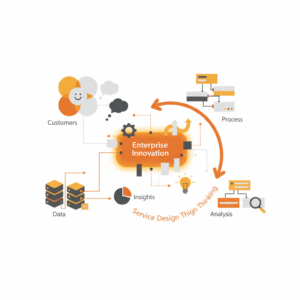
Service design thinking is a structured innovation method that combines customer insight, collaborative design workshops, and rapid prototyping to improve services across complex organisations. Enterprises use it to redesign customer journeys, reduce operational friction, and create measurable improvements in customer experience, employee workflow, and business performance.
Definition: What Is Service Design Thinking?
Service design thinking is a human-centred framework used to design or redesign services based on real customer behaviour, operational constraints, and measurable outcomes.
The method adapts principles from design thinking but applies them to service ecosystems rather than products. A service ecosystem includes people, technology systems, policies, and operational processes that together shape the customer experience.
Large organisations often struggle with fragmented journeys. Customers move between digital channels, contact centres, retail environments, and automated systems. Service design thinking addresses this fragmentation through structured research and collaborative design.
Typical elements include:
• Customer insight research
• Journey mapping
• Design thinking workshops
• Service blueprinting
• Rapid prototyping and testing
The approach gained traction after early work by the UK Design Council and IDEO demonstrated that human-centred design methods could significantly improve service adoption and satisfaction¹.
But the method works best when supported by operational data and structured CX research.
Context: Why Enterprises Use Service Design Thinking
Enterprise organisations operate in complex environments. Customer experiences rarely depend on a single team or technology platform.
Instead, journeys stretch across departments.
Digital platforms. Contact centres. Policy teams. Operations.
Because of this fragmentation, many organisations optimise individual processes but fail to improve the overall experience.
Service design thinking changes the unit of analysis. It focuses on the entire service journey.
Research from McKinsey shows that organisations adopting design-led practices grow revenue at nearly twice the rate of industry peers². Government agencies in Australia have also adopted service design frameworks to improve public services and reduce administrative burden³.
The reason is simple.
Service design thinking links three things that are often disconnected:
• Customer behaviour
• Operational systems
• Strategic objectives
When these elements align, service improvements become both practical and measurable.
How Does Service Design Thinking Work in Practice?
Service design thinking typically follows a structured workflow.
But the steps are iterative.
Teams cycle between research, ideation, and testing until a workable service model emerges.
1. Customer Insight and Discovery
The process begins with evidence.
Researchers collect qualitative and quantitative data from interviews, analytics, support logs, and behavioural observation.
This stage identifies pain points and unmet needs.
Structured CX research programs help organisations ground service design in real behaviour rather than assumptions. For example, Customer Science’s research capability provides enterprise-grade research frameworks for understanding customer journeys and decision triggers.
Explore the approach here:
https://customerscience.com.au/solution/cx-research-design/
2. Journey Mapping and Problem Framing
Researchers translate insights into customer journey maps.
These maps visualise:
• customer goals
• emotional states
• operational touchpoints
• system interactions
The purpose is clarity.
Journey mapping exposes systemic issues such as duplicated processes, policy conflicts, and unnecessary friction.
3. Design Thinking Workshops
Next comes collaborative ideation.
Cross-functional workshops bring together product teams, CX leaders, operations, and technology specialists.
Design thinking workshops generate service concepts using techniques such as:
• ideation sprints
• scenario modelling
• experience prototyping
• service blueprinting
The goal is not creativity alone. It is feasibility.
Participants test ideas against operational constraints early in the design process.
4. Prototyping and Validation
Teams test new service models through pilot programs or rapid prototypes.
Testing might include:
• redesigned digital journeys
• revised contact centre workflows
• new communication strategies
• policy adjustments
Behavioural metrics then confirm whether the new design improves outcomes.
Comparison: Service Design Thinking vs Traditional Service Improvement
Traditional service improvement focuses on internal process optimisation.
Service design thinking begins with the customer journey.
The difference matters.
Process improvement typically asks:
How can we make this task faster?
Service design thinking asks:
What problem is the customer actually trying to solve?
Because of this shift, service design thinking often produces broader organisational change.
Examples include:
• removing redundant policy requirements
• simplifying digital onboarding flows
• redesigning escalation pathways in contact centres
Traditional improvement methods such as Lean or Six Sigma still play an important role. But service design thinking identifies the right problems before optimisation begins⁴.
Applications: Where Service Design Thinking Delivers Value
Large organisations apply service design thinking across many operational areas.
Common applications include:
Customer Journey Redesign
Enterprises redesign journeys such as onboarding, claims processing, or technical support.
Journey redesign often reduces customer effort and operational workload simultaneously.
Contact Centre Experience Improvement
Service design workshops frequently identify workflow issues affecting agents.
Examples include:
• fragmented knowledge systems
• duplicated authentication processes
• poorly structured escalation rules
Tools such as the Customer Science Insights platform support journey diagnostics and behavioural insight modelling for CX leaders.
Explore the platform here:
https://customerscience.com.au/csg-product/customer-science-insights/
Digital Service Transformation
Service design thinking helps organisations align digital channels with real user behaviour.
Government digital transformation programs frequently use service design frameworks to improve accessibility and reduce service abandonment³.
Policy and Process Simplification
Many service failures originate from policy constraints rather than technology limitations.
Design workshops often identify outdated policies that create unnecessary friction for customers and staff.
Risks: Where Service Design Thinking Can Fail
Service design thinking is not guaranteed to succeed.
Several failure patterns appear repeatedly in enterprise programs.
Lack of Operational Ownership
Workshops generate ideas. But operational teams must implement them.
Without executive sponsorship, concepts rarely progress beyond pilot stages.
Insufficient Data
Design sessions based purely on opinion often produce attractive but impractical ideas.
Customer research and behavioural analytics prevent this problem.
Misalignment With Technology Architecture
Service concepts must align with enterprise systems.
Ignoring platform constraints leads to designs that cannot be implemented.
Measurement: How Organisations Evaluate Service Design Outcomes
Enterprises track several indicators to evaluate service design success.
Common metrics include:
Customer metrics
• Customer effort score
• Net Promoter Score
• journey completion rates
Operational metrics
• call deflection rates
• average handling time
• service resolution rates
Financial metrics
• cost-to-serve reduction
• conversion rate improvements
• retention increases
Advanced analytics programs help organisations track these indicators continuously. Customer Science’s consulting and professional services teams support enterprises in building these measurement frameworks and governance models.
Learn more here:
https://customerscience.com.au/service/cx-consulting-and-professional-services/
Next Steps: Embedding Service Design Thinking in Enterprise Strategy
Service design thinking works best when embedded in governance rather than used as a one-off workshop exercise.
Successful organisations establish structured practices such as:
• CX research programs
• design workshop facilitation capability
• journey governance frameworks
• cross-functional innovation teams
These capabilities allow service improvements to scale across multiple business units.
Because customer expectations continue to shift, organisations must treat service design as an ongoing discipline rather than a project.
Evidentiary Layer: Research and Industry Evidence
Empirical studies show strong links between human-centred design and organisational performance.
The UK Design Council found that design-led firms outperform the FTSE 100 by over 200 percent over ten years¹.
Academic research also shows that customer-centric service design improves perceived service quality and loyalty outcomes across sectors⁵.
Public sector transformation programs across Australia, the UK, and Canada have reported measurable reductions in administrative costs after applying service design frameworks³˒⁶.
These findings reinforce a simple idea.
When organisations design services around real human behaviour, both customers and operations benefit.
FAQ
What is service design thinking?
Service design thinking is a structured framework that combines customer insight, collaborative workshops, and rapid prototyping to improve service experiences across complex organisations.
How do design thinking workshops support CX transformation?
Design thinking workshops bring together cross-functional teams to analyse customer journeys, identify operational friction, and generate service improvements that are both customer-centred and operationally feasible.
What industries use service design thinking?
The method is widely used in banking, telecommunications, government services, healthcare, and digital platforms where customer journeys involve multiple teams and systems.
How do organisations measure the impact of service design?
Organisations measure service design outcomes through customer effort scores, Net Promoter Score changes, operational efficiency metrics, and cost-to-serve improvements.
How can enterprises run effective service design programs?
Effective programs combine structured CX research, facilitated workshops, journey analytics, and continuous measurement frameworks. Knowledge management platforms such as Knowledge Quest help teams capture service insights and operational knowledge across departments.
Explore the solution here:
https://customerscience.com.au/csg-product/knowledge-quest/
When should organisations use service design thinking?
Organisations typically use service design thinking when launching new services, redesigning complex journeys, improving contact centre experiences, or aligning digital transformation with customer behaviour.
Sources
- Design Council. The Design Economy Report.
https://www.designcouncil.org.uk/resources/report/design-economy-2018/ - McKinsey & Company. The Business Value of Design.
https://www.mckinsey.com/business-functions/mckinsey-design/our-insights/the-business-value-of-design - Australian Government Digital Transformation Agency. Service Design and Delivery Process.
https://www.dta.gov.au/help-and-advice/build-and-improve-services/service-design - ISO 9241-210:2019 Human-centred design for interactive systems.
https://www.iso.org/standard/77520.html - Ostrom, A. et al. Service Research Priorities in a Rapidly Changing Context. Journal of Service Research.
https://doi.org/10.1177/1094670510376311 - UK Government Service Design Manual.
https://www.gov.uk/service-manual - Lemon, K. & Verhoef, P. Understanding Customer Experience. Journal of Marketing.
https://doi.org/10.1509/jm.15.0420 - Deloitte. Design Thinking in the Enterprise.
https://www2.deloitte.com/us/en/insights/focus/human-capital-trends/design-thinking.html - Harvard Business Review. Design Thinking Comes of Age.
https://hbr.org/2015/09/design-thinking-comes-of-age - ISO 9001:2015 Quality Management Systems.
https://www.iso.org/standard/62085.html