































Summary
Prototyping digital services allows organisations to test service concepts, interfaces, and workflows before development begins. Low fidelity prototypes explore ideas quickly and cheaply, while high fidelity prototypes simulate near-real experiences for usability testing. Used together within CX research and design, prototyping reduces delivery risk, improves usability outcomes, and increases the likelihood that digital services meet real customer needs.
Definition: What Is Prototyping in Digital Services?
Prototyping digital services refers to the practice of building simplified representations of a service, product interface, or workflow before full development begins.
The prototype may represent:
- A mobile application interface
- A web service journey
- A contact centre interaction flow
- A cross-channel customer experience
The goal is simple. Test assumptions before building the final product.
Because digital service development often involves large technology investments, early validation matters. Studies in human–computer interaction show usability issues discovered during design stages cost up to 100 times less to fix than those discovered after launch¹.
Prototypes allow teams to simulate customer interaction. They observe behaviour, they refine design decisions early and avoid expensive mistakes later.
Context: Why CX Teams Prototype Digital Services
Customer expectations continue to rise across digital channels. Poorly designed digital services lead to customer frustration, higher call volumes, and lost revenue.
Research from the Australian Digital Transformation Agency found that poorly designed digital interactions remain one of the largest drivers of service escalation in government digital services².
Prototyping addresses this risk.
It gives design teams a safe environment to test:
- navigation structures
- interaction patterns
- information hierarchy
- task completion paths
- cross-channel journeys
But there is another reason.
Stakeholder alignment.
Executives often struggle to interpret design documents or journey maps. A prototype turns abstract strategy into something visible and interactive.
People see the service.
They try it.
Discussion becomes grounded in real behaviour.
Mechanism: How Digital Service Prototyping Works
Prototyping usually follows an iterative design cycle:
- Customer research identifies needs and behaviours
- Designers create early concept sketches or wireframes
- Prototypes simulate interactions and workflows
- Users test the experience
- Feedback informs revisions
Then the cycle repeats.
Sometimes several rounds occur before development begins.
Prototypes range from simple paper sketches to interactive digital interfaces that closely resemble finished systems.
In professional CX research and design programmes, prototypes are often evaluated through usability testing, behavioural observation, and task completion analysis.
Teams watch how people attempt real tasks.
Logging in.
Finding information.
Completing transactions.
Evidence replaces opinion.
For organisations running structured design programmes, tools such as Customer Science Insights support this work by analysing customer feedback and behavioural signals to inform prototype design decisions.
https://customerscience.com.au/csg-product/customer-science-insights/
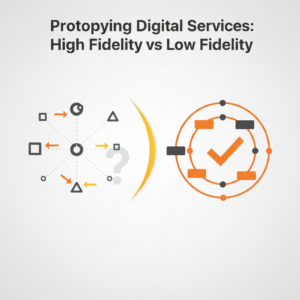
Comparison: High Fidelity vs Low Fidelity Prototypes
Two major categories define most prototyping approaches.
Low fidelity and high fidelity.
Both serve different purposes in the design lifecycle.
Low Fidelity Prototypes
Low fidelity prototypes represent ideas quickly with minimal design detail.
Common formats include:
- paper sketches
- whiteboard workflows
- wireframes
- simple clickable diagrams
They focus on structure rather than appearance.
Layout.
Flow.
Logic.
Low fidelity prototypes allow teams to explore ideas rapidly. Because they require little effort to produce, they encourage experimentation.
Designers can create multiple concepts in a single workshop session.
Discarding ideas costs almost nothing.
Low fidelity testing is particularly effective during early discovery phases when the design problem is still unclear.
High Fidelity Prototypes
High fidelity prototypes simulate the final experience more realistically.
They often include:
- visual design elements
- typography and colour
- realistic interactions
- clickable navigation
- simulated backend responses
Users interacting with a high fidelity prototype often believe they are using the finished product.
This realism supports deeper usability testing.
Teams can measure:
- task success rates
- time to completion
- navigation errors
- cognitive load
High fidelity prototypes require more time to create. Because of this, they are usually produced later in the design process once key interaction concepts are validated.
Applications: Where Prototyping Digital Services Creates Value
Prototyping plays a central role across modern CX design programmes.
Common applications include:
Digital Service Design
Government and enterprise digital service teams prototype services before technology investment decisions are made.
Service tasks are simulated.
User behaviour is observed.
Design improvements occur before engineering begins.
Customer Journey Optimisation
Prototypes allow teams to test cross-channel experiences.
For example:
- switching between mobile app and contact centre
- moving from web chat to human agent
- completing a digital transaction after email verification
These transitions often cause the largest customer friction.
Contact Centre Automation
Digital service prototypes are also used to design automated service flows.
Including:
- chatbot interactions
- voice automation
- self-service knowledge systems
Testing these workflows early prevents automation failures that would otherwise increase call centre demand.
Risks: When Prototyping Goes Wrong
Despite its benefits, prototyping can introduce problems when poorly executed.
Over-Design Too Early
High fidelity prototypes created too early can lock teams into premature design decisions.
Teams may fall in love with visual designs before validating core interaction logic.
Testing with the Wrong Users
Internal staff testing prototypes often produces misleading results.
Real customers behave differently.
Professional research recruitment and moderated usability testing improve reliability.
Stakeholder Misinterpretation
Some stakeholders mistake prototypes for finished products.
Clear communication is necessary. Prototypes represent design hypotheses.
Not final systems.
Measurement: How Do You Evaluate Prototype Success?
The value of prototyping becomes clear through measurable outcomes.
Typical usability metrics include:
- task completion rate
- time on task
- error frequency
- navigation path deviations
- satisfaction scores
Industry usability benchmarks suggest that task success rates above 85 percent typically indicate acceptable interaction design³.
But qualitative observations matter too.
Researchers observe confusion moments.
Navigation hesitation.
Unexpected behaviour.
These behavioural insights often reveal deeper design flaws.
Many organisations combine behavioural testing with structured CX measurement programmes delivered through professional CX consulting and professional services teams.
https://customerscience.com.au/service/cx-consulting-and-professional-services/
Next Steps: Implementing Prototyping in CX Design
Organisations introducing digital service prototyping often begin with a structured CX research and design framework.
Key steps include:
- Conduct foundational customer research
- Map current service journeys
- Identify high-risk interaction points
- Prototype alternative solutions
- Conduct usability testing
- Refine before development
This process aligns design decisions with real user behaviour.
And reduces downstream technology risk.
For organisations managing complex service environments, this method also strengthens collaboration between CX teams, digital product teams, and operational leaders.
Evidentiary Layer
Evidence supporting the value of prototyping is well established across UX and service design research.
Studies show usability testing with prototypes can identify up to 85 percent of major interaction issues before development⁴.
Service design literature also demonstrates that iterative prototyping significantly reduces rework costs in digital product delivery⁵.
Government digital service standards now include prototyping as a mandatory step in many service design frameworks.
Because the cost of failure after launch is far greater.
FAQ
What is prototyping in digital service design?
Prototyping creates simulated versions of digital services so teams can test interactions, navigation, and usability before development. It helps identify design issues early and improves customer experience outcomes.
What is the difference between wireframing and prototyping?
Wireframes represent structural layouts of interfaces. Prototypes simulate interactive experiences. Wireframes often form the first step in low fidelity prototyping.
When should high fidelity prototypes be used?
High fidelity prototypes are best used after early design concepts have been validated. They allow realistic usability testing that closely resembles final system interactions.
Why do CX teams use prototypes before development?
Prototypes reduce delivery risk by validating service interactions before technology investment. Research shows early usability testing dramatically lowers redesign costs.
Can prototyping improve contact centre experiences?
Yes. Prototyping allows organisations to simulate digital self-service journeys and automated interactions before launch. Tools such as Commscore AI analyse customer communications to support these design improvements.
https://customerscience.com.au/csg-product/commscore-ai/
How does CX research support digital service prototyping?
Customer research identifies real behavioural patterns and service needs. These insights guide prototype design and ensure solutions reflect actual customer expectations rather than internal assumptions.
Sources
- Nielsen, J. (1994). Usability inspection methods. John Wiley & Sons. https://doi.org/10.1002/9780470185483
- Australian Digital Transformation Agency. Digital Service Standard. https://www.dta.gov.au/help-and-advice/digital-service-standard
- Sauro, J., Lewis, J. (2016). Quantifying the User Experience. Morgan Kaufmann. https://doi.org/10.1016/C2012-0-06163-1
- Virzi, R. (1992). Refining the test phase of usability evaluation. Human Factors. https://doi.org/10.1177/001872089203400407
- ISO 9241-210:2019 Human-centred design for interactive systems. International Organization for Standardization.
- UK Government Digital Service. Service Design Manual. https://www.gov.uk/service-manual
- Norman, D. (2013). The Design of Everyday Things. Basic Books.
- Australian Government. Digital Experience Policy. https://www.dta.gov.au
- Lazar, J., Feng, J., Hochheiser, H. (2017). Research Methods in Human Computer Interaction. Morgan Kaufmann.