






























Process mining for RPA helps organisations choose workflows that are stable enough to automate, important enough to matter, and measurable enough to justify investment. It works best when leaders use event-log evidence to find rework, variation, waiting time, and exception patterns first, then use task mining only where desktop-level detail is needed to design the last mile of automation.¹˒²˒³ (Springer Nature Link)
What is process mining for RPA?
Process mining for RPA is the use of system event data to discover how work actually flows before deciding what to automate with software bots. It shows real paths, not workshop assumptions. That matters because many RPA programs still fail for a simple reason. They automate a process that looks repetitive on paper but turns out to be messy, exception-heavy, and unstable in practice. Research and current practitioner guidance both point to the same lesson: analysing a process before automating it can simplify the process, expose waste, and make bot design more reliable.¹˒² (Springer Nature Link)
Process mining is not the same as task mining. Process mining looks across systems and traces the end-to-end workflow using event logs. Task mining looks closer to the desktop and captures user actions to show how individual tasks are performed. ABBYY’s 2025 comparison guide describes process mining as the broader system-level view and task mining as the finer user-level view.⁴ That distinction matters because the two methods answer different questions. Process mining tells you whether the workflow is worth automating. Task mining tells you how a person currently completes the most manual part of that workflow. (abbyy.com)
Why is workflow selection the hard part?
Workflow selection is hard because the wrong process can still look busy, repetitive, and expensive. A queue may have high volume, yet hide too many exceptions to suit RPA. Another may look low-value, yet contain a highly standardised repetitive step that would produce a fast return. Recent research on RPA and process mining says process mining can find automation potential by identifying repetitive and structured work inside large or complex processes.¹ But it also says manual intervention remains important, especially for complex processes, because process mining alone does not capture every decision factor.² (Springer Nature Link)
This is where many RPA business cases go wrong. They focus on labour time first. That is too narrow. The better question is whether the workflow has clear inputs, stable rules, low exception rates, measurable outcomes, and enough volume to matter. Customer Science’s current process-mining guidance uses almost that exact logic and adds a practical ranking lens: variant concentration, automation potential, and risk exposure.³ (Customer Science)
How does process mining actually find the right workflows?
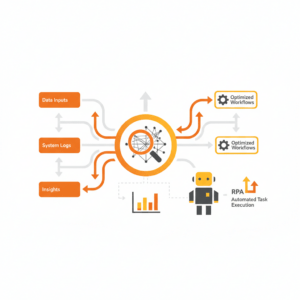
It starts with event logs. Case IDs, timestamps, activities, handoffs, queues, and outcomes. Process mining tools use that data to reconstruct the real flow of work, including loops, waiting times, variant paths, and non-compliant routes. The result is not just a map. It is evidence about where work slows down, where it branches, where it returns, and where manual effort clusters.²˒⁵ (ResearchGate)
That evidence becomes useful for RPA when you screen workflows through a simple funnel. First, identify process families with enough volume and repeatability. Second, remove those with too much rule ambiguity or too many business-critical exceptions. Third, measure how much time is lost in waiting, rework, and handoffs. Fourth, decide whether the issue is really workflow design, not automation opportunity. The 2025 framework on process mining in RPA assessment describes this as a more structured, data-driven way to improve resource allocation and ROI, while warning that only a subset of process metrics is directly attainable from mining alone.² (ResearchGate)
What is the difference between process mining and task mining tools?
Process mining and task mining tools should be treated as complementary, not interchangeable. Process mining reveals how the full workflow behaves across systems. Task mining shows what happens inside a narrower, UI-heavy activity at the user level. ABBYY’s 2025 guide says process mining gives the big picture and task mining gives the finer detail.⁴ Customer Science’s 2026 article makes the same point more bluntly: use process mining to prove flow and variation, and task mining to optimise last-mile user actions after the end-to-end design is stable.³ (abbyy.com)
This matters because task mining tools can tempt teams into automating whatever is visible on a screen. But desktop repetition is not always the real bottleneck. Sometimes the waste sits upstream in approvals, broken handoffs, poor data quality, or avoidable routing. When that happens, automating the screen work alone just makes a bad process run faster.
Which workflows make strong RPA candidates?
Strong RPA candidates usually share five traits. They have structured inputs, explicit rules, limited exceptions, predictable volume, and outcomes you can measure. Customer Science’s current process-mining article highlights clear inputs, stable rules, low exception rates, and measurable outcomes as practical selection criteria.³ Research on integrating process mining with RPA supports the same pattern by linking mining to more accurate discovery and better assessment before build.¹˒² (Customer Science)
In service and back-office environments, that often means billing corrections, standard case updates, identity checks, scheduled reconciliations, after-call administration, claims preparation, or high-volume email triage. A good first application section should also connect the discovery layer to a live operational data layer. Customer Science Insights fits well here because it provides real-time service and contact-centre visibility that can expose rework, repeat demand, and bottlenecks before leaders commit to automation. (Customer Science)
Where do organisations get this wrong?
The first mistake is automating variability. A process may be frequent, but still change too often to suit classic RPA. The second mistake is confusing local repetition with end-to-end value. A user may repeat the same clicks all day because upstream policy is broken. The third mistake is skipping governance. Process mining maturity research from 2024 shows organisations need readiness, capability, and tangible improvement actions if they want mining to become repeatable and useful rather than a one-off visualisation exercise.⁶˒⁷ (Springer Nature Link)
There is also a portfolio mistake. Teams often pick candidates one by one, without asking whether the automation roadmap as a whole will create measurable business value. The 2025 portfolio-management method for process-mining-enabled improvements was developed specifically to help organisations identify portfolios of value cases rather than isolated experiments.⁷ That is a better fit for executive decision-making because it links workflow selection to an evolutionary roadmap, not just a queue of bot ideas. (Springer Nature Link)
How should leaders compare process mining with manual discovery?
Manual discovery is still useful. People know the workarounds, the policy exceptions, and the reasons behind odd paths. But manual discovery is subjective and often incomplete. Process mining adds objectivity by showing what really happened in the data. The strongest approach is combined. Use process mining to identify the patterns, then validate them with frontline and operational leaders before automating anything.¹˒² (Springer Nature Link)
That blend matters because complex service workflows often include hidden human judgment that event logs alone cannot explain. The 2025 RPA assessment framework says manual intervention remains crucial, especially for complex processes, because mining alone is insufficient.² So the right operating model is not “trust the tool.” It is “use the tool to focus human judgment where it matters most.” (ResearchGate)
How should you measure the business case?
Measure candidate quality before you measure automation savings. Start with variant count, rework rate, average handling path, waiting time, exception frequency, and outcome stability. Then add cost and CX measures such as time to complete, backlog age, transfer rate, error rate, and repeat contact where customer service is involved.³˒⁷ (Customer Science)
After that, build the financial case around three questions. How much manual effort is removed? How much instability is avoided? How much service quality improves? This is where many teams need design and implementation support, not just software. Intelligent Automation Consulting Services Australia is the right type of link in the measurement section because the challenge is usually operating design, workflow selection, and governed rollout rather than mining alone. (Customer Science)
What should happen next?
Start with one process family. Not the whole enterprise. Pull the event data, map the current flow, identify the top variants, and rank the process against stability, rule clarity, exception rate, and business value. Then decide whether the answer is process redesign, deterministic RPA, or something broader such as intelligent automation. Customer Science’s recent migration and roadmap articles both support that wave-based approach, especially where legacy bots have already made the estate brittle.³˒⁸ (Customer Science)
FAQ
What does process mining for RPA actually do?
It uses event-log data to show how work really flows so teams can choose workflows that are stable and worthwhile enough to automate.¹˒² (Springer Nature Link)
Are task mining tools enough on their own?
No. Task mining tools help with user-level detail, but they can miss upstream and downstream constraints in the full workflow.³˒⁴ (Customer Science)
What is the best first workflow to assess?
Start with a high-volume process that has visible rework, clear rules, and measurable outcomes. Billing corrections, standard case updates, and email triage are common examples.³ (Customer Science)
What usually blocks good workflow selection?
Poor event data, weak ownership, unstable processes, and the habit of choosing candidates based on gut feel instead of evidence block good selection most often.²˒⁶ (ResearchGate)
Does process mining replace process mapping workshops?
No. It improves them. Process mining gives objective evidence, while workshops explain context, exceptions, and policy logic.¹˒² (Springer Nature Link)
What helps teams keep process evidence usable over time?
A strong reporting and data discipline helps. Business Intelligence is relevant where teams need cleaner process data, repeatable dashboards, and a stronger evidence layer for automation decisions.
Evidentiary Layer
The evidence supports a straightforward conclusion. Process mining for RPA is most useful at the selection stage, where it can replace guesswork with data on flow, variation, and exception patterns. Research shows it improves discovery accuracy and strengthens assessment, but also that it is not enough on its own for complex workflows.¹˒² Current maturity and portfolio work adds the operating lesson: the value comes from using mining to guide an evidence-based roadmap, not from generating maps for their own sake.⁶˒⁷ Process mining finds the right workflows when leaders treat it as a decision system for automation, not a visualisation exercise. (Springer Nature Link)
Sources
-
Plattfaut, R., Beverungen, D., et al. Robotic process automation: research impulses from the BPM 2023 panel discussion. Process Science, 2024. Stable Springer page. https://link.springer.com/article/10.1007/s44311-024-00005-1
-
El-Tanany, M. A., Adris, A.-E., Kaoud, H. A framework for using process mining in process discovery and assessment in robotic process automation. International Journal of Business Process Integration and Management, 2025. DOI: 10.1504/IJBPIM.2025.10075214
-
Customer Science. Process mining for automation before AI investment, 2026. Stable page. https://customerscience.com.au/technology/process-mining-before-ai/
-
ABBYY. Task Mining vs Process Mining: Comparison Guide, 2 April 2025. Stable page. https://www.abbyy.com/blog/task-mining-vs-process-mining/
-
van der Aalst, W. and related process mining literature as summarised in On the application of process management and process mining, 2024. Stable Springer page. https://link.springer.com/article/10.1007/s10270-024-01175-z
-
Brock, J., et al. Improving Process Mining Maturity: From Intentions to Actions. Business & Information Systems Engineering, 2024. Stable Springer page. https://link.springer.com/article/10.1007/s12599-024-00882-7
-
Fischer, D. A., et al. A Portfolio Management Method for Process Mining-Enabled Business Process Improvement Projects. Business & Information Systems Engineering, 2025. Stable Springer page. https://link.springer.com/article/10.1007/s12599-024-00906-2
-
Customer Science. Legacy RPA Migration to Intelligent Automation Platforms, 2 February 2026. Stable page. https://customerscience.com.au/technology/legacy-rpa-migration-guide/
-
Customer Science. Process Automation Roadmap for Service Operations, 23 January 2026. Stable page. https://customerscience.com.au/customer-experience-2/process-automation-roadmap-for-service-operations/