































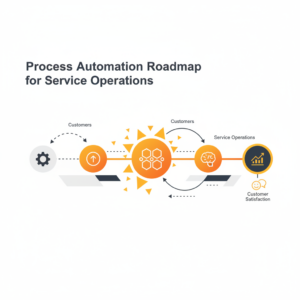
What problem does a service automation roadmap actually solve?
Leaders need faster cycle times, lower cost to serve, and fewer repeats without breaking core systems. Teams need a credible sequence that turns candidate use cases into shipped automations that improve First Contact Resolution and quality. A roadmap solves the prioritisation and proof problem. It ranks opportunities by business value and feasibility, chooses the right tool for each step, and installs governance that keeps outcomes honest. Research on automation shows that sustained value arrives when organisations redesign processes around automation rather than recording existing clicks.¹ A roadmap makes that redesign explicit, measurable, and sequenced.
What is “service automation” in plain terms?
Service automation uses software to execute deterministic tasks, orchestrate decisions between systems, and trigger communications when events occur. Robotic Process Automation handles rules-based screen work. APIs and microservices move data reliably. Event orchestration sends messages when a state changes so customers do not need to chase status. Intelligent components like document AI extract data from forms and retrieval-augmented assistants draft answers that cite approved sources. Deloitte’s field research shows that programs that blend RPA, API integration, and AI deliver larger, more durable outcomes than single-tool efforts.²
Where should you start and how should you prioritise?
Start where frequency, rules, and rework intersect. Select two to four use cases that meet three tests: high volume, clear rules, and measurable pain such as long wrap time or repeat-within-seven-days. McKinsey recommends sizing benefits and constraints at the journey level, then sequencing work so early wins unlock next steps.³ Rank candidates with a short scorecard across four columns: customer outcome impact, cost-to-serve reduction, feasibility, and risk. Use Forrester’s TEI method to express benefits in low, base, and high cases with confidence ranges so the board sees risk priced in.⁴
Which use cases usually return value fast in service operations?
Service operations share repeatable patterns. After-call work automation closes cases, updates systems, and documents outcomes, which trims wrap and reduces variability.³ Identity and entitlement checks fetch plan, warranty, or eligibility in one click so agents start with authority, which lifts First Contact Resolution.⁵ Billing corrections and refunds run cleanly as unattended batches with audit trails.³ Status and appointment updates use event-driven messages to prevent “just checking” contacts that clog queues. Orchestrators that hold messages until a confirming event lands reduce avoidable contacts significantly by stopping irrelevant prompts.⁶ Each pattern pairs a clear mechanism with an auditable outcome.
What architecture supports a multi-year roadmap without rework?
Build a layered architecture you can extend. The engagement layer handles chat, voice, email, and portals. The decision and orchestration layer evaluates rules and triggers actions. The execution layer mixes APIs, RPA robots, and workflow services. The knowledge and AI layer grounds answers in approved sources and assists agents in drafting, while logging citations for audit. A process mining layer reads event logs to reveal variants, rework, and bottlenecks so teams automate the right steps. Process mining consistently exposes where rework loops live and where control failures create repeat demand.⁷ Using this stack prevents tool-first cul-de-sacs and keeps attention on flow.
How do you scope the first 12 months without boiling the ocean?
Scope three waves and keep each wave small enough to ship. Wave 1 should remove two or three steps in one high-volume interaction and one back office process. Wave 2 should extend automation to adjacent steps and add event-driven notifications. Wave 3 should replace brittle RPA segments with APIs where possible and expand agent-assist. McKinsey’s implementation lessons show that programs that pair quick wins with platform build-out sustain lift and avoid stall-out after the pilot.³ TEI guidance encourages periodic re-estimation with observed deltas so benefits remain credible.⁴
How do you decide between RPA, APIs, workflow, and AI?
Choose the lightest tool that solves the problem. Prefer APIs when systems support them because they are stable and fast. Use RPA for deterministic steps across systems that lack APIs or to bridge while integration work proceeds. Adopt workflow for human-in-the-loop approvals and multi-party steps. Add AI where inputs are unstructured or where retrieval and summarisation speed human work, but ground outputs in approved sources to avoid hallucinations.² If two tools fit, test the smallest thin slice and measure cycle time, accuracy, and exception rate before scaling.
What operating model keeps automation safe and fast?
Create a small design authority that meets weekly with three artefacts: a candidate register with value and risk scores, a control checklist, and a runbook library. The checklist verifies stable rules, clean inputs, authoritative sources, exception handling, and rollback. Programs that review candidates against a standard avoid automating unstable steps and reduce brittle bots.³ Keep ownership clear: a product owner owns the journey outcome, a tech owner owns the solution, and an operations owner owns the run. Auditors expect execution logs and traceable approvals for changes; build these into the platform rather than relying on ad hoc spreadsheets.²
How do you measure success in week and prove ROI in month?
Track paired leading and lagging indicators. Leading indicators include bot success rate, exception rate, wrap reduction, time to first useful step in agent-assist, and right-first-time updates. Lagging indicators include First Contact Resolution for targeted intents, repeat-within-seven-days, journey cycle time, refunds or rework avoided, and cost per contact. ICMI’s FCR definition provides a clear lagging proof that customers received what they needed the first time.⁵ For the financial model, TEI advises presenting low, base, and high benefits with confidence factors and adoption curves.⁴ This pairing satisfies operations and finance without bloated dashboards.
How do you keep customers out of the loop while staying transparent?
Use event-driven orchestration so systems message customers when a state changes, not on fixed timers. Twilio’s documentation shows how hold-until and conditional steps prevent messages from firing after the customer already acted, which reduces irritation and follow-up calls.⁶ When agents or bots make changes, record the state and trigger the right next step with timestamps. Service blueprinting and status clarity reduce the “just checking” contact ratio because customers can see progress without calling. The roadmap should bake this hygiene into every wave.
How do process mining and RCA accelerate the roadmap?
Process mining reconstructs the real flow from logs and reveals variants, loops, and long waits.⁷ Root cause analysis then ties those defects to changeable controls such as validation, sequencing, and permissions. Use mining to pinpoint the step that causes the most rework, then automate or change that step first. This shifts teams from automating visible toil to eliminating the mechanism that generates that toil. Programs that use mining for selection and validation report fewer dead ends and faster payback because fixes target the actual bottleneck, not the perceived one.⁷
What risks derail automation and how do you mitigate them?
Three risks recur. First, teams automate unstable processes. Fix by running candidates through the control checklist and by stabilising inputs before build.³ Second, leaders chase bot counts instead of outcomes. Fix by reporting FCR, repeats, and cycle time alongside bot metrics and by pausing expansion when lagging outcomes do not move.⁵ Third, change control lags. Fix by maintaining a bot and integration catalogue with owners and dependency maps and by subscribing to release calendars so upstream changes do not break flows. Deloitte’s guidance stresses run governance as a core discipline, not an afterthought.²
What does a 90-day starter plan look like?
Days 1–30: Discover and size.
Inventory top interactions and back office flows. Quantify volume, repeat-within-seven-days, wrap, and cycle time. Select two use cases with clear rules and measurable rework. Build a one-page TEI-style case with low, base, and high benefits and owners.¹ ⁴
Days 31–60: Build and prove.
Design thin-slice automations that remove two to three steps. Add event-driven messages for the same journey. Instrument success, exception, and wrap reduction. Run controlled comparisons for two weeks. Promote only when FCR and repeats move in the right direction, not just handle time.³ ⁵ ⁶
Days 61–90: Harden and extend.
Add retries, exceptions, and runbooks. Stand up the weekly design authority and publish the bot and integration catalogue. Refresh the business case with observed deltas and confidence updates. Start discovery for Wave 2 using process mining to target the next bottleneck.² ⁴ ⁷
What outcomes should executives expect in quarter one and two?
Expect early movement in wrap reduction and time to first useful step on agent-assist flows within weeks. Expect measurable lifts in First Contact Resolution and reductions in repeat-within-seven-days on the automated intents within one to two cycles. Expect journey cycle times to fall where back office steps moved to unattended automation, with fewer error-related refunds. Programs that continue to replace brittle bridges with APIs and that extend event-driven status updates see complaint rates drop for “status opacity” and “did you get my form” issues. These gains stack because each wave removes a source of rework rather than shifting it.
FAQ
What is the fastest path to prove automation value without a platform rebuild?
Automate after-call work and one back office correction with clear rules. Measure wrap reduction, FCR, repeats, and cycle time. Present a TEI-style one pager with low, base, and high cases.³ ⁴ ⁵
Should we lead with RPA or APIs?
Prefer APIs where available. Use RPA to bridge gaps when APIs are absent or slow to deliver. Replace RPA segments with APIs over time as part of the roadmap.²
How do we pick use cases that will not stall?
Choose high volume, rules-based steps with authoritative data and clear exception paths. Score by customer impact, cost reduction, feasibility, and risk. Validate with two-week controlled comparisons.³ ⁴
How do we stop automation from creating new failure demand?
Use event-driven orchestration with hold-until to prevent irrelevant prompts. Trigger updates on real state changes. Confirm that repeats fall for the automated intents before scaling.⁶ ⁵
How should we staff the automation team?
Assign a product owner for each journey, a technical owner for delivery, and an operations owner for run. Meet weekly as a design authority with a control checklist and a runbook library.² ³
What metrics belong on the executive pack each month?
FCR and repeat-within-seven-days for automated intents, journey cycle time, refunds or rework avoided, bot success and exception rates, and TEI-style realised value with confidence.⁴ ⁵
Sources
-
A Future That Works: Automation, Employment, and Productivity — Manyika, Chui, Miremadi, et al., 2017, McKinsey Global Institute. https://www.mckinsey.com/featured-insights/employment-and-growth/a-future-that-works-automation-employment-and-productivity
-
Intelligent Automation: Getting RPA and AI Right — Frank Farrall, David Schatsky, Jeff Loucks, 2019, Deloitte Insights. https://www2.deloitte.com/us/en/insights/focus/cognitive-technologies/intelligent-automation-real-world.html
-
RPA: Five Lessons to Scale Successfully — McKinsey Digital, 2020, McKinsey Insights. https://www.mckinsey.com/capabilities/operations/our-insights/robotic-process-automation-implementation-lessons-to-scale
-
Total Economic Impact (TEI) Methodology — Forrester, 2020–2025, Forrester Research. https://www.forrester.com/teI/methodology
-
First Contact Resolution: Definition and Approach — ICMI, 2008, ICMI Resource. https://www.icmi.com/files/ICMI/members/ccmr/ccmr2008/ccmr03/SI00026.pdf
-
Event-Triggered Journeys: Hold-Until and Experiments — Twilio Segment Docs, 2024, Twilio. https://www.twilio.com/docs/segment/engage/journeys/v2/event-triggered-journeys-steps
-
Process Mining: Data Science in Action — Wil van der Aalst, 2016, Springer. https://link.springer.com/book/10.1007/978-3-662-49851-4