

























Why do leaders confuse preference centers and consent management?
Many teams conflate “preference centers” with “consent management” because both sit in the customer data layer and both ask people to make choices. The two systems serve different purposes. A preference center lets people choose how a brand communicates. A consent management platform records the legal permission to process personal data for specified purposes. The distinction matters because regulators evaluate permission, not marketing settings, and customers judge experience, not legal artifacts. Precision reduces risk and improves trust. Precision also creates cleaner data for analytics and for personalisation. Clear definitions help leaders fund the right capabilities and avoid duplicative tooling that confuses customers and staff.¹⁻⁵
What is consent management and why does it sit at the foundation?
Consent management is the set of policies, interfaces, and systems that capture, store, and propagate a person’s permission to process personal data for stated purposes. In the European Union, consent means a freely given, specific, informed, and unambiguous indication given by clear affirmative action. Supervisory guidance expects the ability to withdraw consent as easily as it was given.¹,⁵ In California, the regime centers on the right to opt out of selling or sharing personal information, with explicit opt in for children under 16. Businesses must honor global privacy control signals.²,¹¹,¹⁶ In Australia, consent is generally required for sensitive information and for uses beyond the original purpose. Entities must align use and disclosure to the purpose collected.⁴,¹9 Consent management therefore governs lawful basis and purpose limitation, not channel preferences.
What is a preference center and where does it add value?
A preference center is a brand-owned interface where customers manage communication topics, frequency, and channels. A good design lets people opt down rather than opt out. It also differentiates content interests from legal permissions. A preference center can reduce churn from blanket unsubscribes by offering choice. It can improve deliverability by matching cadence to appetite. It can raise satisfaction by making control visible. Marketing literature defines a preference center as the page or tool that allows subscribers to tailor the content they receive and the timing of messages.¹⁷,⁷ When connected to the profile, this unit feeds targeting and journey orchestration. It should never override recorded consent. It should respect rights to object to direct marketing.³
Where do these systems overlap and diverge in practice?
Both systems collect choices. The overlap ends there. Consent choices determine whether processing is permitted for a purpose such as analytics, personalisation, or targeted advertising. Preference choices determine how a permitted communication happens. A consent banner that sets lawful basis for cookies is not a preference center. A subscription page that sets frequency is not a lawful consent record. In ad tech, frameworks like the IAB Transparency and Consent Framework encode consent strings for downstream vendors. These strings communicate permissions across the ecosystem.³,⁸,¹³ Preference centers do not create consent strings. They broadcast profile settings to martech. Teams should keep the legal record authoritative and isolate channel choices in marketing systems that reference the consent store.
How does consent vary across jurisdictions and what does that change?
Regulatory models differ. The EU treats consent as one lawful basis among several and sets strict conditions for validity.¹,⁵ California sets a primarily opt out model for sale and sharing, with specific opt in for minors and controls for cross-context behavioral advertising.²,¹¹,¹⁶ Australia focuses on purpose alignment and sensitive information, with consent often required for secondary use.⁴,¹⁹ The United States also sees divergent state laws that toggle between opt in for sensitive data and opt out for general personal data, which raises operational complexity. This fragmentation pressures global brands to design a common consent store that can express purpose, scope, and jurisdictional nuance. It also requires interfaces that adapt to the local legal basis without confusing the user.¹⁵,turn0news55
Which problems signal that you need stronger consent management?
Leaders should act when they see analytics models trained on data without a traceable legal basis. Teams should act when vendors cannot receive or honor a consent string or a global privacy control. Storage gaps appear when consent is captured in web tags but not persisted to the profile. Process gaps appear when withdrawals do not propagate to downstream systems within an acceptable window. Audit gaps appear when the business cannot show purpose, timestamp, mechanism, and proof of notice. The remedy starts with a unified consent ledger that records identity, purpose, legal basis, scope, and expiry. This ledger should drive enforcement at collection, activation, and retention. It should integrate with CMPs, tag managers, CDPs, and data lakes.¹,³,²
Which problems suggest you need a better preference center?
Leaders should invest when unsubscribe rates spike on broadcast campaigns. They should invest when the same person receives contradictory content across channels. They should act when journey performance suffers from cadence fatigue. A preference center solves these by offering topic-level subscriptions, channel options, and frequency controls. It should explain the value of staying subscribed. It should offer a true opt out with one click for compliance. It should write back to email, SMS, app, and push systems in near real time. Good examples show plain language, short forms, and immediate confirmation. Industry guidance stresses that preference centers reduce opt outs by giving choice and promote healthier lists by aligning content to interest.¹⁷,⁷,¹²
How do you decide which unit owns which decision?
A simple rule prevents confusion. Consent gates whether the brand may process personal data for a purpose. Preference gates how the brand communicates when processing is allowed. Put consent in a consent management platform or unified consent service. Put preferences in marketing tools and in a central profile. Connect the two so that a revoked consent disables related preferences automatically. For example, if a person withdraws consent for email marketing, the email cadence setting becomes moot and the system must stop sending. If a person opts out of sale or sharing, activation to third-party audiences must cease even if the person remains subscribed to newsletters.²,¹¹,³
How should ethical analytics teams operationalise the boundary?
Ethical analytics teams document a purpose catalog that defines permitted processing. The catalog lists analytics, personalisation, advertising, and profiling with clear descriptions and legal bases. The team maps each data element and each model to a purpose. The team separates operational metrics from personalization data where possible to reduce dependency on consent. The team builds suppression logic that enforces opt outs and withdrawals at query time. The team uses a consent string or token that downstream jobs must check before use. Ad tech relies on the TCF to pass signals to vendors.³,⁸ Data teams rely on profile attributes that encode purpose-level permission. Product teams design friction-light withdrawal so that control remains credible.¹,⁵
What architecture patterns work best for enterprises?
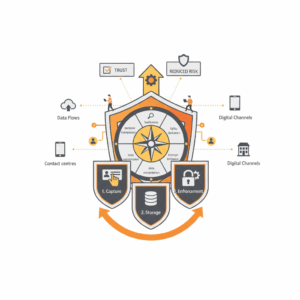
Enterprises succeed when they centralise permission and decentralise use. A central consent ledger normalises inputs from web, app, call center, and in-store capture. The ledger signs each record with source, mechanism, and jurisdiction. APIs expose read checks at activation time. Web and app surfaces use a CMP to display notices and obtain consent where required. The CMP writes to the ledger and issues vendor-specific signals such as TCF strings. Martech uses a preference center to collect topics and cadence. The center writes to a customer data platform that syncs to email and mobile tools. A rule engine prevents any activation that conflicts with consent status. This structure reduces engineering cost and simplifies audits.³,¹,²
How do you measure effectiveness and prove compliance?
Teams should track withdrawal latency from user action to enforcement. They should track the percentage of downstream tools that honor the latest consent. They should measure the lift in list health and engagement from preference adoption. They should monitor the share of data available for analytics by purpose and jurisdiction. They should keep evidence packs that show notice content, interface screenshots, timestamps, and identifiers. Regulators expect records that prove consent was informed and specific.¹,⁵ California expects visible opt out links and respect for global privacy control.²,¹¹ Australia expects alignment to collection purpose and care with sensitive information.⁴,¹⁹ Brands that measure both legal fitness and customer comfort reduce risk and raise lifetime value.
What should leaders do next?
Leaders should define consent and preference as separate products with shared service agreements. The consent product owns lawful basis, purpose catalog, and auditability. The preference product owns channel experience and engagement outcomes. The two products share identity and profile services. Start by inventorying every capture point and every activation. Map each to a purpose and to a tool. Close gaps with a central ledger and a single preference center. Train teams to avoid swapping terms. Publish a public policy that explains the difference in plain language. Align this with regional expectations and industry frameworks so that vendors can consume signals reliably across the ecosystem.¹,²,³,⁴
FAQ
What is the difference between a preference center and consent management?
A preference center lets customers specify communication topics, channels, and frequency. Consent management records legal permission to process personal data for stated purposes and supports withdrawal and audit. Preference settings never override consent status.¹,³,⁵
Which laws shape consent requirements for customer analytics and marketing?
The EU GDPR defines strict consent conditions and requires easy withdrawal. California provides rights to opt out of sale or sharing and mandates honoring global privacy control. Australia requires consent for sensitive data and alignment to original purpose.¹,²,⁴,¹¹,¹⁶,¹⁹
When should an enterprise deploy an IAB TCF integration versus a preference center?
Use the IAB TCF when you need to pass consent signals for advertising across websites, apps, and ad tech vendors. Deploy a preference center to manage subscribers’ topics and cadence in email, SMS, and app notifications. These solve different problems and often work together.³,⁸,¹³
Which indicators show that consent management is failing?
Warning signs include models trained on data without a traceable legal basis, vendors that cannot receive or honor consent strings, slow propagation of withdrawals, and missing audit fields like purpose and timestamp. Strengthen the consent ledger and enforcement APIs when these appear.¹,³
How does a preference center reduce unsubscribes without risking compliance?
A preference center offers opt down choices for content and frequency while still providing a one-click opt out. It improves engagement by aligning messages to interests and by making control visible. It never bypasses the legal record of consent.¹⁷,⁷,³
Which architecture pattern keeps systems simple and auditable?
Centralise consent into a unified ledger and decentralise preference capture into martech. Connect them through identity and enforce checks at activation. Use a CMP for notices and legal capture and a CDP for preference-driven targeting.³,¹,²
Which metrics prove that the approach works?
Track withdrawal latency, downstream honor rates, list health and engagement, jurisdictional data availability by purpose, and completeness of evidence packs for audits. These show both legal fitness and customer comfort.¹,²,⁵,¹¹
Sources
-
European Data Protection Board, “Guidelines 05/2020 on consent under Regulation 2016/679,” 2020, EDPB. https://www.edpb.europa.eu/sites/default/files/files/file1/edpb_guidelines_202005_consent_en.pdf
-
California Department of Justice, “California Consumer Privacy Act (CCPA),” 2024, State of California. https://oag.ca.gov/privacy/ccpa
-
IAB Europe, “Transparency & Consent Framework,” 2025, IAB Europe. https://iabeurope.eu/transparency-consent-framework/
-
Office of the Australian Information Commissioner, “Consent to the handling of personal information,” 2022, OAIC. https://www.oaic.gov.au/privacy/your-privacy-rights/your-personal-information/consent-to-the-handling-of-personal-information
-
Information Commissioner’s Office, “What is valid consent?,” 2024, ICO. https://ico.org.uk/for-organisations/uk-gdpr-guidance-and-resources/lawful-basis/consent/what-is-valid-consent/
-
GDPR Info, “Article 4 GDPR – Definitions,” 2025, GDPR.EU mirror. https://gdpr-info.eu/art-4-gdpr/
-
Litmus, “Email Preference Center Tips to Keep Subscribers Happy,” 2022, Litmus. https://www.litmus.com/blog/email-preferences-center-best-practices
-
IAB Australia, “Transparency & Consent Framework (TCF) – Legal Update,” 2025, IAB Australia. https://iabaustralia.com.au/guideline/transparency-consent-framework-tcf-legal-update-may-2025/
-
Moosend, “Email Preference Center Best Practices,” 2024, Moosend. https://moosend.com/blog/email-preference-center-best-practices/
-
California Privacy Protection Agency, “Text of the CPRA,” 2020, CPPA. https://www.caprivacy.org/cpra-text/
-
Usercentrics, “CCPA vs CPRA: Key Differences for Businesses to Know,” 2024, Usercentrics. https://usercentrics.com/knowledge-hub/ccpa-vs-cpra/
-
Information Commissioner’s Office, “Respect people’s preferences,” 2024, ICO. https://ico.org.uk/for-organisations/direct-marketing-and-privacy-and-electronic-communications/direct-marketing-guidance/respect-peoples-preferences/
-
IAB Europe, “What is the Transparency and Consent Framework? (Factsheet),” 2019, IAB Europe. https://iabeurope.eu/wp-content/uploads/2019/08/IAB_Factsheet_v02new1.pdf
-
OAIC, “Australian Privacy Principles Guidelines: Chapter B Key concepts,” 2022, OAIC. https://www.oaic.gov.au/privacy/australian-privacy-principles/australian-privacy-principles-guidelines/chapter-b-key-concepts
-
Reuters, “The privacy tug-of-war: States grappling with divergent consent standards,” 2025, Reuters. https://www.reuters.com/legal/legalindustry/privacy-tug-of-war-states-grappling-with-divergent-consent-standards-2025-03-27/
-
OAIC, “Chapter 6: APP 6 Use or disclosure of personal information,” 2019, OAIC. https://www.oaic.gov.au/privacy/australian-privacy-principles/australian-privacy-principles-guidelines/chapter-6-app-6-use-or-disclosure-of-personal-information