























What is personalisation in enterprise CX and why does it matter now?
Leaders define personalisation as the dynamic tailoring of experiences, content, and offers to an individual or account using declared, observed, and inferred data. Personalisation increases conversion, reduces service effort, and lifts loyalty when it aligns with explicit consent and clear value exchange. McKinsey reports that companies that excel at personalisation generate more revenue from those activities than average peers.¹ Regulation and consumer trust now shape the contour of every tactic. The GDPR, the CCPA and successor CPRA, and other privacy laws set conditions for lawful processing, transparency, and data subject rights.² ³ The NIST Privacy Framework provides a practical reference model for integrating privacy risk into engineering and operations.⁴ Executives need a playbook that blends identity, consent, data quality, and activation with controls that auditors can verify. This article provides that playbook and two reusable templates.
How should leaders scope the personalisation problem before they deploy tools?
Executives start by clarifying the target business outcomes. Personalisation must attach to concrete goals such as first contact resolution, average handle time reduction, digital self-service adoption, cross-sell rate, or NPS. Teams then define audiences and channels that matter most. Start with the few interactions that drive disproportionate value, such as password reset flows, cart recovery, or renewal journeys. A crisp scope reduces entropy, keeps the data model small, and accelerates testing. Leaders also align the maturity level to the identity reality. If first-party identity is weak, then focus on session-level signals and contextual messaging. If first-party identity is strong, then scale to account-based and lifecycle programs. The scoping step prevents a tool-led project and anchors personalisation in measurable journey economics. Clear scope helps data owners estimate the minimum viable dataset and the minimum viable rules catalog.
What data foundations enable respectful and rigorous personalisation?
Teams build on identity resolution, consent state, and data quality. Identity resolution links identifiers such as email, phone, device ID, and account ID across systems into a persistent profile. A modern Customer Data Platform, or CDP, supports consolidating events and attributes while enforcing consent decisions across activations. The CDP Institute’s RealCDP criteria highlight unified customer profiles, real-time updates, identity resolution, and activation as non-negotiables.⁵ Consent and preference capture must be explicit, unbundled, and retrievable. Lawful processing under GDPR requires a valid legal basis such as consent or legitimate interest.² Data quality should follow a formal model. ISO 25012 defines dimensions such as accuracy, completeness, consistency, and timeliness that can be measured and governed.⁶ These foundations reduce waste, increase rule precision, and protect trust. High-quality identity and consent data lower false positives and prevent embarrassing mis-personalisation.
Personalisation checklist template you can adopt today
Executives can institutionalise the following checklist inside a work intake or release process. Product managers attach it to every story that adds or changes a rule. Architects and data owners agree the thresholds and evidence format. Compliance and security review the artifacts.
Purpose and value exchange
Subject defines the user benefit and the business outcome. The statement passes a simple test: would a customer accept this as fair and useful. The team stores the statement with the rule for audit.Legal basis and consent status
Owner confirms the legal basis for processing and the current consent state at the time of decision. Evidence includes consent record ID and timestamp. GDPR and CCPA require that processing aligns with purpose and consent.² ³Identity confidence
Engineer records the identity confidence score used to trigger the rule. The score reflects the strength of the identity graph at that moment. Documentation includes identifier types and last match event.Data quality thresholds
Analyst lists attributes and events required by the rule with quality thresholds mapped to ISO 25012 dimensions.⁶ Each attribute has freshness, accuracy, and completeness targets. The pipeline blocks activation if thresholds fail.Risk and harm review
Team classifies potential harms such as sensitive inference, exclusion, or manipulation. The NIST Privacy Framework suggests cataloging risks and mitigations.⁴ Record residual risk and the rationale.Evaluation plan
Owner defines success metrics, control groups, and guardrails such as frequency caps and suppression rules. The plan includes an offline backtest and an online test with clear stop rules.Logging and traceability
Engineering ensures the decision service writes immutable logs that capture input attributes, rule ID, consent state, and outcome. Auditors can reconstruct the decision without replaying the entire stack.Data minimisation
Designer proves that the rule uses the smallest set of attributes that achieve the outcome. This aligns with GDPR principles of data minimisation.² The project removes fields that do not move the metric.Accessibility and inclusion
Team confirms that content variants meet accessibility standards and avoid discriminatory outcomes. Learnings in this section flow back into the rule catalog as constraints.Security controls
Security confirms encryption in transit and at rest for all paths involved and records the control references. ISO 27001 provides common control families that leaders can reference.⁷
What is a rules catalog and how does it govern personalisation at scale?
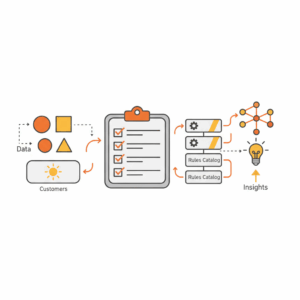
A rules catalog is a versioned inventory of eligibility, treatment, and suppression logic with explicit linkages to data, consent, and measurement. The catalog records each rule’s purpose, owner, channel, and dependencies. The catalog also records conflict resolution policies such as priority, arbitration logic, and collision handling. A strong catalog enables reuse, reduces duplication, and speeds audit. The IAB Europe Transparency and Consent Framework shows how a structured registry of vendors and purposes improves compliance and transparency.⁸ Leaders can apply the same discipline inside the enterprise. The rules catalog becomes a living contract between data, content, and activation teams. It centralises knowledge in a format that machines and auditors can parse.
Rules catalog template fields that keep teams aligned
Use the following fields in your catalog. Keep names consistent across platforms to support lineage.
Field group 1. Identification
Rule ID, human-readable name, rule type (eligibility, ranking, suppression), version, owner, status, creation date, last review date.
Field group 2. Purpose and outcomes
Business objective, customer value statement, target KPI, counter-metric, channel scope, lifecycle stage.
Field group 3. Legal and consent
Legal basis, consent requirement, consent sources, consent record linkage, retention period, data minimisation rationale.
Field group 4. Data and identity
Required attributes, required events, identity confidence threshold, profile segment, data quality thresholds, data steward contact.
Field group 5. Logic and constraints
Condition expression, priority, frequency cap, collision policy, fallback content, sensitive data constraints.
Field group 6. Measurement and governance
Experiment design, control group definition, sample sizes, stop rules, logging schema, review cadence, rollback plan.
Field group 7. Evidence and attachments
Test results, accessibility checks, security attestations, change history, deprecation notes. This grouping supports durable audit trails and smoother incident response.
How do teams compare rules engines, decisioning, and CDPs without vendor bias?
Executives often face overlapping capabilities. A CDP focuses on data unification and activation across channels. A rules or decision engine focuses on evaluation at request time with latency guarantees. Modern stacks combine a CDP profile store with an API-first decision service to deliver channel-agnostic logic. The RealCDP criteria help leaders test vendor claims with observable features such as unified profiles and event capture.⁵ The NIST Privacy Framework and ISO 27001 controls help compare privacy and security posture.⁴ ⁷ Vendor comparison should include a catalog export and import test. If a vendor cannot express rules and dependencies in a portable format, teams will face lock-in and audit friction. Use the checklist and catalog templates to drive the proof of concept and to keep scope honest.
What risks should executives mitigate before scaling personalisation?
Three risks dominate at scale. First, privacy and consent drift occurs when data reuse exceeds the original purpose. GDPR requires explicit purpose limitation and data minimisation.² Second, data quality regressions create false positives that frustrate customers. ISO 25012 gives a stable schema for prevention.⁶ Third, bias and harm can emerge from proxies for protected characteristics. The NIST Privacy Framework encourages risk assessment and mitigation plans that sit inside engineering.⁴ Leaders mitigate these risks with automated conformance checks at deployment, with quarterly catalog reviews, and with a single enterprise preference centre that writes consent into the profile. The IAB framework demonstrates how standardised consent signals can reduce ambiguity across vendors.⁸ Clear controls lower operational noise and protect brand equity.
How should leaders measure impact and maintain continuous control?
Leaders define a small set of north-star metrics and a larger set of diagnostic measures. Revenue lift, cost-to-serve reduction, and customer satisfaction tell the story to the board. Uplift experiments and holdout groups provide statistical proof of causality. Personalisation leaders refresh content and rule weights based on observed marginal lift and fatigue. Advanced teams use treatment-level logging to build effect libraries that show which rules work for which cohorts. Strong governance pairs these practices with routine reviews, catalog health dashboards, and security attestations under ISO 27001.⁷ Regular measurement prevents vanity metrics and ties personalisation to enterprise value. The discipline also gives regulators and auditors confidence.
What next step should executives take this quarter?
Executives should operationalise the checklist and rules catalog in the work management system. Start with one journey, one channel, and three rules that matter. Build the first catalog entries with full evidence. Apply the checklist as a quality gate. Prove lift with a holdout and publish both positive and negative findings. If the program clears the bar, expand to adjacent journeys and new channels. If the program fails, refine the hypothesis, fix the data, and try again. The combination of a crisp checklist and a living rules catalog creates a reliable operating system for personalisation. The system improves customer experience, protects privacy, and compounds value over time. This approach builds trust because it respects people, reduces waste, and scales with governance.
FAQ
What is a personalisation rules catalog and why should Customer Science leaders use one?
A rules catalog is a versioned inventory of eligibility, treatment, and suppression logic linked to data, consent, and measurement. It creates reuse, speeds audit, and reduces duplication. It aligns data, content, and activation teams around transparent decisioning.
How do Customer Experience leaders operationalise consent in personalisation?
CX leaders use explicit consent capture, store consent IDs and timestamps in the profile, and reference consent in every rule. They enforce data minimisation and align processing with GDPR or CCPA requirements at decision time.² ³
Which data quality standards help govern attributes used in targeting?
Teams use ISO 25012 to define accuracy, completeness, consistency, and timeliness thresholds per attribute. This standard gives objective controls that engineers can automate.⁶
Why do executives pair CDPs with decision engines for real-time CX?
A CDP unifies events and attributes while a decision engine evaluates rules with low latency. Together they enable channel-agnostic logic with auditable outcomes aligned to consent and identity.
How should contact centre leaders measure the impact of personalisation?
Leaders track revenue lift, cost-to-serve reduction, and satisfaction, then validate causality with holdouts and uplift tests. Logging at the treatment level supports effect libraries and ongoing optimisation.
Who owns the personalisation checklist and how is it used in governance?
Product managers own the checklist and attach it to every change. Security, compliance, and data owners review evidence. The checklist acts as a release gate and a durable audit artifact.
Which standards and frameworks support secure and compliant personalisation?
Executives reference GDPR for lawful processing, CCPA for US consumer rights, NIST Privacy Framework for risk management, ISO 27001 for security controls, ISO 25012 for data quality, and IAB TCF for consent signal standardisation.² ³ ⁴ ⁷ ⁶ ⁸
Sources
“The value of getting personalization right—or wrong—is multiplying,” McKinsey & Company, 2021, Article. https://www.mckinsey.com/capabilities/growth-marketing-and-sales/our-insights/the-value-of-getting-personalization-right-or-wrong-is-multiplying
“General Data Protection Regulation (GDPR),” European Union, 2016, Regulation Text. https://gdpr.eu/
“California Consumer Privacy Act and CPRA,” California Privacy Protection Agency, 2023, Agency Guidance. https://cppa.ca.gov/
“NIST Privacy Framework: A Tool for Improving Privacy through Enterprise Risk Management,” NIST, 2020, Framework. https://www.nist.gov/privacy-framework
“RealCDP Certification,” CDP Institute, 2024, Program Criteria. https://www.cdpinstitute.org/realcdp/
“ISO/IEC 25012: Data quality model,” ISO, 2008, Standard Overview. https://iso.org/standard/35736.html
“ISO/IEC 27001 Information security management,” ISO, 2022, Standard Overview. https://www.iso.org/isoiec-27001-information-security.html
“Transparency and Consent Framework,” IAB Europe, 2023, Framework. https://iabeurope.eu/transparency-consent-framework/