















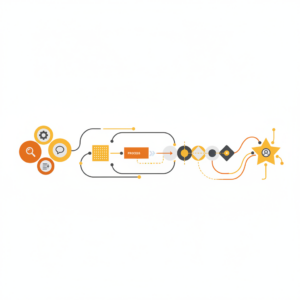
Personas only create business value when they drive decisions. Persona journey mapping connects research-based personas to journey maps that show what customers try to achieve, where effort spikes, and which operational fixes matter. Done well, it turns “insight” into a measurable service transformation backlog, improves consistency across channels, and reduces avoidable demand and cost.
Definition
What does “personas to journey maps” mean in CX transformation?
“Personas to journey maps” means linking two different artefacts into one decision system. A persona describes a research-based archetype with shared goals, behaviours, and context, not a fictional character or a demographic segment. Persona systems are the governance, evidence, and update cadence that keep personas accurate over time. Persona journey mapping then uses that persona to build a journey map that explains how the experience unfolds across stages, channels, and moments of truth, with clear causes of friction and outcomes.
Early disambiguation matters because “persona” is often used to mean a marketing profile or a comms tone target. This article uses “persona” in the human-centred design sense, where the artefact is grounded in user research and is designed to improve decisions, usability, and service outcomes under ISO-aligned human-centred practice¹.
Context
Why do persona systems fail to influence service transformation?
Most organisations create personas in one workstream and journey maps in another. The outputs look polished, but leaders cannot trace them to operational data, funding logic, or accountabilities. Research on personas shows that value depends on how they are used, not whether they exist³. Research on customer journeys shows similar fragmentation, with inconsistent terms and uneven links to action⁴˒⁵.
In practice, transformation fails when teams treat persona work as “insight” and journey mapping as “workshops”. The organisation then optimises touchpoints in isolation, while avoidable demand, channel switching, and rework continue. The fix is to treat personas and journey maps as connected components in one operating model: one shared vocabulary, one evidence base, and one change pipeline.
Mechanism
How do you translate a persona into a journey map that drives change?
Start with a persona that is specific enough to predict behaviour. Data-driven persona development research highlights the value of combining qualitative insight with behavioural and attitudinal data to reduce stereotypes and increase reliability². The persona should include: primary goal, triggering context, constraints (time, risk, capability), success criteria, and common failure patterns. Add “decision moments” where the customer changes channel, seeks reassurance, or escalates, because these are where cost and dissatisfaction concentrate.
Then build the journey map around a single scenario. Avoid “end-to-end for everything”. Pick one high-value outcome (for example, “resolve a billing error without calling”) and map the journey stages, actions, emotions, and barriers. Use evidence tags on each step: interview quotes, analytics, complaints themes, call drivers, and process timings. This keeps the journey map a testable hypothesis rather than wall art, aligning with government journey mapping guidance that places maps after user research and ties them to actionable artefacts⁹.
Finally, convert the journey map into an execution structure: moments that matter, root causes, measurable hypotheses, and owners. At this point, add service blueprint layers where operational risk is high, so teams can see frontstage experience and backstage work together⁵.
Comparison
Personas, segments, JTBD, and journey maps: what is different and when?
Segments answer “who is valuable to the business” using statistical grouping. Personas answer “who is this experience for, in context” using a research-based archetype³. Jobs to Be Done (JTBD) answers “what progress is the person trying to make” and is often strongest for innovation and messaging clarity. Journey maps answer “how the experience unfolds over time”, including cross-channel behaviour, emotions, and breakdown points⁵.
Use persona journey mapping when the organisation needs consistency across channels and teams. Use segmentation when investment needs to be allocated across markets. Use JTBD when the organisation needs sharper proposition clarity or to understand switching behaviour. Many mature organisations use all three, but avoid mixing them in one artefact. Instead, keep each entity clean and connect them through explicit relationships: persona → scenario → journey → operational drivers → metrics.
Applications
Where does persona journey mapping create the most value?
Persona journey mapping delivers the highest return where the service is complex, regulated, or multi-channel. It helps leaders focus transformation on the moments that actually drive satisfaction, failure, and recovery themes identified in journey research⁴.
Common high-value applications include:
Contact centre demand reduction by mapping the “why” behind repeat calls and escalations, not just the call reason.
Digital onboarding improvement by mapping confidence gaps, verification friction, and channel switching.
Complaints and remediation redesign by linking personas to failure pathways and service recovery.
Consistent service communications by mapping where customers need clarity, reassurance, and next-step guidance.
A practical accelerator is to connect journey steps to the actual words customers see. Use CommScore.AI to audit and improve customer-facing messages at scale, so the experience described in the journey map is reinforced in emails, letters, SMS, and chat: https://customerscience.com.au/csg-product/commscore-ai/ (This reduces mismatch between “designed” journeys and “delivered” communications.)
Risks
What goes wrong when teams connect personas to journey maps?
The most common failure is building personas that feel true but are not verifiable. Persona research warns that personas can become stereotypes when evidence is weak or when the artefact is not maintained²˒³. This risk rises when teams over-index on demographics and under-index on context, constraints, and behaviour.
The second failure is building one journey map per channel. Customers do not experience channels, they experience outcomes. Government service standards emphasise designing around user needs and measurable service performance, which implies cross-channel coherence rather than channel-by-channel optimisation⁷.
The third failure is governance. Without a cadence, the organisation keeps using outdated personas and maps while policies, products, and channel mix change. Co-creation research also shows that stakeholder engagement affects how artefacts are adopted, so governance must include the teams who run the service, not only the teams who design it¹⁰.
Measurement
How do you measure whether personas and journey maps improved CX and cost?
Measurement must link experience to outcomes. Use a small set of “journey outcomes” that matter to both customers and the business: task success, time to resolution, first-contact resolution, avoidable demand rate, and complaint rate. Then add “experience signals” such as perceived effort, confidence, and clarity at critical steps, because these often predict escalation.
For customer satisfaction monitoring and measurement processes, ISO guidance recommends defined processes, systematic collection, and analysis that drives improvement, not just reporting⁸. Apply this by measuring before and after changes at the moments that matter, with clear baselines and control periods where feasible. Tie each improvement initiative to a hypothesis derived from the journey map, such as “reducing identity verification steps will reduce drop-off and repeat contact”.
Also measure adoption. If frontline teams do not use the persona system, it will not drive change. Track whether personas and journey maps are referenced in business cases, backlog items, QA rubrics, and training materials. This is a leading indicator of sustained value.
Next Steps
What is an executive-ready operating model for persona to journey mapping?
An executive-ready model turns persona journey mapping into a repeatable cycle:
Prioritise 1–2 personas based on value and risk, not popularity.
Select one scenario per persona that is strongly linked to cost, churn, or trust outcomes.
Triangulate evidence: qualitative research, operational data, and complaints themes, then update the persona to reflect what the data shows².
Map the current journey, then design a target journey with explicit assumptions.
Blueprint only the high-risk steps to expose backstage constraints and controls⁵.
Convert insights into a funded change backlog with owners, measures, and delivery sequencing.
Re-measure and refresh the persona system on a scheduled cadence.
To operationalise this quickly across CX, service design, and delivery teams, use CX consulting and service transformation delivery that connects research, mapping, business cases, and implementation: https://customerscience.com.au/solution/cx-consulting/
Evidentiary Layer
What evidence supports persona journey mapping?
Customer journey research shows rapid growth and recurring themes that directly affect transformation priorities, including failure and recovery, channels, and technology disruption⁴. Systematic reviews of customer journeys also highlight the need for consistent terminology and methods, which supports creating a standardised persona-to-journey workflow rather than ad hoc workshops⁵.
Persona research shows that personas are used across design and decision-making, but effectiveness depends on use cases, governance, and evidence quality³. Data-driven persona development also strengthens the reliability of personas by grounding archetypes in behavioural and quantitative signals, which reduces “storytelling drift” over time². Together, these findings support a disciplined approach: personas provide context, journey maps provide the temporal experience model, and measurement standards provide the improvement loop¹˒⁸.
FAQ
What is the minimum viable persona system for executives?
One to three personas, each tied to a measurable scenario, with evidence tags, owners, and a refresh cadence. This prevents artefact sprawl while keeping decisions consistent.
How many journey maps should we create per persona?
Start with one high-value scenario per persona. Expand only after you have implemented changes and validated impact, so mapping effort stays proportional to outcomes.
What data should sit behind a journey map?
Research notes, call drivers, digital funnel analytics, complaint themes, and operational timings, linked to each journey step so the map remains testable⁸.
How do we keep personas and journey maps current as channels change?
Treat them as living assets with quarterly review triggers, using real-time interaction signals and updated knowledge flows. Knowledge Quest can help convert live interactions into maintainable, brand-aligned knowledge that supports consistent journeys: https://customerscience.com.au/csg-product/knowledge-quest/
What is the fastest way to turn journey insights into lower cost-to-serve?
Target avoidable demand moments, then fix upstream clarity and process gaps. Improvements to communications and knowledge often reduce repeat contact faster than technology changes.
How do we avoid biased or stereotyped personas?
Use mixed-method evidence, include behavioural data, and validate with frontline teams and customers. Refresh when data shows different patterns²˒³.
Sources
ISO. ISO 9241-210:2019 Ergonomics of human-system interaction, Human-centred design for interactive systems. https://www.iso.org/standard/77520.html
Salminen, J. et al. (2021). A Survey of 15 Years of Data-Driven Persona Development. International Journal of Human–Computer Interaction. https://doi.org/10.1080/10447318.2021.1908670
Salminen, J. et al. (2022). Use Cases for Design Personas: A Systematic Review and New Frontiers. ACM (CHI). https://doi.org/10.1145/3491102.3517589
Tueanrat, Y., Papagiannidis, S., Alamanos, E. (2021). Going on a journey: A review of the customer journey literature. Journal of Business Research, 125, 336–353. https://doi.org/10.1016/j.jbusres.2020.12.028
Følstad, A., Kvåle, K. (2018). Customer journeys: a systematic literature review. Journal of Service Theory and Practice, 28(2), 196–227. (Stable record) https://www.semanticscholar.org/paper/Customer-journeys%3A-a-systematic-literature-review-F%C3%B8lstad-Kv%C3%A5le/1a98d8aba48f51d35be79bbe6cbd013dc671b47b
Micheaux, A., Bosio, B. (2019). Customer Journey Mapping as a New Way to Teach Data-Driven Marketing as a Service. Journal of Marketing Education, 41(2), 127–140. https://doi.org/10.1177/0273475318812551
Australian Government. Digital Service Standard. https://www.digital.gov.au/policy/digital-experience/digital-service-standard
ISO. ISO 10004:2018 Quality management, Customer satisfaction, Guidelines for monitoring and measuring. https://www.iso.org/standard/71582.html
APS Professions. Journey maps (Australian Government guidance). https://www.apsprofessions.gov.au/content-strategy/define-user-content-needs/create-actionable-artefacts/journey-maps
Neate, T. et al. (2019). Co-Created Personas: Engaging and Empowering Users with Diverse Needs. CHI (PDF). https://openaccess.city.ac.uk/id/eprint/21271/1/co-created-personas-chi-2019.pdf
Mele, C. et al. (2025). Unravelling the customer journey: A conceptual framework and bibliometric review. Technological Forecasting and Social Change. https://www.sciencedirect.com/science/article/pii/S0040162524007145
Queensland Government. Customer journey mapping (Digital service design playbook). https://www.forgov.qld.gov.au/service-design-and-delivery/design-public-services/digital-service-design-playbook/all-plays/customer-journey-mapping