



























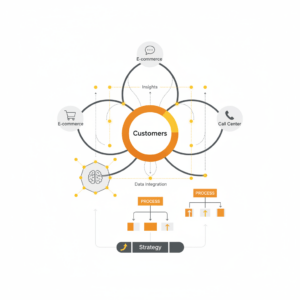
What is an omnichannel CX strategy and why does it matter now?
Executives seek growth, efficiency, and trust. Customers expect continuity when they switch from web to app to service and back again. An omnichannel customer experience strategy coordinates data, decisions, and delivery so every channel shares context and advances the same outcome. Forrester frames this as connecting journeys with real-time interaction management that delivers contextually relevant experiences across the life cycle.¹ Firms that operationalise relevance and timing see material revenue lift, which makes omnichannel a core operating model rather than a UI refresh.²
What does “good” look like in practical terms?
Teams define a small set of journeys that matter most, then ensure that identity, consent, and state travel with the customer. Adobe’s event model shows how reusable, versioned events keep semantics stable across channels, which prevents brittle point-to-point integrations.³ Treating journeys as simple state machines clarifies legal transitions and failure paths so systems recover gracefully when dependencies fail.⁴ Modern orchestration tools add no-code steps like Hold until, Delay, Splits, and Randomized Split to adapt to behavior while enabling safe experiments.⁵ This mechanism produces continuity without custom plumbing in every channel.
How does the framework work under the hood?
A practical omnichannel framework runs a closed loop: sense, decide, act, and learn.
Sense. Capture reusable events such as
signup.created,payment.failed, andcase.resolved. Version schemas and validate at the edge so one channel’s change does not break another.³Decide. Evaluate rules for consent and policy, apply predictive models where they outperform simple thresholds, and expose experiments that compare variants safely.¹ ⁵
Act. Trigger messages, UI changes, service tasks, or entitlement updates in the right channel and hand off context when escalation is needed.
Learn. Measure progression, time in state, and first contact resolution across channels. HEART’s goal–signal–metric mapping keeps signals tied to outcomes.⁶
Where should you start to avoid sprawl?
Leaders begin with two journeys that combine high volume and high avoidable effort. Typical candidates are onboarding and payment recovery. Map each journey as states like Not Activated, Activated, Payment Pending, and Paid. Define entry events, guards for consent, and re-entry rules. Use conditional holds so you never send a reminder after the customer has already acted.⁵ Link outcomes to activation time, resolution, and repeat contact so the business case is visible early.²
How do identity, consent, and privacy stay compliant across channels?
Identity connects touchpoints; consent limits what you can do. Australian Privacy Principles require consent that is informed, specific, current, and voluntary, plus purpose checks before activation.⁷ ⁸ Store consent with timestamp and provenance. Apply checks at entry and at send, not only during audience building. Respect channel-level permissions and provide easy opt out. This posture reduces risk and preserves trust while you integrate channels.
What is the minimum viable architecture?
Architects stabilise four layers that scale patiently.
Data and identity. Reusable events with versioned schemas and consent attributes.³
Decisioning. Rules for policy and safety, models for optimization, and experiments for learning.¹ ⁵
Activation. Connectors to email, SMS, push, in-app, web, service, and retail, plus non-message actions such as case creation and entitlement updates.
Observability. Entry counts, branch distribution, error rates, event latency, time in state, and journey completion. HEART keeps definitions crisp and comparable.⁶
How do you blend channels without forcing customers to repeat themselves?
Continuity comes from state and context handoff. When self-service escalates to chat or voice, pass the task ID, last step, and verified identity so agents start in the right place. Knowledge-centered practices place short, current answers inside the desktop so the first capable resolver can finish the job.⁹ Contact programs that pair strong handoffs with clear knowledge raise first contact resolution and lower repeat volume.¹⁰
What governance keeps omnichannel fast and safe?
Governance should be light but real. Leaders install a weekly design authority to approve new events, rules, and experiments against a checklist: schema versioning present, consent checks at entry and send, re-eligibility defined, deduplication enabled, branch counts within platform limits, failure paths designed.³ ⁵ The same group owns a monthly scorecard that tracks reliability and outcomes, which keeps investment tied to results rather than preferences.
How do you measure progress with leading and lagging indicators?
Use a paired scorecard.
Leading: event latency P95, time-in-state P75, rule hit rates, hold-to-event conversion, duplicate-prevention saves.⁶
Lagging: activation rate, first contact resolution, repeat-within-window, revenue lift from personalization, and cost to serve.² ¹⁰
Write formulas once, then reuse across journeys. Leading indicators let teams steer in week; lagging indicators prove value to finance and the board.
What mistakes derail omnichannel and how to avoid them?
Three traps recur. First, channel-first builds create silos that cannot share state. Fix by standardising events and states before adding new channels.³ ⁴ Second, fixed delays send irrelevant reminders after the job is done. Fix with conditional holds that resume on proof of action.⁵ Third, vanity metrics like opens displace progression and resolution. Fix by adopting HEART and FCR so metrics reflect customer outcomes.⁶ ¹⁰
What does a 90-day omnichannel plan look like?
Phase 1: Thin slice.
Choose onboarding. Ship reusable events, define states, enforce consent at entry and send, and instrument time to first value.³ ⁶
Phase 2: Cross-channel continuity.
Add chat and voice escalation with context handoff. Embed knowledge in the desktop and introduce warm-transfer standards.⁹ ¹⁰
Phase 3: Experiment and expand.
Introduce a randomized split to test message order or channel mix. Keep within documented platform limits and publish lift with confidence intervals.⁵
Phase 4: Governance and rollout.
Launch the weekly design authority and monthly board review. Version schemas, refine thresholds, and add one adjacent journey such as payment recovery.
What outcomes should executives expect if the framework is followed?
Executives should see faster activation, higher first contact resolution, and lower repeat contacts for targeted journeys within the first quarter. They should also see fewer irrelevant nudges due to event-driven holds and clearer status across channels. Over time, personalization and timing improvements compound into measurable revenue lift and lower cost to serve, which justifies expansion to additional journeys.²
FAQ
What is the simplest definition of omnichannel CX?
Omnichannel CX coordinates data, decisions, and delivery so every channel shares context and advances the same outcome rather than running separate tracks.¹
Where should we start next month?
Start with one journey such as onboarding. Define states, version events, enforce consent, and add conditional holds. Measure activation time and first contact resolution.³ ⁵ ¹⁰
Which technology choices matter most early?
Reusable events with versioned schemas, a decision layer that supports rules and experiments, and orchestration steps like Hold until and Randomized Split.³ ⁵
How do we keep customers from repeating themselves on escalation?
Pass task ID, last step, and verified identity to the agent. Use knowledge-centered practices so the first capable resolver can finish on the same interaction.⁹ ¹⁰
What metrics prove omnichannel is working?
Time-in-state, event latency, first contact resolution, repeat-within-window, and revenue lift. HEART keeps signals aligned to outcomes that executives trust.² ⁶ ¹⁰
How do we avoid sending irrelevant reminders?
Replace fixed delays with conditional holds that resume on real events such as login or payment. This keeps communication timely and reduces fatigue.⁵
Sources
Invisible experiences: Anticipate customer needs with Real-Time Interaction Management — Forrester Research, 2024, Forrester Blog. https://www.forrester.com/blogs/invisible-experiences-anticipate-customer-needs-with-real-time-interaction-management/
The value of getting personalization right—or wrong—is multiplying — N. Arora, D. Ensslen, L. Fiedler, W. Liu, K. Robinson, E. Stein, G. Schüler, 2021, McKinsey Insights. https://www.mckinsey.com/capabilities/growth-marketing-and-sales/our-insights/the-value-of-getting-personalization-right-or-wrong-is-multiplying
About events | Adobe Journey Orchestration — Adobe, 2025, Adobe Experience League. https://experienceleague.adobe.com/en/docs/journeys/using/events-journeys/about-events/about-events
Learn about state machines in Step Functions — AWS, 2024, AWS Documentation. https://docs.aws.amazon.com/step-functions/latest/dg/concepts-statemachines.html
Event-Triggered Journeys: Steps and Experiments — Twilio Segment Docs, 2024. https://www.twilio.com/docs/segment/engage/journeys/v2/event-triggered-journeys-steps
Measuring the User Experience at Scale: The HEART Framework — K. Rodden, H. Hutchinson, X. Fu, 2010, Google Research Note. https://research.google/pubs/pub36299/
Australian Privacy Principles — Office of the Australian Information Commissioner, 2023, OAIC. https://www.oaic.gov.au/privacy/australian-privacy-principles
Australian Privacy Principles guidelines — Office of the Australian Information Commissioner, 2025, OAIC. https://www.oaic.gov.au/privacy/australian-privacy-principles/australian-privacy-principles-guidelines
Knowledge-Centered Service Practices Guide — Consortium for Service Innovation, 2020. https://www.serviceinnovation.org/kcs-resources
First Contact Resolution: Definition and Approach — ICMI, 2008, ICMI Resource. https://www.icmi.com/files/ICMI/members/ccmr/ccmr2008/ccmr03/SI00026.pdf