



















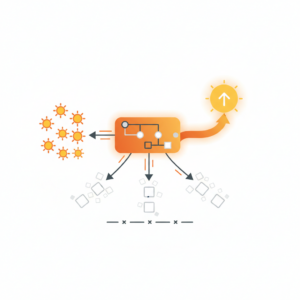
What is channel switching and why does it explode effort?
Customers start in one channel and jump to another when progress stalls. Channel switching raises effort, increases cost, and erodes trust because each handoff risks re-authentication, context loss, and duplicated work. Research on service effort shows that reducing customer effort is a stronger predictor of loyalty than “delight” tactics, which makes channel switching a prime target for improvement.¹ In commerce and service, people often migrate channels to reduce uncertainty or complete a blocked task; the literature labels this “channel migration,” driven by perceived risk, task complexity, and expected utility.² When switching happens, repeat contacts rise and first contact resolution falls.³
What actually causes channel switching in the wild?
Channel switching rarely comes from “channel preference.” It comes from friction in the current step. Five drivers dominate. First, forms demand extra information and error messages hide the fix; users abandon to phone or chat for help. Independent usability research shows unnecessary fields and poor error handling depress completion across industries.⁴ Second, status is opaque; people switch to “confirm it went through.” Service blueprinting work shows backstage transparency reduces “just checking” contacts.⁵ Third, delays are timer-based rather than event-based; a reminder arrives after the user already acted, pushing them to seek a human. Orchestration tools address this with conditional holds that wait for proof of action.⁶ Fourth, escalation drops context; repeating details in a new channel is a guaranteed trigger for switching. Fifth, authentication fails or feels heavy; customers pick the channel that seems fastest, not the one the business intended. Each driver is solvable with design, orchestration, and policy—not just training.
How do you diagnose switching with signals rather than anecdotes?
Strong programs model journeys as simple state machines and watch the transitions. A “switch” is observable: web session starts task, session stalls, then a related call or chat arrives within a defined window. Treat time-in-state, progression rate by step, and repeat-within-window as leading indicators so you can act before lagging outcomes like churn move. The HEART framework maps goals to signals and metrics, which keeps measurement honest and comparable.⁷ Add two operational signals: first contact resolution and contact reason taxonomy. FCR quantifies whether the problem was actually solved on the first interaction; low FCR clusters around switching hot spots.³ A lightweight issue taxonomy joins “where” and “why” so fixes target the true blockers rather than symptoms.
Where should you intervene first to prevent switching?
Intervene where stalls are frequent and cheap to fix. Start with forms and identity flows because they create the most avoidable leakage. Remove nonessential fields and validate inline; this reliably improves completion and reduces assisted demand.⁴ Collapse authentication to the lightest step compatible with risk, and use step-up only when required. Make state visible with clear labels like Submitted, In Review, Approved, with timestamps and next-step certainty; this alone cuts “just checking” calls.⁵ Replace fixed waits with conditional holds so messages stop and switch the moment an action lands.⁶ When escalation is required, pass the task ID, verified identity, and prior steps to the agent so customers do not repeat themselves. These moves lower perceived effort, which, in turn, lowers the urge to switch.¹
When is a channel switch healthy—and how do you enable it safely?
Some switching is rational. Complex claims, vulnerable-customer cases, or high-stakes transactions genuinely need a human. Make those switches fast and safe. Signal availability early, offer callback or asynchronous messaging instead of a hard hold, and preserve context across the boundary. Queue studies show that well-implemented callbacks reduce abandonment and perceived wait without adding staff pressure, which makes them ideal for “healthy” switches.⁸ The goal is not zero switching; it is purposeful switching with continuity.
What operating model keeps switching under control week after week?
Build a simple loop: observe, detect, fix, and verify. Observe switching by step with a weekly report that joins digital stalls to assisted follow-ups within a defined window. Detect when thresholds breach: event latency P95 above target, time-in-state P75 rising, FCR dipping on a specific intent. Fix by changing content, sequence, policy, or system behavior—prefer non-message fixes before more reminders. Verify with controlled tests; randomized splits in modern journey tools let you compare “fixed delay” vs “hold until event” or “old form” vs “reduced fields” without heavy engineering.⁶ Keep a design authority that approves changes against a checklist: schema versioning present, consent and purpose checks at entry and send, re-eligibility set, dedupe enabled, and failure paths designed.⁹
Portal vs app vs messaging: which channel reduces switching for your use case?
Choose the channel that best fits the job frequency and capability need, not the one with the loudest stakeholder. Mobile web and portals win for episodic tasks because they have the lowest acquisition friction and are easy to keep current; this increases first-time success.¹⁰ Native apps win when tasks are frequent and benefit from push, offline, or sensors.¹¹ Messaging absorbs peaks and supports stop–resume work with context, which lowers switching during busy hours. When in doubt, ship a great portal flow end to end, then add a focused app utility where frequency and device capabilities clearly matter.¹⁰ ¹¹
How do you prove your fixes reduced switching and not just clicks?
Measure the mechanism and the outcome together. Mechanism: drop-off by step, login error rate, event latency, hold-to-event conversion, and percent of assisted contacts with full context attached at entry. Outcome: repeat-within-window on the same issue, first contact resolution by intent, and contact ratio for targeted tasks. Publish one page per journey with the North Star (for example, activated accounts per week) and the inputs that move it. HEART’s goal–signal–metric mapping keeps every team aligned on the same evidence.⁷ When both mechanism and outcome improve, you reduced switching for the right reasons.
The five-point playbook to cut channel switching this quarter
-
Instrument the “switch” by tagging assisted contacts that follow a stalled digital step within a 3–7 day window. Treat this as an incident trend, not a curiosity.
-
Fix the top form by removing fields and adding inline validation; confirm completion lift and lower assisted follow-up.⁴
-
Make status explicit with state labels and timestamps; add proactive confirmations to preempt “just checking” calls.⁵
-
Turn delays into holds so nudges and offers stop on proof of action; verify with a randomized split.⁶
-
Preserve context on escalation with task ID, verified identity, and last step; coach to first contact resolution.³
Run the loop weekly. Publish results monthly with the business impact: fewer repeat contacts, lower wait time, and higher progression.
FAQ
What is the single biggest driver of channel switching?
Stalled progress. Customers switch when a step blocks or lacks clear status. Fix forms and identity flows first, then add explicit state and proactive confirmations.⁴ ⁵
How do we measure switching objectively?
Link digital stalls to assisted contacts on the same issue within a defined repeat window, then track first contact resolution and repeat-within-window to confirm real improvement.³ ⁷
Do reminders increase or decrease switching?
It depends. Fixed-delay reminders often arrive after action and trigger frustration. Event-driven “hold until” logic reduces irrelevant nudges and unnecessary switching.⁶
Is it realistic to aim for zero channel switching?
No. Some cases need humans. Aim for purposeful switching with preserved context, callbacks, or messaging to avoid new queues and rework.⁸
Which channel should we prioritise to reduce switching?
Prioritise a responsive portal for episodic jobs and a focused app only where frequency and device capabilities create clear value; add messaging to absorb peaks and preserve context.¹⁰ ¹¹
How does lowering effort relate to switching?
Directly. High-effort experiences drive defection and repeat contacts; reducing effort through better flow, status, and orchestration lowers the urge to switch channels.¹
Sources
-
Stop Trying to Delight Your Customers — Matthew Dixon, Karen Freeman, Nicholas Toman, 2010, Harvard Business Review. https://hbr.org/2010/07/stop-trying-to-delight-your-customers
-
Customer Experience Creation: Determinants, Dynamics and Management Strategies — Peter C. Verhoef, Scott A. Neslin, Björn Vroomen, 2007, Journal of Retailing. https://www.sciencedirect.com/science/article/abs/pii/S0022435907000342
-
First Contact Resolution: Definition and Approach — ICMI, 2008, ICMI Resource. https://www.icmi.com/files/ICMI/members/ccmr/ccmr2008/ccmr03/SI00026.pdf
-
Checkout and Form Usability: Research Findings — Baymard Institute, 2019–2024, Baymard Research. https://baymard.com/research/forms
-
Service Blueprinting: A Practical Technique for Service Innovation — Mary Jo Bitner, Amy L. Ostrom, Felicia Goul, 2008, California Management Review. https://cmr.berkeley.edu/2010/09/service-blueprinting/
-
Event-Triggered Journeys: Steps (Hold Until, Randomized Split) — Twilio Segment Docs, 2024, Twilio. https://www.twilio.com/docs/segment/engage/journeys/v2/event-triggered-journeys-steps
-
Measuring the User Experience at Scale: The HEART Framework — Kerry Rodden, Hilary Hutchinson, Xin Fu, 2010, Google Research Note. https://research.google/pubs/pub36299/
-
Optimal Scheduling in Call Centers with a Callback Option — B. Legros, 2016, European Journal of Operational Research. https://www.sciencedirect.com/science/article/abs/pii/S0166531615000930
-
About Events | Adobe Journey Orchestration — Adobe, 2025, Experience League. https://experienceleague.adobe.com/en/docs/journeys/using/events-journeys/about-events/about-events
-
Mobile Website vs. Mobile App: When and Why — Nielsen Norman Group, 2023, NN/g. https://www.nngroup.com/articles/mobile-sites-apps-differences/
-
The Mobile App Engagement Playbook — Forrester, 2023, Forrester Research. https://www.forrester.com/report