






























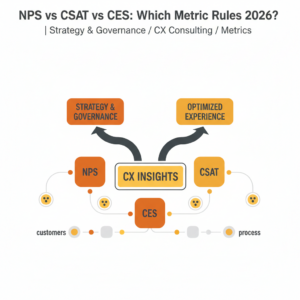
No single metric rules 2026. CSAT is the best base metric for day-to-day service quality, CES is the best diagnostic for friction, and NPS is the best high-level loyalty signal. If an executive team insists on one headline number, CSAT is the safest choice for most service environments because it is closest to the interaction, easier to act on, and already recognised as an industry-standard service-quality measure.¹˒²˒³˒⁴
What is the real difference between NPS vs CSAT vs CES?
NPS measures stated advocacy. It asks whether a customer would recommend the brand or service. CSAT measures satisfaction with an interaction, service, or experience. CES measures how easy or hard it was for the customer to get something done. These are not competing versions of the same thing. They answer different management questions.³˒⁵˒⁶
That distinction matters because leaders still ask for one “best customer experience metric” when the better question is which decision each metric supports. Academic work comparing customer feedback metrics found that satisfaction, NPS, and effort differ in what they predict and how they should be used.⁵˒⁶ More recent work also shows that customer satisfaction is positively associated with retention, word of mouth, spending, and firm-level performance, while NPS remains widely used as a loyalty and advocacy signal despite long-running methodological debate.⁷˒⁸
Which metric rules 2026?
For most CX and service teams, none should rule alone. But CSAT should lead.
That conclusion follows from how service operations are actually run in 2026. Australia’s Digital Performance Standard says customer satisfaction is an industry-standard measure of digital service quality and tells teams to monitor services with a holistic approach.¹˒² That does not make CSAT perfect. It does make it the most defensible default metric for live service governance.
NPS still matters. But it is better as a board-level or relationship-level signal than as the main tool for fixing broken journeys. CES matters too. In fact, it is often the sharper lens when the real problem is friction, handoffs, or repeat effort. The mistake is asking one metric to do all three jobs.
Why is CSAT the strongest base metric?
CSAT sits closest to the experience you are trying to improve. It can be tied to a transaction, a case, a complaint, a resolution event, or a journey stage. That makes it easier to connect to operational causes such as delays, poor handoffs, weak knowledge, or inconsistent answers.¹˒²˒⁷
There is also a stronger evidence base behind satisfaction than many executive teams admit. A 2023 meta-analysis covering 535 correlations from 245 articles found a positive association between customer satisfaction and customer-level outcomes such as retention, word of mouth, spending, and price tolerance, as well as firm-level outcomes.⁷ That makes CSAT more than a soft sentiment score. It is a practical bridge between frontline quality and commercial performance.
When does CES matter more than CSAT?
CES matters most when the customer goal is clear and the task should be easy. Password resets. Claims updates. Appointment changes. Onboarding steps. Complaints. Identity checks. Any journey where effort is the real source of value loss.
This is why CES has become more useful in service redesign than in executive storytelling. Academic work comparing feedback metrics found that effort can perform strongly in some settings, especially where retention or defection is linked to ease of task completion.⁵˒⁹ In hospitality and service contexts, consumer satisfaction and effort have both been found to outperform NPS in predicting important outcomes in some sectors.⁹
But CES has limits. It can tell you that a process feels hard. It cannot fully tell you whether the outcome felt fair, trustworthy, or emotionally satisfying. So it is best used as a friction lens, not as a full replacement for CSAT.
Why is NPS still used so heavily?
Because NPS is simple, familiar, and easy to explain to boards. It compresses advocacy into one number and gives leaders a directional brand or relationship signal. That simplicity is exactly why it spread so widely.⁸˒¹⁰
Still, the research base is more mixed than the marketing around it. Earlier and more recent academic work both challenge the idea that NPS is the single best predictor of growth or the clear winner over satisfaction.⁶˒⁸˒¹⁰ A 2023 study on whether NPS should be supplemented with other metrics concluded that different metrics add value for different outcomes such as retention, recommendation, and share of wallet.¹⁰ So NPS is still useful. It just should not be treated as the only score that matters.
How should leaders choose the best customer experience metric?
Choose by decision type.
If the question is, “Are we delivering a good service interaction?” use CSAT.¹˒²
If the question is, “Where are customers working too hard?” use CES.⁵˒⁹
If the question is, “Are we building advocacy and relationship strength over time?” use NPS.⁸˒¹⁰
That sounds tidy. Real life is messier. Which is why the best 2026 model is a metric stack, not a metric monarchy. One base metric. Two supporting metrics. Clear roles.
Comparison
Which metric is best for service operations?
CSAT is best for service operations because it is the easiest to tie to teams, touchpoints, and interventions. It works well for weekly governance, quality reviews, and journey-stage reporting.¹˒²˒⁷
Which metric is best for removing friction from CX?
CES is best for removing friction from CX because it directly captures perceived effort. Where repeat contact, channel switching, and unresolved demand are the problem, CES often surfaces the issue faster than NPS.⁵˒⁹
Which metric is best for executive and board reporting?
NPS is still the easiest board-level headline metric because it is widely recognised and simple to trend over time. But it should sit beside operational evidence, not above it.⁸˒¹⁰
Applications
The strongest 2026 measurement model is simple. Use CSAT as the base service-quality score. Add CES on high-friction journeys. Use NPS at relationship checkpoints such as renewal, major lifecycle reviews, or periodic brand tracking.
That model works especially well when paired with live operational data. Customer Science Insights is relevant here because metric debates usually go nowhere when teams cannot connect scores to demand, transfers, repeat contact, handle time, and resolution patterns. The internal link set supplied by the user lists it as a core product page.
What usually goes wrong?
The first mistake is turning one metric into a political trophy. A team hits NPS while customers still struggle to complete tasks. Or CSAT rises because expectations fell, not because the service improved.
The second mistake is surveying at the wrong moment. CES asked after a complex complaint may reveal effort clearly. NPS asked immediately after a password reset may reveal almost nothing useful. Metric fit depends on journey context.⁵˒¹⁰
The third mistake is separating survey data from operating data. Qualtrics’ 2025 ROI work argues that CX metrics become more valuable when tied to loyalty outcomes such as trust, recommendation, and purchase intent.³ But operationally, you still need to know what caused the score to move. Otherwise the metric becomes decorative.
How should leaders measure success in 2026?
Use one governing rule. No metric should stand alone.
For most service organisations, that means CSAT plus at least one behavioural or operational companion metric such as completion, recontact, or resolution time.¹˒² Then add CES where friction matters and NPS where relationship strength matters.³˒⁵˒⁷
This is also where measurement design support can help. CX Consulting and Professional Services fits naturally in the measurement and governance phase because the hard part is usually not collecting scores. It is deciding where to ask, what to pair them with, and how to make the results useful in management forums. The page is included in the internal link file.
Next steps
Start by classifying your decisions. Which ones are about service quality, which are about friction, and which are about loyalty? Then assign the metric to the decision, not the other way around.
After that, simplify the scorecard. One base metric for service control. One friction metric where effort matters. One relationship metric for leadership tracking. That is usually enough. And it is far better than pretending one number can carry the whole customer experience.
Evidentiary layer
The evidence base does not support crowning one universal winner. Government guidance supports customer satisfaction as a standard service-quality measure and calls for holistic monitoring.¹˒² Academic comparisons show that satisfaction, effort, and NPS each have different predictive strengths depending on the outcome and context.⁵˒⁶˒⁹˒¹⁰ Meta-analytic evidence gives satisfaction a particularly strong link to customer and firm outcomes.⁷ Vendor research adds that satisfaction is also closely tied to trust, recommendation, and intended loyalty in recent consumer datasets.³˒⁴ Put together, the practical conclusion is clear. CSAT should lead. CES should diagnose. NPS should signal longer-term advocacy.
FAQ
Which is the best customer experience metric in 2026?
For most service organisations, CSAT is the best single base metric because it is the most actionable for service quality and is already recognised as an industry-standard quality measure.¹˒²
Does that mean NPS is outdated?
No. NPS is still useful for tracking advocacy and relationship strength. It is just weaker as a standalone operating metric for fixing daily service problems.⁸˒¹⁰
When should we use CES?
Use CES on journeys where the customer is trying to complete a task and ease matters most. It is especially useful for diagnosing friction, repeat effort, and broken handoffs.⁵˒⁹
Should we report all three to the board?
Usually not in the same way. Boards often need one headline relationship signal and a small number of supporting outcome measures. Executives and service leaders need the fuller mix.¹˒²˒³
What metric should contact centres manage week to week?
CSAT is usually the best week-to-week management score because it can be tied closely to interactions, journey stages, and quality improvement work.¹˒²
Where does knowledge management fit into this?
It sits underneath all three metrics. Poor knowledge drives lower CSAT, higher effort, and eventually weaker advocacy. Knowledge Quest is relevant when inconsistent answers or slow content updates are distorting the metric picture before leaders even start analysing it. Its inclusion is confirmed in the internal link file.
Sources
-
Australian Government Digital Transformation Agency. Digital Performance Standard. 24 July 2024. Criterion 4 states that customer satisfaction is an industry-standard measure of digital service quality. (Digital Australia)
-
Australian Government Digital Transformation Agency. Digital Performance Standard guidance on holistic monitoring and outcome measurement. 2024. (Digital Australia)
-
Qualtrics XM Institute. ROI of Customer Experience, 2025. Based on the 2024 Global Consumer Study. (qualtrics.com)
-
Qualtrics. Understanding Customer Experience ROI. 31 December 2025. (qualtrics.com)
-
de Haan E, Verhoef PC, Wiesel T. The predictive ability of different customer feedback metrics for retention. International Journal of Research in Marketing. 2015. (ScienceDirect)
-
van Doorn J, Leeflang PSH, Tijs M. Satisfaction as a predictor of future performance: A replication. International Journal of Research in Marketing. 2013. (ScienceDirect)
-
Mittal V, et al. Customer satisfaction, loyalty behaviors, and firm financial performance: A meta-analysis. Journal of the Academy of Marketing Science. 2023. (Springer Nature)
-
Baehre S, O’Dwyer M, O’Malley L, Lee N. The use of Net Promoter Score to predict sales growth. Journal of the Academy of Marketing Science. 2022. (Springer Nature)
-
Agag G, Eid R. Which consumer feedback metrics are the most valuable in explaining hotels’, restaurants’, and airlines’ financial performance? Tourism Management. 2020. (ScienceDirect)
-
“Should Net Promoter Score be supplemented with other customer metrics?” Journal of Service Research. 2023. Examines the value of different customer satisfaction and loyalty metrics in predicting retention, recommendation, and share of wallet. (journals.sagepub.com)