




























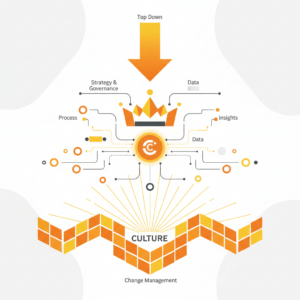
Customer centric culture change sticks when senior leaders change what the organisation rewards, measures, funds, and reviews. In 2026, slogans are not enough. Teams need one view of the customer, shared priorities across functions, and visible executive accountability for outcomes. That is what turns CX from a side program into a management system.¹˒²˒³˒⁴
What is customer centric culture change?
Customer centric culture change is the shift from function-led decision-making to customer-outcome-led decision-making across the whole organisation. That means strategy, operations, technology, policy, and frontline work all start from the customer task and the value the organisation is trying to create. Recent research argues that firms still fall into predictable customer-centricity traps, and that digital technology plus leadership behaviours are two of the main tools for closing the gap between customer intent and organisational action.⁵
That gap is easy to recognise. Marketing says one thing. Service handles the fallout. Product teams build to internal priorities. Operations protect throughput. Customers experience the joins. The APS Experience Design Principles were built to support people-centred and inclusive service design across channels, and the Digital Service Standard still frames good services as user-friendly, inclusive, adaptable, and measurable.¹˒² Those are culture signals as much as design signals.
Why does top-down change still matter?
Because most barriers to customer centricity sit above the frontline. Strategy decides what gets funded. Governance decides what gets reviewed. Incentives decide what people actually do when trade-offs appear. Research on customer experience strategy implementation found that top management support, organisation-wide involvement, CX measurement capability, and internal use of CX data all have significant positive effects on implementation success.⁶
That matters more in 2026 because the pace of change is still rising. Deloitte’s 2026 Global Human Capital Trends reports that only 27% of respondents believe their organisations manage change effectively, and only 8% say their organisations are highly effective at meeting continuous learning needs.⁷ When change is constant, leaders cannot treat customer centric culture change as a communications campaign. They have to redesign how work is run.
How should leaders structure a CX change management strategy?
A practical CX change management strategy has four parts.
First, define the customer outcomes the organisation will treat as shared outcomes. Not abstract values. Real outcomes such as journey completion, avoidable recontact, complaint reduction, and trust.
Second, change the management cadence. Review customer outcomes in executive forums, not just project updates or silo KPIs.
Third, connect cross-functional accountability. Research on cross-functional coordination shows that process coordination increases customer strategic and operational coordination, and both support operational performance.⁸
Fourth, build the evidence loop. Teams need customer data, service data, and feedback data in forms they can use. The Digital Experience Policy, which took effect from 1 January 2025, reinforces that digital services should be delivered consistently through a common policy and standards framework.⁹
What should executives change first?
Executives should change what gets measured, what gets escalated, and what gets defended.
Measurement comes first because culture follows scorecards more often than speeches. If functions are still managed only through budget, volume, utilisation, or delivery speed, they will keep making local decisions. A stronger model adds customer outcome measures that matter across departments. Gallup’s 2025 global workplace data found only 21% of employees globally are engaged, while its workplace report says falling engagement cost the world economy US$438 billion in lost productivity last year.¹⁰˒¹¹ Low engagement is not a side issue here. It weakens follow-through, manager consistency, and the energy needed for service change.
Escalation rules come next. If a customer issue crosses business units, there should be one owner, one path, and one decision point. That is where top-down intent becomes operational reality.
How do you break silos in practice?
You break silos by giving teams shared work, shared facts, and shared consequences.
Recent research on customer centricity in B2B settings shows that implementation is shaped by triggers, enablers, inhibitors, and conditions across the organisation, not inside one function alone.¹² Another study on cross-functional interconnectedness describes these relationships as enablers of customer value.¹³ Put plainly, departments do not become customer-centric because they agree with the concept. They change when the work itself requires them to coordinate.
That is why customer journey governance matters so much. Leaders should pick one high-friction journey, map every function touching it, and expose where ownership breaks. Then they should redesign the path around shared service-state visibility, shared policy interpretation, and shared measures. Because until teams see the same customer problem at the same time, they will keep protecting their own slice.
Applications
The strongest starting point is one journey that already exposes leadership misalignment. Complaints are a common one. So are onboarding, appointment changes, identity updates, claims, and service recovery. These journeys show where policy, technology, and frontline execution stop behaving like one organisation.
A practical first move is to create a shared operational fact base for that journey. Customer Science Insights belongs here because a culture-change effort gets stuck fast when leaders cannot see repeat contact, transfer patterns, unresolved demand, and cross-team failure points in one place. The product link itself appears in the internal link file supplied by the user. Once the same facts are visible, arguments about ownership become more concrete and less political.
What are the biggest risks?
The first risk is false sponsorship. Executives announce customer centricity, then continue approving trade-offs that reward silo performance. The second risk is weak middle-management translation. Gallup’s 2025 workplace findings point to declining manager engagement as a major problem, and Deloitte’s 2026 work shows most organisations still struggle to manage change well.⁷˒¹¹ If managers are overloaded or unclear, culture change stalls in the layer that turns strategy into daily behaviour.
The third risk is governance debt. The OAIC says privacy by design means building privacy into the design specifications and architecture of new systems and processes.¹⁴ NIST’s Generative AI Profile says organisations should manage AI risks in a way that aligns with goals, legal requirements, and risk priorities across the lifecycle.⁴ A customer-first culture that ignores data handling, consent, or AI oversight is not mature. It is exposed.
How should leaders measure progress?
Start with a small scorecard and keep it live. Use journey completion, avoidable recontact, complaint recurrence, time to resolution, customer satisfaction, and a measure of cross-functional issue closure. Those indicators fit the Digital Service Standard’s measurable-service logic and the APS emphasis on connected experiences.¹˒²
Then add internal measures that show whether the culture is shifting. Track whether CX data are used in executive reviews, whether functions share targets, whether decisions are made at journey level, and whether managers are coaching to customer outcomes rather than only to volume. This is where CX Consulting and Professional Services fits naturally. The internal link file lists it as one of the main service pages, and it suits the measurement and operating-model phase where governance, sequencing, and accountability design matter most.
What should happen next?
Choose one enterprise journey and make one executive accountable for its outcome. Not just for budget. For the customer result. Then set a 90-day cycle. Review the journey monthly. Surface the blockers. Change the rules where they create friction. Keep the scorecard visible.
And keep the message plain. Customer centric culture change is not about making everyone nicer. It is about making the organisation easier to deal with. Research on successful CX strategy implementation shows that cross-functional working acts as a moderator on success.⁶ So the next step is rarely another values workshop. It is usually redesigning decisions, reviews, and ownership around one shared customer outcome.
Evidentiary layer
The evidence base points in the same direction. Government guidance supports people-centred, connected, measurable services.¹˒²˒⁹ Peer-reviewed research shows top management support, CX data use, and cross-functional working are major determinants of successful CX strategy implementation.⁶ Cross-functional coordination and interconnectedness improve customer coordination and customer value.⁸˒¹³ More recent customer-centricity research shows leadership behaviour and digital capability help firms escape common traps.⁵˒¹² Current workforce data adds the practical constraint: most organisations are still weak at managing change and continuous learning.⁷ So top-down change works when leaders change the operating system, not just the language.
FAQ
Why does customer centric culture change usually fail?
It usually fails because the organisation keeps measuring and funding work by function while asking people to think by journey. That mismatch defeats the change even when the intent is real.⁵˒⁶
What should the CEO actually own?
The CEO should own the customer-outcome agenda, name the priority journeys, and require executive peers to review those outcomes together. Without that level of sponsorship, customer centricity stays optional.⁶˒⁷
Is this mainly a training problem?
No. Training helps, but the bigger problem is management design. Teams need shared goals, shared facts, and shared consequences before training translates into behaviour.⁸˒¹²
How long does a CX change management strategy take?
Visible movement can happen within one or two quarters on a single journey, but broader culture change usually takes 12 to 18 months of repeated executive attention, manager coaching, and operational redesign. This timing is an inference from the scale of change described in the sources, not a fixed benchmark.⁶˒⁷˒¹²
What role does knowledge management play?
A big one. Teams cannot act in a customer-centric way if they are working from inconsistent answers, outdated policies, or fragmented guidance. Knowledge Quest is relevant when the main barrier is poor knowledge consistency across channels and functions. Its inclusion as a main product page is confirmed in the internal link file.
What should boards ask for?
Boards should ask for a compact view of customer outcomes, cross-functional blockers, benefit movement, and control risks across privacy, AI, and service stability.¹˒⁴˒¹⁴
Sources
-
Australian Government Digital Transformation Agency. Digital Service Standard. Updated 24 July 2024. (Digital Australia)
-
Australian Government Digital Transformation Agency. APS Experience Design Principles. 2025. (Digital Australia)
-
OECD. Digital Public Infrastructure for Digital Governments. 2024. (OECD)
-
NIST. Artificial Intelligence Risk Management Framework: Generative Artificial Intelligence Profile, NIST AI 600-1. Released 26 July 2024. (NIST Technical Series)
-
Dalsace F, Bonnet D, Lange K. Customer centricity: Digital technology and leadership to address the implementation challenge. Business Horizons. 2025. DOI: 10.1016/j.bushor.2025.02.011. (ScienceDirect)
-
Köninger JK, Gouthier MHJ. Successful implementation of customer experience strategy: determinants and results. Journal of Service Management. 2024. DOI: 10.1108/JOSM-10-2023-0431. (Emerald Publishing)
-
Deloitte. 2026 Global Human Capital Trends. Published 4 March 2026. (Deloitte)
-
Li S, Wang Z, Yeung KL, et al. The impact of cross-functional coordination on customer coordination and operational performance. Industrial Management & Data Systems. 2022. (ScienceDirect)
-
Australian Government Digital Transformation Agency. Digital Experience Policy. In effect from 1 January 2025. (Digital Australia)
-
Gallup. State of the Global Workplace 2025: Global Data Summary. 2025. (Gallup.com)
-
Gallup. State of the Global Workplace Report. 2025. (Gallup.com)
-
Osei-Frimpong K, et al. Customer centricity in B2B context: Exploring triggers, enablers, inhibitors, and conditions. Journal of Business Research. 2025. (ScienceDirect)
-
Daymond J, Weaven S, et al. Cross-functional interconnectedness as an enabler of customer value. Journal of Business & Industrial Marketing. 2019. (Emerald Publishing)
-
Office of the Australian Information Commissioner. Privacy by design. (oaic.gov.au)