






























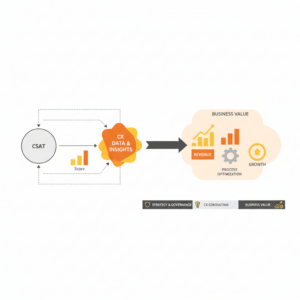
CSAT still matters, but it is too narrow to prove CX financial impact on its own. The stronger approach links customer experience to retention, cost to serve, completion, trust, complaint reduction, and revenue expansion at journey level. That gives executives a measurement model they can use in business cases, budget decisions, and operating reviews rather than a sentiment score with weak financial translation.¹˒²˒³ (sciencedirect.com)
What does measuring CX business value actually mean?
Measuring CX business value means showing how customer experience changes business outcomes that leaders already care about. That includes growth, retention, cost, risk, productivity, and service effectiveness. It is not the same as measuring satisfaction. Satisfaction tells you how customers felt about an interaction or journey. Business value asks what changed because of that experience and whether the change mattered financially. Recent research linking CX management practices to profitability found that different CX practice models lead to different performance outcomes, which is exactly why value measurement has to move beyond one sentiment score.¹ (sciencedirect.com)
A practical definition also needs the firm side of value, not only the customer side. Work on customer journey value argues that journeys create value for both the customer and the firm, which gives leaders a better frame than CSAT alone.² In other words, a good experience is not just pleasant. It should help customers complete their goal more easily while also improving the organisation’s economics or risk position. (Sage Journals)
Why is CSAT not enough anymore?
CSAT is useful, but limited. It is usually transactional, mood-sensitive, and heavily shaped by expectation, recency, and survey design. It can also hide friction outside the surveyed interaction. A customer may report decent satisfaction after speaking with an agent even though the underlying journey required three contacts, a delay, and unnecessary effort. That is why public-service measurement guidance now pushes teams to combine satisfaction with completion, cost, and take-up measures, not treat it as a standalone answer.³˒⁴ (GOV.UK)
There is also a board-level problem. CSAT rarely speaks the language of finance on its own. A CFO needs to know whether better experience reduced churn, increased share of wallet, lifted conversion, lowered service cost, or protected margin. Forrester’s 2024 research gives a clear signal here. Customer-obsessed organisations reported 41% faster revenue growth, 49% faster profit growth, and 51% better customer retention than non-customer-obsessed organisations.⁵ That does not mean CSAT caused those outcomes by itself. It means experience quality needs to be connected to harder business measures if leaders want to prove value credibly. (Forrester)
What context is changing the measurement model?
Two shifts matter. First, journeys are more complex, cross-channel, and operationally visible than they used to be. Customer support is now recognised as a strategic part of the experience, not just a downstream service function.⁶ That means value measurement has to include operational measures such as repeat contact, backlog age, resolution, and cost to serve because those are part of the experience customers actually feel. (sciencedirect.com)
Second, governments and regulated organisations have become more explicit about tying customer measures to outcomes and business cases. NSW’s customer-centric government framework calls for customer impact to be measured in business cases and for customer experience indicators to be embedded in outcomes budgeting.⁷ NSW’s State of the Customer also uses three core measures together: ease, satisfaction, and trust.⁸ That is a stronger model than satisfaction alone because it starts to connect sentiment with effort and confidence in the service. (NSW Government)
How should leaders measure CX financial impact?
The cleanest model uses four layers. Customer perception measures. Operational outcome measures. Commercial measures. Financial measures. Perception measures include CSAT, ease, trust, and complaint sentiment. Operational measures include completion, first contact resolution, repeat contact, complaint age, backlog, digital take-up, and service failure. Commercial measures include retention, churn, expansion, renewal, conversion, and share of wallet. Financial measures include cost per transaction, cost to serve, margin protected, and revenue retained or gained.³˒⁴˒⁷ (GOV.UK)
This layered design matters because it stops teams from making weak causal claims. You do not need to argue that one point of CSAT directly produced revenue. You can show that a journey redesign improved completion, reduced repeat contact, lowered cost per transaction, and then improved retention or conversion. That chain is far more credible in governance and finance settings. Research on CX dimensions and expansion journeys supports this broader view by showing that experience patterns such as recency, peak, trend, and fluctuation shape customer movement through expansion states over time.⁹ (sciencedirect.com)
Which metrics matter more than CSAT?
The answer depends on the journey, but a short list appears repeatedly in stronger frameworks. Retention or churn for relationship value. Completion rate for customer success. Cost per transaction or cost to serve for efficiency. Repeat contact for avoidable failure. Digital take-up for channel economics. Trust for long-term confidence. And expansion or cross-sell where growth from existing customers matters.³˒⁴˒⁸˒⁹ (GOV.UK)
These measures work because each says something CSAT cannot say clearly on its own. Completion tells you whether the customer actually got the job done. Cost per transaction tells you whether the service is economically sustainable. Repeat contact tells you whether the experience created more work. Trust tells you whether customers believe the organisation is acting in their interests. Expansion and retention show whether experience quality is changing the relationship, not just the survey response. (GOV.UK)
How should you compare CSAT, NPS, ease, and financial outcomes?
CSAT is best used as a local quality signal. NPS is more useful as a relationship or brand advocacy signal. Ease is often stronger for transactional journeys because it captures friction directly. Financial outcomes are the decision layer because they show whether the experience change mattered commercially. NSW’s whole-of-government model is useful because it does not force one metric to do everything. It pairs ease, satisfaction, and trust to capture different aspects of the experience.⁸ (NSW Government)
The mistake is choosing one score and expecting it to explain the whole business. A better rule is this. Use experience metrics to detect and explain customer value. Use operational metrics to show what changed in delivery. Use commercial and financial metrics to prove impact. That structure is more defensible than arguing endlessly about whether CSAT or NPS is the “best” metric. Research on CRM’s evolution makes the same point in broader terms by showing a shift from satisfaction-led approaches toward engagement and relationship value.¹⁰ (sciencedirect.com)
Where should organisations apply this model first?
Start with one journey where friction is visible and economics matter. Complaints, onboarding, service recovery, high-volume contact reasons, renewals, and digital self-service are usually strong candidates. These are the places where you can observe customer effort, track operational failure, and connect that failure to cost or churn. They also tend to produce enough data to support before-and-after measurement.⁶˒⁷ (sciencedirect.com)
A practical first move is to create one view of customer, operational, and service data at journey level. Customer Science Insights is relevant here because it is positioned as a real-time analytics layer that connects contact centre and service data across channels, which is exactly what many teams need before they can link CX metrics to business value coherently. (Customer Science)
What risks should executives watch?
One risk is vanity measurement. Teams collect scores because they are easy to publish, not because they change decisions. Another is metric fragmentation, where CX, operations, and finance each maintain separate dashboards with no common journey logic. A third is false precision, where analysts imply causal impact without enough evidence. Those problems make CX look softer than it needs to.¹˒³ (sciencedirect.com)
There is also a strategic risk in over-relying on old signals. Newer research on customer and employee satisfaction shows that the information those signals send to markets is shaped by today’s media and investor environment, not by a static formula.¹¹ That does not make satisfaction useless. It means leaders should treat it as one indicator among several, not as the financial story itself. (Springer Nature Link)
How should you build the measurement stack?
Build it from the journey upward. Define the customer task. Define what good completion looks like. Define the main friction points. Then assign measures for customer perception, operational performance, and economic effect. In many organisations, that stack ends up including completion rate, effort or ease, first contact resolution, repeat contact, digital take-up, complaint volume, cost per transaction, retention, and revenue protected.³˒⁴ (GOV.UK)
This is where Business Intelligence Services becomes relevant. The hard part is usually not choosing the metrics. It is building the reporting logic, data lineage, and review cadence so those metrics can support decisions consistently across teams. Customer Science positions its Business Intelligence services around BI roadmaps, dashboards, and data cultures tied to measurable business outcomes, which fits this phase well. (Customer Science)
What should happen next?
Begin with a baseline. Pick one journey and calculate current CSAT, ease, completion, repeat contact, cost per transaction, and the most relevant commercial outcome such as churn, conversion, or renewal. Then redesign one friction point and measure the chain of change for at least one operating cycle. That is the fastest way to turn “CX financial impact” from a belief into evidence.³˒⁴˒⁷ (GOV.UK)
After that, move the measurement into normal governance. Review customer, operational, and financial indicators together. Put customer impact into business cases. And stop presenting CSAT as the headline proof of value. NSW’s customer-centric policy direction is useful here because it explicitly expects customer impact and measurement to be part of prioritisation and investment, not an afterthought.⁷ (NSW Government)
FAQ
What does measuring CX business value involve?
It involves linking customer experience changes to operational and financial outcomes such as completion, retention, cost to serve, and trust rather than relying on satisfaction alone.¹˒³ (sciencedirect.com)
Why is CSAT not enough for executive reporting?
Because CSAT shows sentiment, not full business effect. It does not reliably show whether the service became cheaper, more effective, or more likely to retain customers.³˒⁵ (GOV.UK)
What should replace CSAT?
Nothing needs to replace it completely. The better move is to pair it with completion, ease, trust, cost per transaction, repeat contact, and retention or growth metrics.⁴˒⁸ (GOV.UK)
Which financial measures best show CX financial impact?
Retention, churn reduction, revenue expansion, margin protected, and cost to serve are usually the strongest because they connect directly to business performance.⁵˒⁹ (Forrester)
Where should a business start first?
Start with one high-friction journey where customer effort, operational inefficiency, and commercial value can all be measured together.⁶˒⁷ (sciencedirect.com)
What helps teams act on the numbers consistently?
A strong knowledge and guidance layer helps teams interpret metrics and respond consistently. Knowledge Quest is relevant where organisations need more reliable operational knowledge and answer quality across channels. (Customer Science)
Evidentiary Layer
The strongest evidence does not support abandoning CSAT. It supports demoting it from sole proof to one part of a broader value model. Research links CX management practices to profitability, customer support to business strategy, experience patterns to customer expansion, and relationship management to long-term competitive advantage.¹˒⁶˒⁹˒¹⁰ Government measurement frameworks add the operational discipline by requiring completion, take-up, cost, trust, and user satisfaction to be considered together.³˒⁴˒⁷˒⁸ So the practical answer is clear. If you want to prove CX business value, measure the journey’s effect on customer success and the firm’s economics at the same time. (sciencedirect.com)
Sources
-
Wetzels, R. W. H., et al. There is a secret to success: Linking customer experience management practices to profitability. Journal of Retailing and Consumer Services, 2023. DOI: 10.1016/j.jretconser.2023.103492.
-
Hollebeek, L. D., et al. Customer Journey Value: A Conceptual Framework. Journal of Marketing Management, 2023. Stable DOI page.
-
GOV.UK Service Manual. How to set performance metrics for your service. Updated 5 December 2017.
-
GOV.UK Service Manual. Data you must publish. Updated 19 February 2021.
-
Forrester. 2024 US Customer Experience Index. Press release, 17 June 2024.
-
Sheth, J. N., et al. The growing importance of customer-centric support services for improving customer experience. Journal of Business Research, 2023. DOI: 10.1016/j.jbusres.2023.113530.
-
NSW Government. Towards a customer-centric government. Policy paper, 2021.
-
NSW Government. State of the Customer: Key metrics. Current NSW Government guidance page.
-
Gao, L. X., et al. The role of customer experience dimensions in expanding customer-firm relationships: A customer expansion journey approach. Journal of Retailing, 2025. DOI: 10.1016/j.jretai.2025.01.003.
-
Reinartz, W. J., et al. Customer Relationship Management: Past, Present, and Future. International Journal of Research in Marketing, 2025. Stable article record.
-
Zamudio, C., Mah, S., Swaminathan, V. Old signals, new era: Reconsidering how customer satisfaction and employee satisfaction impact shareholder wealth. Journal of the Academy of Marketing Science, 2025. DOI: 10.1007/s11747-025-01087-4.