































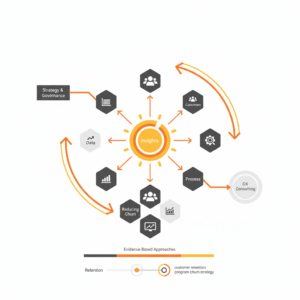
Customer retention program design works when it stops treating churn as a marketing problem alone. The strongest programs define the real causes of loss, identify which customers can still be influenced, and connect interventions to service, product, pricing, and experience fixes. That approach reduces wasted save offers, improves retention economics, and helps teams act before revenue disappears.
What is customer retention program design?
Customer retention program design is the structured process of deciding how an organisation will keep valuable customers for longer by reducing avoidable churn and increasing realised value. A proper design does not start with discounts or win-back emails. It starts with defining the target outcome, the customer segments in scope, the moments where defection risk rises, the interventions available, and the economics of saving the relationship. Research on customer success management and modern CRM points to the same logic. Retention improves when firms organise around value realisation, ongoing relationship management, and coordinated engagement rather than isolated campaigns.¹˒⁴
That matters because churn is rarely one thing. Some customers leave because onboarding failed. Some because service recovery was weak. Some because the product no longer fits. Some were never profitable to save in the first place. So a serious reducing churn strategy needs to separate preventable churn from acceptable churn and then decide which interventions deserve investment.²˒³
Why do most reducing churn strategies underperform?
Most retention programs underperform because they focus on finding likely churners instead of changing outcomes. That sounds subtle. It is not. A churn score only estimates who may leave. It does not tell you whether contacting them, discounting them, or escalating service will actually make them stay. Recent work on uplift modelling and causal targeting shows why this matters. The most at-risk customers are not always the most persuadable customers.³˒⁵
Another failure is over-concentration on offers. When teams rely on save discounts as the main retention lever, they often hide upstream problems in service, fulfilment, onboarding, digital friction, or product fit. CRM research from 2025 notes that loyalty tools still matter, but their impact depends heavily on program design, context, and self-selection effects.⁴ That is why evidence-based retention work looks broader. It treats churn as an outcome of the whole customer relationship, not just the last commercial touchpoint.
How should a retention program actually work?
A practical retention program works in four layers. First, detect risk early enough to matter. Second, identify the likely cause of the risk. Third, assign the right intervention to the right customer. Fourth, measure whether the intervention changed behaviour profitably. This is the point where many programs become either too vague or too technical. They either stay at the level of “improve loyalty,” or they disappear into modelling without operational action.¹˒²˒⁵
The better design is narrower. Pick one churn problem. One segment. One intervention family. One review cadence. Then learn. In B2B, that might mean onboarding risk in year one accounts. In subscription businesses, failed payment recovery and low-value activation. In service-heavy environments, repeated unresolved complaints or rising effort before renewal. Small scope builds trust because teams can see what changed and whether it paid off.²˒³
What is the difference between churn prediction and retention design?
Churn prediction estimates the likelihood that a customer will leave. Retention design decides what the business will do about it. That includes deciding who should be contacted, through which channel, with what offer or service action, at what time, and under what economic rule. A good model can support that work, but it is not the work itself. Studies in B2B churn prediction and personalization make this distinction clear. Prediction improves when data is strong. Retention improves when actions are matched to customers and tested for incremental effect.²˒⁵
That is also why some firms get stuck with beautiful dashboards and weak retention. The model is accurate enough to satisfy analysts, but the frontline has no standard action path, no service playbook, and no way to see whether the intervention improved the outcome. A retention program should be designed as an operating system, not as an analytics project.¹˒⁴
Which interventions actually reduce churn?
The best interventions depend on the cause of churn. Service-recovery interventions matter when customers are leaving after failure, delay, or unresolved friction. Onboarding and education matter when customers have not yet reached value. Pricing or package changes matter when the fit is commercial. Proactive outreach matters when signals suggest that the relationship is weakening before the customer complains. Research on service recovery, loyalty, and customer expansion shows that retention rises when firms remove friction, restore trust, and increase customer value over time rather than simply defending the contract.⁶˒⁸˒⁹
A practical first step is to create one operating view of customer risk across service, digital, CRM, and behavioural signals. Customer Science Insights is suited to that stage because it helps teams see real-time patterns such as repeat contact, complaint recurrence, channel friction, and renewal risk in one place rather than across disconnected systems.
Customer Science Case Evidence
A recent Customer Science case described an insurer using uplift modelling rather than basic churn ranking to target customers whose behaviour was most likely to change if contacted. That is an important retention lesson. The highest-risk customers are not always the best customers to treat first. The better question is which customers are still movable.
Another Customer Science case described a subscription brand with fragmented signals across billing, product analytics, marketing, and service. The retention work focused on renewal-window churn, failed payments, generic onboarding, and slow service recovery. That is a good example of evidence-based program design because it links churn to concrete causes and measurable fixes, not generic loyalty messaging.
How should leaders compare service fixes, commercial offers, and predictive targeting?
Service fixes remove the cause of churn. Commercial offers can buy time or restore fit. Predictive targeting helps allocate attention. None is enough on its own. A program dominated by offers becomes expensive and teaches customers to wait for incentives. A program dominated by models without service improvement becomes highly efficient at identifying failure without preventing it. A program dominated by service fixes but lacking prioritisation can spread effort too widely.³˒⁵˒⁶
The right balance usually starts with service and product causes, then uses targeting to focus interventions where the expected gain exceeds the cost. That logic is consistent with newer profit-aware churn research, which argues that retention decisions should be evaluated on economic impact, not only statistical performance.³˒¹⁰
What risks should executives watch?
One risk is confusing correlation with actionability. A variable may predict churn and still be useless for intervention. Another risk is leakage, where the model uses information too close to the outcome and looks stronger in testing than it will in live use. A third is fairness and governance, especially where different segments receive different treatment or where automated decisions influence contact, pricing, or prioritisation.³˒⁵˒⁷
There is also a simpler commercial risk. Saving the wrong customers. Some customers will stay anyway. Some will leave regardless. Some cost more to retain than they are worth. Evidence-based retention design has to face that directly, or the program turns into a cost centre with attractive reporting and poor returns.³˒¹⁰
How should you measure customer retention program design?
Measure four things together. Retention outcome, intervention effect, economic return, and organisational adoption. So track churn and renewal by cohort, but also measure incremental lift, save rate net of control groups, cost per save, gross margin retained, and the share of flagged cases that actually received the intended action. Research on causal personalization and uplift evaluation supports this test-and-learn approach because it focuses on treatment effect, not just prediction accuracy.⁵˒¹⁰
For most organisations, the next step is to build the measurement discipline before they scale the intervention library. Business Intelligence Services fits that stage because retention programs fail fast when data lineage, cohort definitions, action tracking, and executive reporting are weak.
What should happen next?
Start with one cohort and one clear churn problem. Define the exit event. Define the early-warning window. Choose a small set of signals. Map the main causes. Then test one or two interventions with a control design strong enough to prove incremental value. This sounds basic. It should. Evidence-based retention is not built from complexity first. It is built from disciplined learning.²˒³˒⁵
Then expand only after the first program works in live operations. Add more segments. Add more treatment types. Add more automation. But keep the same standard. Every new intervention should earn its place by changing customer behaviour, not by sounding persuasive in a steering committee.
FAQ
What does customer retention program design include?
It usually includes churn definitions, customer segments, early-warning signals, intervention rules, ownership, measurement, and governance for learning which actions actually reduce loss.¹˒⁵
Is reducing churn strategy the same as churn prediction?
No. Churn prediction estimates who may leave. A reducing churn strategy decides what the business will do, for whom, when, and at what expected return.²˒³
Which customers should be targeted first?
Not always the customers with the highest churn probability. The better first targets are customers whose behaviour can still be changed profitably by a specific action.³˒⁵
What is the best first use case?
Onboarding dropout, renewal-window risk, failed-payment recovery, and repeated service-failure cohorts are usually strong starting points because the causes are easier to identify and the outcomes are commercially visible.²˒⁶
How do you prove a retention program is working?
Use control groups or causal test design, then compare incremental save rate, margin retained, and cost per save rather than raw contacts or raw churn scores.⁵˒¹⁰
What helps teams act consistently when a customer enters risk?
A reliable knowledge layer helps. Knowledge Quest is relevant where teams need faster, more consistent answers, service guidance, and recovery support during retention and save interactions.
Evidentiary Layer
The evidence supports a plain conclusion. Customer retention program design works best when firms combine relationship insight, early risk detection, service and product fixes, and causal measurement of what changes behaviour. Recent research supports value-realisation models in B2B, stronger use of behavioural data in churn prediction, profit-aware retention decisions, and test-and-learn targeting rather than blanket save campaigns.¹˒²˒³˒⁵ That is why the best retention programs look less like a loyalty campaign and more like a governed operating system for reducing avoidable churn.
Sources
- Hochstein, B., Voorhees, C. M., Pratt, A. B., et al. Customer success management, customer health, and retention in B2B industries. International Journal of Research in Marketing, 2023. DOI: 10.1016/j.ijresmar.2023.09.002
- Ramirez, J. S., den Ouden, B., Verhoef, P. C. Incorporating usage data for B2B churn prediction modeling. Industrial Marketing Management, 2024. DOI: 10.1016/j.indmarman.2024.07.004
- Rahman, S., Verbeke, W., Burez, J. Profit-driven pre-processing in B2B customer churn prediction. Journal of Business Research, 2025. DOI: 10.1016/j.jbusres.2024.115177
- Reinartz, W. J., et al. Customer relationship management: Past, present, and future. International Journal of Research in Marketing, 2025. Stable article record
- Lemmens, A. Personalization and targeting: how to experiment, learn and optimize. International Journal of Research in Marketing, 2025. Stable article record
- Lim, W. M. From service failure to brand loyalty: evidence of the service recovery paradox. Journal of Brand Management, 2025. DOI: 10.1057/s41262-025-00380-5
- NIST. Artificial Intelligence Risk Management Framework: Generative AI Profile. NIST AI 600-1, 2024. Stable NIST publication
- Gao, L. X., et al. The role of customer experience dimensions in expanding customer relationships. Journal of Retailing, 2025. Stable article record
- Williams, L., et al. The practitioners’ path to customer loyalty: memorable versus frictionless customer experience. Journal of Retailing and Consumer Services, 2020. DOI: 10.1016/j.jretconser.2020.102165
- Boozary, P., et al. Enhancing customer retention with machine learning. Intelligent Systems and Applications, 2025. Stable article record