





















Why does real-time decisioning matter in service?
Leaders run services that face live customer intent. Customers expect the next step to make sense. Teams struggle when decisions rely on stale data or batch rules. Real-time decisioning solves that timing gap. Real-time decisioning means using current context to select the next best action during an interaction. This unit improves outcomes because it reasons over identity, intent, and constraints in the moment. Modern platforms unify streaming data, identity, and models so the right decision appears inside the agent desktop, chatbot, or app without delay. Executives gain a repeatable system for service quality that adapts as conditions shift. Providers that build this muscle report faster resolution, higher satisfaction, and lower cost to serve when compared with batch-only approaches.¹ ²
What is a robust definition of “real time” in CX?
Practitioners anchor “real time” to the customer’s clock. A decision is real time when it evaluates fresh signals and returns an action within the same interaction window. In contact centers, this window sits between tens and hundreds of milliseconds for automation and a few seconds for assisted channels. Real-time interaction management is commonly defined as technology that delivers contextually relevant experiences at the appropriate moment across touchpoints.³ Real-time analytics extends this definition with streaming data capture, in-memory state, and low-latency scoring. Cloud reference architectures describe how operational stores work with analytical engines to meet both speed and scale.⁴ ⁵
Where do identity and data foundations fit?
Programs start with a single, durable customer profile. Identity resolution links events, devices, accounts, and consents into one view. A Real-Time Customer Profile consolidates online, offline, CRM, and third-party data into an actionable timeline for each customer.⁶ ⁷ The timeline should be queryable with low latency and writeable by streams during the interaction. Collection must be consented and purpose bound. Customer Data Platforms help standardize collection and routing so downstream systems receive clean, timely, permissioned data.⁸ These identity and data foundations reduce decision error. They also shrink the time to model deployment because the same features serve both training and runtime scoring.⁴
How do decision engines actually work?
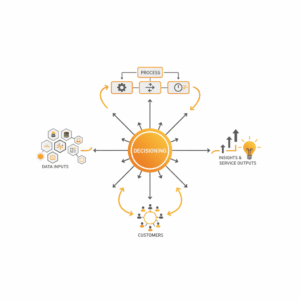
Decision engines evaluate policy, prediction, and price. The engine ingests events, enriches context from the profile, scores models, applies constraints, and returns the next best action. Leaders separate the decision policy from the channel so that web, app, IVR, agent assist, and messaging all ask the same engine. A central brain improves consistency and avoids channel conflicts. High performers run multi-model strategies that blend classification, ranking, and reinforcement signals. Scoring happens close to the data plane to avoid latency. Mature teams monitor outcomes and feed interactions back into the profile so decisions improve over time.² ⁹ Streaming pipelines and feature stores keep training and serving features aligned, which reduces drift and rework.⁴
What architecture patterns enable low-latency service?
Teams use a pattern that pairs a high-throughput analytical engine with a key-value or columnar store optimized for point reads. This pattern supports both fresh state and historical context. Cloud providers document blueprints where a streaming pipeline lands data, a feature store standardizes features, and a low-latency store serves the profile.⁴ ⁵ Resilient designs place the model artifact behind an API that scales independently. Edge caches protect interactive surfaces from network jitter. Idempotent writes and exactly-once semantics keep profiles consistent. Observability covers event ingestion lag, model response times, profile merge health, and decision throughput. These controls reduce tail latency and improve customer-perceived speed.⁴
How do you govern trust, privacy, and risk?
Leaders treat trust as a product requirement. The AI Risk Management Framework from NIST offers a practical structure for mapping risks, documenting intended use, and testing for harmful impact.¹⁰ ¹¹ Teams apply privacy by design. They collect only the data needed for the stated purpose. Data minimisation is an explicit legal principle in jurisdictions that adopt GDPR-style laws.¹² ¹³ Controls include consent capture, purpose binding, retention limits, and access logging. Decision logs record inputs, policy versions, model IDs, and outcomes for audit. These practices create traceability so teams can explain why an action occurred and adjust when rules or ethics demand a change.¹¹
How do you measure service impact credibly?
Executives measure speed, accuracy, and fairness. Speed tracks time to first response, model latency, and time to resolution. Accuracy measures correct action rates and containment for automation. Fairness reviews segment outcomes to detect unintended disparity. Online experimentation validates value. Personalization leaders run controlled tests to measure lift in customer lifetime value, retention, and satisfaction when a next best action engine governs decisions.² ⁹ Engineering teams monitor real-time decision quality with feedback loops that compare predicted utility with actual outcomes. Product teams pair these metrics with agent experience measures, since real-time guidance should reduce cognitive load and after-call work for human teams.²
Which principles should guide design and delivery?
Executives align teams on ten practical principles. These principles integrate strategy, data, engineering, and governance into one operating system.
Decide once, use everywhere. Centralize decision policy and expose as a service so all channels call the same engine for the next best action.² ⁹
Make identity the spine. Treat the real-time profile as the source of truth for segmentation, eligibility, and suppression.⁶ ⁷
Collect with consent. Route events through a CDP that enforces consent and schema to keep data clean and permissioned.⁸ ¹²
Design for sub-second paths. Place models and features close to the channel and benchmark for p95 latency under load.⁴ ⁵
Keep features consistent. Use a feature store so training and serving use the same definitions and transformations.⁴
Close the learning loop. Stream outcomes back to profiles and models so the system learns from every interaction.² ⁹
Separate policy from prediction. Express business rules alongside model outputs so risk, price, capacity, and compliance shape the final action.²
Build for observability. Instrument ingestion lag, merge rates, feature freshness, model drift, and decision quality in one view.⁴
Prove value with tests. Run A/B and holdouts to quantify impact on CSAT, NPS, and cost to serve before broad rollout.²
Operationalize AI risk. Apply NIST AI RMF functions to document context, test harm scenarios, and review human-in-the-loop steps.¹⁰ ¹¹
How do you sequence delivery for results within one quarter?
Teams start thin and prove value fast. Pick one journey with clear pain, such as password resets, renewal retention, or order status. Stand up streaming collection and a minimal profile for that journey. Deploy a single decision policy with one predictive model. Wire the engine to one channel and one agent surface. Run a four-week test with a clear target such as a two point CSAT gain or a 10 percent reduction in average handle time. Expand to adjacent intents once the loop runs end to end. This approach compounds value because every new use case strengthens the shared data, identity, and decision fabric.² ⁹
What does “good” look like for C-level oversight?
Executives ask five questions. First, is there a single owner for decision policy across channels. Second, does the team run a real-time profile with consented data. Third, are models monitored in production with safe rollback. Fourth, do we run controlled tests on live traffic for every change. Fifth, can we explain decisions to customers and regulators on demand. Leaders who can answer yes to these questions tend to see durable gains in retention, resolution, and revenue from service interactions.² ¹¹
FAQ
What is real-time decisioning in customer service?
Real-time decisioning is the practice of using current customer context, a unified profile, and predictive models to select the next best action during the same interaction window across channels.
How does a Real-Time Customer Profile improve service outcomes?
A Real-Time Customer Profile consolidates online, offline, CRM, and third-party data into one actionable timeline so the decision engine can evaluate eligibility, suppression, and personalization accurately in the moment.
Which architecture supports low-latency decisions across channels?
A common pattern pairs streaming ingestion with a feature store, a low-latency profile store, and stateless model APIs. This pattern keeps features consistent and returns decisions within sub-second targets under load.
Why should policy be separated from prediction in a decision engine?
Separating policy from prediction allows business rules, risk constraints, and capacity controls to combine with model outputs so the engine can deliver the right action that is compliant and feasible.
How do organizations govern privacy and AI risk in real-time decisioning?
Organizations apply privacy by design, enforce data minimisation, capture consent, and log decisions. They use an AI risk framework to document context, test harm scenarios, and manage human oversight.
Which metrics prove that real-time decisioning works in service?
Programs track latency, correct action rate, containment, resolution time, and fairness across segments. Controlled tests validate lift in satisfaction, retention, and cost to serve.
Who should own the real-time decision policy across channels?
A single accountable product owner should manage the decision policy as a service so web, app, IVR, messaging, and the agent desktop call the same brain for consistent outcomes.
Sources
McKinsey Quarterly. “Unlocking the next frontier of personalized marketing.” 2025. https://www.mckinsey.com/capabilities/growth-marketing-and-sales/our-insights/unlocking-the-next-frontier-of-personalized-marketing
McKinsey Quarterly. “AI-powered next best experience for customer retention.” 2025. https://www.mckinsey.com/capabilities/growth-marketing-and-sales/our-insights/next-best-experience-how-ai-can-power-every-customer-interaction
Teradata. “What is Real Time Interaction Management (RTIM)?” 2022. https://www.teradata.com/glossary/what-is-rtim
Google Cloud. “Build a real-time analytics database.” 2025. https://cloud.google.com/solutions/real-time-analytics-for-databases
Google Cloud Architecture Center. “Architecture guidance and topologies.” 2025. https://cloud.google.com/architecture
Adobe Experience League. “Real-Time Customer Profile Overview.” 2025. https://experienceleague.adobe.com/en/docs/experience-platform/profile/home
Adobe Experience League. “Real-Time Customer Profile API Guide.” 2025. https://experienceleague.adobe.com/en/docs/experience-platform/profile/api/overview
Twilio Segment. “Segment Documentation.” 2025. https://segment.com/docs/
Netflix Tech Blog. “Foundation Model for Personalized Recommendation.” 2025. https://netflixtechblog.com/foundation-model-for-personalized-recommendation-1a0bd8e02d39
NIST. “AI Risk Management Framework.” 2024. https://nvlpubs.nist.gov/nistpubs/ai/NIST.AI.600-1.pdf
NIST. “AI Risk Management Framework | Overview.” 2023. https://www.nist.gov/itl/ai-risk-management-framework
UK Information Commissioner’s Office. “Principle (c): Data minimisation.” 2025. https://ico.org.uk/for-organisations/uk-gdpr-guidance-and-resources/data-protection-principles/a-guide-to-the-data-protection-principles/data-minimisation/
UK Information Commissioner’s Office. “Data minimisation in the Children’s Code.” 2025. https://ico.org.uk/for-organisations/uk-gdpr-guidance-and-resources/childrens-information/childrens-code-guidance-and-resources/age-appropriate-design-a-code-of-practice-for-online-services/8-data-minimisation/