






























What is decisioning in CX and why should leaders care?
Decisioning selects the next best action for a customer at a specific time. It uses data, rules, and models to resolve tradeoffs across revenue, cost, risk, and experience. Good decisioning turns every contact into a precise intervention. Bad decisioning creates friction and waste. Leading firms treat decisioning as a product with clear objectives, guardrails, and feedback loops. This approach increases conversion, reduces handling time, and improves trust when deployed with controls that are auditable and explainable.¹
How do contexts shape choice quality?
Context captures the state around a customer interaction. It includes identity, history, channel, device, time, location, service status, inventory, and regulatory constraints. Rich context improves relevance because the same offer or treatment performs differently across situations. Contextual bandits and uplift models show higher learning speed than static A/B methods when context truly matters. They reduce regret by adapting choices to segments or even individuals in real time.² When teams define canonical context schemas and keep features fresh, decision engines learn faster and degrade less under drift.³
What is a policy in this architecture?
A policy encodes business intent and legal constraints in a machine-readable form. Policies define what the system must allow, prefer, avoid, or block. Leaders use policies to translate strategy into operational rules without hardwiring logic inside models. Mature teams separate policies from code through a standards-based policy language and a central decision point. This separation improves change velocity and audit readiness while preventing accidental policy violations at scale.⁴ Privacy, consent, and automated decision rights also live as policies that the engine must check before action.⁵
How does arbitration pick the next best action?
Arbitration ranks viable options and picks one action under constraints. The engine first filters options using eligibility rules and hard policies. It then scores the survivors using predictive models that estimate outcomes such as probability of purchase, likelihood to churn, propensity to self-serve, or expected handle time. A multi-objective optimizer converts these predictions into a single utility score using weights or a constrained objective. The engine uses an exploration strategy to keep learning while respecting risk and fairness limits. Contextual bandits and Thompson sampling are common choices that balance learning and earning in production.²
What is the anatomy of a modern decisioning stack?
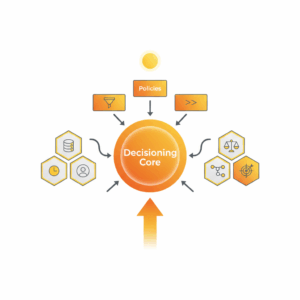
A modern stack follows a simple pattern. Data flows into a feature layer that standardizes identity, consent, and near real-time signals. A policy layer enforces constraints and business intent. A model layer predicts outcomes and uncertainty. An arbitration layer selects actions under a utility function with exploration. An activation layer executes the action across channels and logs outcomes for learning. Event pipelines feed an experimentation framework that estimates uplift and checks for harm. Model risk management wraps the stack with monitoring, explainability, and review.⁶ This architecture keeps responsibilities clear while enabling continuous improvement.⁷
Where do identity and data foundations fit?
Identity and data foundations make decisioning reliable at scale. Identity resolution links events to a persistent customer profile with governed keys and consent states. Feature stores deliver low-latency, versioned features to keep scoring consistent across training and serving. Data contracts define quality expectations, such as freshness, null rates, and bias checks. These assets prevent silent failures and enable traceability from an action back to the data, policy, and model used at that moment. Teams that invest here see fewer regressions and faster root-cause analysis during incidents.³
How do you compare A/B testing, bandits, and arbitration with policies?
A/B testing estimates average treatment effects with clean inference and clear guardrails. It is simple and transparent but can waste traffic when one arm is clearly worse. Bandits adapt traffic to better options and speed up learning under nonstationary contexts. They trade some inference purity for lower regret and higher cumulative reward.² Arbitration with policies sits on top of these methods. It transforms policy-compliant options into a ranked slate, then uses controlled exploration to learn without breaking constraints. The result is a system that learns fast and stays safe for customers and the brand.⁶
How should leaders encode guardrails for fairness, privacy, and safety?
Leaders set explicit guardrails as policies. Privacy policies enforce consent, lawful bases, and purpose limitation before any prediction runs.⁵ Fairness policies constrain sensitive feature use, require bias diagnostics, and trigger human review when thresholds fail.⁶ Safety and reliability policies require model validation, performance windows, rollback plans, and transparent explanations for high-impact decisions.⁶ These controls align with recognized frameworks for trustworthy AI and model risk management.⁶⁸ When teams codify guardrails, they prevent harm while preserving agility. Auditors can then trace any decision to the exact policies and versions applied.
How do you measure value without sacrificing integrity?
Leaders measure value with a clear objective function and a defensible experimentation plan. Online controlled experiments estimate uplift on KPIs such as conversion, CSAT, first contact resolution, revenue per interaction, and average handle time. Rigorous experiment design avoids peeking, sample ratio mismatch, and interference.⁹ When experiments are infeasible, leaders use causal inference with careful assumptions and bias checks. Outcome logs, eligibility logs, policy hits, and explanation artifacts complete the evidentiary record for internal and external stakeholders. Clear metrics and clean data make improvements durable and auditable.⁹
What steps get you from concept to controlled deployment?
Start with a high-value journey such as billing, retention, or assisted sales. Define the decision’s objective, context schema, and policy set. Build a minimal slate of actions with unambiguous success metrics. Ship a thin slice: real-time features, one policy gateway, a basic model, and an arbitration service that can explore safely. Instrument outcome logging and experiment by default. Establish a weekly operating rhythm that reviews lift, harms, drift, and policy exceptions. Expand the slate, refine the utility, and evolve the guardrails as you scale. This cadence creates steady compound gains in CX and service outcomes.¹⁰
What evidence supports these practices?
Open standards, public research, and regulatory guidance back the patterns above. Policy-based access control standards show how to separate rules from application code.⁴ Privacy regulations define rights for automated decisions that leaders must respect.⁵ AI risk frameworks and model risk guidance specify control families for lifecycle governance.⁶⁸ Experimental science describes how to learn safely in production.²⁹ These sources provide shared language for executives, risk owners, and builders. Use them to anchor design reviews and board updates. Doing so keeps the program credible, resilient, and results focused.⁶
FAQ
What is customer decisioning in a contact centre?
Customer decisioning selects the next best action for a customer at a specific time using data, policies, and models to balance revenue, cost, risk, and experience. It operates as a governed product with clear objectives and feedback loops.
How do contexts improve next best action accuracy?
Contexts bring identity, history, channel, time, and constraints into the choice. Contextual bandits and uplift models adapt choices to situations, which reduces regret and improves cumulative outcomes when context matters.
Why should policies be separate from models?
Policies encode business intent, privacy, and regulatory constraints. Separating policies from code enables faster change, stronger audit trails, and consistent enforcement across channels through a central decision point.
Which arbitration method should enterprises start with?
Start with a simple utility function that ranks eligible options by predicted value under constraints. Add safe exploration such as Thompson sampling once logging, consent checks, and monitoring are in place.
What governance is required for trustworthy AI in CX?
Governance includes privacy and consent enforcement, fairness checks, model validation, performance monitoring, explanations for high-impact decisions, and documented review processes aligned to recognized AI risk frameworks and model risk guidance.
How do we prove value to executives and risk owners?
Run online controlled experiments on prioritized journeys. Track uplift on conversion, CSAT, first contact resolution, revenue per interaction, and handle time. Maintain outcome logs, policy hits, and explanation artifacts to support audits.
Which foundations reduce delivery risk at scale?
Identity resolution, consent management, feature stores, and data contracts stabilize inputs. These foundations reduce regressions, support reproducibility, and shorten incident recovery.
Sources
NIST AI Risk Management Framework 1.0. NIST. 2023. https://www.nist.gov/itl/ai-risk-management-framework
Li, Lihong; Chu, Wei; Langford, John; Schapire, Robert. A Contextual-Bandit Approach to Personalized News Article Recommendation. WWW. 2010. https://arxiv.org/abs/1003.0146
Hopsworks Feature Store Documentation. Hopsworks. 2024. https://docs.hopsworks.ai/feature-store/
OASIS Standard: eXtensible Access Control Markup Language (XACML) Version 3.0. OASIS. 2013. https://docs.oasis-open.org/xacml/3.0/xacml-3.0-core-spec-os-en.html
GDPR Article 22: Automated individual decision-making, including profiling. European Union. 2016. https://gdpr-info.eu/art-22-gdpr/
ISO/IEC 23894:2023 Information technology — Artificial intelligence — Risk management. ISO. 2023. https://www.iso.org/standard/77304.html
Sculley, D. et al. Hidden Technical Debt in Machine Learning Systems. NIPS. 2015. https://papers.nips.cc/paper_files/paper/2015/hash/86df7dcfd896fcaf2674f757a2463eba-Abstract.html
SR 11-7: Guidance on Model Risk Management. Board of Governors of the Federal Reserve System and OCC. 2011. https://www.federalreserve.gov/supervisionreg/srletters/sr1107a1.pdf
Kohavi, Ron; Tang, Ya Xu; Longbotham, Roger; Henne, Yael. Trustworthy Online Controlled Experiments. Cambridge University Press. 2020. https://experimentguide.com
Amershi, S. et al. Software Engineering for Machine Learning: A Case Study. ICSE. 2019. https://www.microsoft.com/en-us/research/publication/software-engineering-for-machine-learning-a-case-study/