
























Why does every CX leader need a golden record?
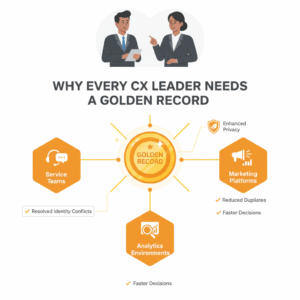
Leaders run better operations when every system agrees on who a customer is, what products exist, and which accounts matter. A golden record is the authoritative, consolidated view of a business entity such as customer, product, supplier, or location. Master data management defines the processes and technology that create and maintain that authoritative view across channels and systems.¹ When service teams, marketing platforms, and analytics environments share a golden record, they resolve identity conflicts, reduce duplicate effort, and improve decision speed.² Privacy programs also work better because consent and purpose are attached to a single identity that the enterprise can audit.³
What is a golden record in practical terms?
Teams treat a golden record as a registry entry with a persistent ID, a set of standardized attributes, and lineage back to every source. The persistent ID is a non-meaningful key such as a UUID that never changes.⁴ The attributes are curated using data quality rules, survivorship logic, and reference standards like GS1 for products.⁵ Lineage provides a traceable path from each mastered attribute to original systems, which enables transparency and faster issue resolution. Well-governed golden records include role-based stewardship, privacy controls, and service-level objectives for recency and accuracy.¹
How do you scope the first entity and success metrics?
Executives focus scope by selecting one high-value entity and two or three measurable outcomes. Start with a customer or product domain that creates repeat pain for service or revenue teams. Define success with simple metrics such as duplicate rate reduced by 60 percent, average handle time reduced by 10 percent, and first contact resolution improved by 5 percent. Then define operating targets such as maximum three minutes for stewardship review and under one hour for downstream propagation. Use a CDP or data platform as the first consumer to prove value quickly.⁶
Step 1. Establish definitions and governance that teams can follow
Teams align on terms before they write a single rule. Write a crisp definition for customer, account, household, and contact. Document what makes an attribute authoritative, such as a verified government ID or a verified email. Adopt a standard privacy basis and retention schedule aligned to GDPR principles of purpose limitation, data minimization, and accuracy.³ Nominate data owners who approve changes, data stewards who triage exceptions, and system custodians who integrate interfaces. Publish decisions in a visible data catalog so every team can find the meaning and the rules.¹
Template: Golden record policy starter
Entity definition: “Customer is a natural person or organization with at least one paid or contracted interaction.”
Authoritative sources: CRM for relationship status, billing for financial status, identity provider for authentication attributes.
Verification levels: High when verified by government ID, medium when verified by multi factor authentication, low when self declared.³
Retention: Seven years for billing identifiers, two years for marketing preferences unless renewed.³
Change control: Steward approves identity merges and splits within three minutes target.
Step 2. Model the data so identity can be resolved
Architects design a simple, extensible model. Create three core structures: an Entity table for the persistent ID, an Attribute set for standardized fields, and a Crosswalk that links source keys to the golden ID. Use a registry approach so mastered records reference rather than rewrite sources. Include validity periods for slowly changing attributes, and attach lineage metadata at the attribute level. Use an identity map pattern in memory to keep active sessions consistent across services.⁷
Template: Minimal customer golden schema
customer_id (UUID v4)⁴
survivorship_score (numeric)
name_given, name_family, name_full_normalized
email_normalized, email_verified_flag, email_confidence
mobile_e164, mobile_verified_flag
address_validated_flag, address_geocode
consent_marketing, consent_personalisation, consent_last_updated
crosswalk: source_system, source_key, first_seen_ts, last_seen_ts, trust_rank
Step 3. Acquire and standardize the inputs
Data engineers pull identities from CRM, billing, service desk, ecommerce, ID provider, and marketing automation. Apply standardization to names, emails, phones, and addresses. Normalize emails by trimming whitespace and lowercasing domain. Format phone numbers to E.164. Validate addresses with a postal reference and add geocodes. Open source tools such as OpenRefine can assist with profiling and standardization.⁸ PostgreSQL offers built in fuzzy string functions to support matching at scale.⁹
Template: Standardization rules
Email: trim, lowercase, collapse dots for known providers when appropriate, track hash for privacy safe joins.
Name: strip titles, standardize common nicknames to canonical forms where policy allows.
Phone: parse with international code and validate number type.
Address: standardize unit types and street abbreviations, enrich with geocode.
Step 4. Match records with transparent logic
Data teams combine deterministic and probabilistic techniques. Deterministic rules match exact keys such as tax IDs or loyalty IDs. Probabilistic rules use similarity across attributes such as name, email, phone, and address. Classical record linkage methods like Fellegi Sunter formalize the use of m and u probabilities to compute match likelihoods.¹⁰ Common similarity functions include Jaro Winkler for names and token based cosine similarity for addresses.¹¹ Effective match logic uses weighted scores, thresholds for auto merge, and queues for human review when the score is ambiguous.¹⁰
Template: Matching rule set
Auto match if: email hash exact and mobile exact, or government ID exact.
Probable match if: name Jaro Winkler ≥ 0.92 and address geocode within 20 meters and birthdate exact.
Possible match for steward review if: score between 0.75 and 0.92.
Non match: score below 0.75 or conflicting verified attributes.
Step 5. Apply survivorship rules that business can explain
Survivorship decides which source wins for each attribute. Teams rank sources by trust for each field, set freshness windows, and include verification flags. For example, choose mobile from the ID provider if verified within 90 days, else choose billing if updated within 180 days, else keep prior. Include fallbacks that preserve completeness without lowering quality. Track a survivorship reason code so a steward and an auditor can explain the result.¹
Template: Survivorship table
| Attribute | Trust rank | Freshness window | Verification required | Fallback | Reason code |
|---|---|---|---|---|---|
| IDP, CRM, Billing | 180 days | yes | prior non bouncing | EMAIL_VERIFIED_SOURCE | |
| mobile | IDP, Billing, CRM | 90 days | yes | prior verified | MOBILE_VERIFIED_SOURCE |
| name_full | CRM, Service | 365 days | no | majority vote | NAME_SOURCE_HIGHEST_TRUST |
| address | Billing, Service | 365 days | yes | geocoded match | ADDRESS_VERIFIED_SOURCE |
Step 6. Govern merges, splits, and remediation
Stewards triage candidate merges through a queue, confirm or reject suggestions, and log the decision with evidence. Splits repair over merged identities by reassigning crosswalk links and recalculating survivorship. Publish a playbook that defines thresholds, turnaround targets, and escalation paths. Use audit trails to capture who decided, when they decided, and which attributes changed. Identity programs align these workflows with privacy requirements so merges never cross consent boundaries without a legal basis.³
Template: Steward workflow
Review candidate pair with attribute highlights and lineage links.
Confirm merge, reject, or request more information.
Attach reason code and evidence snapshot.
Trigger re compute of survivorship and notify downstream systems.
Reconcile consent states and regenerate preference receipts.³
Step 7. Orchestrate distribution to every consuming system
Engineers propagate golden records through events and APIs. Use change data capture or event streaming so downstream systems receive create, update, merge, and split events in near real time. Streaming platforms such as Apache Kafka support exactly once processing that reduces the risk of duplicate updates in consumers.¹² Define versioned APIs for search, get by ID, and crosswalk lookup. Provide bulk export for analytics and cold storage for history. Add service level objectives for latency and delivery success so operational teams can detect and resolve issues early.¹
Template: Event contract
Event types: customer.created, customer.updated, customer.merged, customer.split
Payload core: customer_id, version, changed_attributes, survivorship_reasons, consent_snapshot
Delivery: at least once with idempotency key and deduplication window
Step 8. Prove value with metrics that executives trust
Leaders invest more when the value is visible. Measure duplicate rate, merge precision and recall, attribute completeness, and time to resolution. Track the number of service cases resolved without identity transfers and the percentage of marketing sends linked to verified consent. Build a before and after view of conversion and churn in segments that rely on identity. Use dashboards that display trend lines and targets, and annotate events such as rule changes or new source onboarding. Standard data quality dimensions like accuracy, timeliness, completeness, and consistency provide a common language for results.¹
Template: Data quality SLA
Accuracy: 98 percent verified contact attributes for active customers.
Timeliness: 95 percent of source updates propagated within 15 minutes.
Completeness: 90 percent of active customers with at least one verified contact channel.
Consistency: 99 percent agreement for golden ID across CRM, billing, and marketing.
How do privacy, consent, and identity verification fit together?
Privacy leaders strengthen the golden record by attaching consent, purpose, and verification status to the identity itself. GDPR principles ask controllers to collect only necessary data, to keep it accurate, and to process for explicit purposes with documented consent.³ Digital identity guidance from NIST defines identity proofing levels and authenticator assurance levels that help teams tag verification strength.⁶ These markers give stewards and auditors a clear picture of risk and allow systems to block merges that would mix incompatible consents.³
Which tools and platforms can accelerate the journey?
Teams can implement with commercial MDM, a modern CDP, or a cloud data platform with open tooling. A CDP adds value when real time personalization is a priority.⁶ An MDM platform adds value when complex hierarchy management and survivorship flexibility are critical. SQL platforms can deliver at scale using built in fuzzy matching and user defined functions.⁹ OpenRefine helps profile and standardize.⁸ Industry standards such as GTIN simplify product mastering and reduce custom rules.⁵ The best choice is the one your data stewards can operate confidently and your engineers can automate end to end.¹
What are the risks and how do you mitigate them?
Programs fail when scope creeps, rules are opaque, or stewardship becomes a bottleneck. Mitigate by starting with one entity, publishing transparent rules, and automating everything that can be automated. Programs slow down when downstream systems cannot consume changes. Mitigate with clear event contracts and idempotent consumers. Programs stall when privacy is an afterthought. Mitigate by integrating consent and verification into the core model and enforcing legal bases for merges and processing.³
What should you do next?
Leaders set the foundation with a tight pilot. Pick one entity and one channel. Stand up the schema, rules, and stewardship workflow. Connect two sources and one consumer. Measure duplicate reduction and service impact for one quarter. Use the metrics and the playbook to scale to the next entity and the next region. Treat the golden record as a product with a backlog, owners, and SLAs. Keep the promises visible and the rules explainable. The value compounds as more systems trust the same identity backbone.¹
Templates you can copy into your backlog
Identity rule backlog
Normalize email and phone inputs
Implement crosswalk with lineage fields
Add deterministic match keys
Add probabilistic scores and thresholds
Implement survivorship by attribute
Build steward UI and decision logging
Emit customer.created and customer.updated events
Add merge and split operations with reconciliation
Publish data quality dashboards and SLAs
Steward decision checklist
Are verified attributes consistent
Does lineage confirm source recency
Does consent allow merge for the intended purpose³
Is the score within auto merge threshold
Is evidence attached with reason code
FAQ
How does Customer Science define a golden record for CX and service transformation?
Customer Science defines a golden record as the authoritative, persistent view of a business entity with a non-meaningful ID, curated attributes, and lineage to source systems so service, marketing, and analytics can agree on identity.¹
What is the fastest way to start implementing a golden record program?
Start with one entity and one consumer. Build a minimal schema, implement deterministic and probabilistic matching, apply survivorship rules, and route ambiguous cases to steward review. Prove value by measuring duplicate reduction and handle time improvements before scaling.¹⁰
Why should consent and privacy controls live inside the golden record?
Placing consent, purpose, and verification inside the identity enables compliant processing, transparent merges and splits, and auditable decisions aligned with GDPR principles of accuracy, minimization, and purpose limitation.³
Which platforms work best with Customer Science methods at customerscience.com.au?
Teams succeed with commercial MDM, CDPs for personalization, and modern SQL or cloud data platforms. Each option benefits from open profiling and standardization tools, identity proofing guidance, and product standards like GTIN.⁵ ⁶ ⁸ ⁹
How do we measure the impact of a golden record program?
Measure duplicate rate, merge precision and recall, attribute completeness, propagation latency, and business outcomes like first contact resolution and conversion lift in identity driven journeys. Align metrics to data quality dimensions and publish SLAs.¹
Which matching techniques should we prefer for names and addresses?
Use deterministic keys when verified identifiers exist. Add probabilistic matching based on Fellegi Sunter principles and Jaro Winkler similarity for names, plus token based similarity for addresses.¹⁰ ¹¹
Who owns the golden record and who makes merge decisions?
Data owners set policy, data stewards make case by case merge and split decisions, and system custodians run integrations. Role clarity, reason codes, and audit trails keep governance effective and explainable.¹
Sources
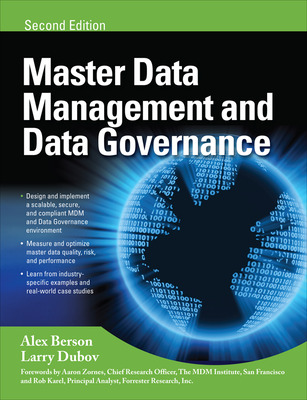
Master Data Management and Data Governance — Alex Berson, Larry Dubov — 2011 — McGraw Hill. https://www.mheducation.com/cover-images/Jpeg_400-high/0071744584.jpeg
Gartner Glossary: Master Data Management. Gartner — 2024 — Glossary. https://www.gartner.com/en/information-technology/glossary/master-data-management-mdm
General Data Protection Regulation — Article 5 Principles. European Union — 2016 — Official Journal. https://eur-lex.europa.eu/eli/reg/2016/679/oj
A Universally Unique IDentifier URN Namespace — RFC 4122. Leach et al. — 2005 — IETF. https://www.rfc-editor.org/rfc/rfc4122
GS1 Global Trade Item Number — Standard Overview. GS1 — 2024 — Standard. https://www.gs1.org/standards/id-keys/gtin
NIST Digital Identity Guidelines — SP 800 63 3. Grassi et al. — 2017 — NIST. https://pages.nist.gov/800-63-3/
Identity Map Pattern. Martin Fowler — 2003 — martinfowler.com. https://martinfowler.com/eaaCatalog/identityMap.html
OpenRefine Documentation — Data Cleaning and Transformation. OpenRefine — 2024 — Documentation. https://openrefine.org/docs/
PostgreSQL Documentation — Fuzzy String Matching. PostgreSQL Global Development Group — 2024 — Docs. https://www.postgresql.org/docs/current/fuzzystrmatch.html
A Theory for Record Linkage — Fellegi and Sunter — 1969 — Journal of the American Statistical Association. https://www.jstor.org/stable/2286061
Winkler, William E. — String Comparator Metrics and Enhanced Decision Rules in the Fellegi Sunter Model of Record Linkage — 1990 — U.S. Census Bureau. https://www.census.gov/library/working-papers/1990/adrm/rr90-9.html
Exactly Once Semantics in Apache Kafka. Confluent — 2017 — Blog and Documentation. https://www.confluent.io/blog/exactly-once-semantics-are-possible-heres-how-apache-kafka-does-it/