














Why do leaders need a rigorous identity data baseline?
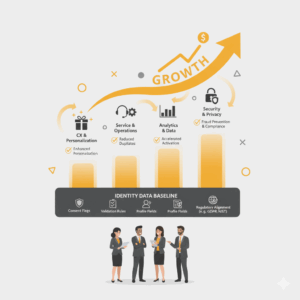
Leaders set growth targets that depend on trusted identity data. Poor identity data blocks personalisation, inflates acquisition costs, and erodes consent trust. Strong identity foundations improve match rates, unify profiles, and reduce fraud. Digital identity describes the attributes that uniquely represent a person, account, or device across channels. Consent describes the lawful basis for processing personal data. A robust baseline aligns definitions to regulations and standards. The baseline anchors profile fields, validation rules, consent flags, and lifecycle events. The result gives CX, service, analytics, and security teams one language. The same baseline reduces duplicate records and accelerates activation through CDPs, CRMs, and contact centres. The baseline also supports policy and audit. The foundations follow proven references such as GDPR definitions of personal data and W3C/NIST guidance on identity assurance.¹²³
What is an identity profile schema?
An identity profile schema defines the canonical structure for storing and exchanging identity attributes. The schema lists fields, data types, allowed values, provenance, consent status, and retention rules. The schema enables interoperability between systems like CRM, CDP, marketing automation, and contact centre. The schema should map to open protocols where possible. OpenID Connect supplies authentication claims. SCIM supplies standard user attributes and provisioning APIs. Using these standards lowers integration risk and speeds vendor onboarding.⁴⁵
How should organisations govern identity attributes?
Organisations govern identity attributes through a data dictionary, stewardship roles, and quality rules. The data dictionary names each attribute, defines the purpose, and describes valid ranges. Stewards own data quality metrics such as completeness, uniqueness, timeliness, and accuracy. ISO and DAMA literature describe common dimensions and controls that fit identity data well. Strong governance links attributes to consent, retention, and audit trails. Teams measure quality with thresholds that trigger remediation. The remediation path may include deduplication, address verification, and identity proofing.⁶⁷
Identity data readiness checklist
Use this checklist to assess technical and operational readiness. Treat each item as pass, partial, or gap.
Purpose clarity. Teams document the business use for each identity attribute, including CX personalisation and service routing.
Lawful basis. Records store the lawful basis for processing with timestamps and scope per channel and purpose. GDPR and similar laws require explicit definitions.¹
Consent capture. Systems capture consent and preferences in a granular and auditable form. Consent stores provenance, method, and policy version.¹
Minimum data. Forms collect only the minimum attributes required for the stated purpose.¹
Standards mapping. Identity claims and profile fields map to OpenID Connect, SCIM, and vendor schemas to enable portability.⁴⁵
Assurance level. Flows label the confidence level of identity proofing using recognised levels.²
Data quality rules. Platforms enforce validation, deduplication, and survivorship policies that prioritise authoritative sources.⁶
Lifecycle events. Profiles track creation, verification, merge, split, and deletion events with immutable audit logs.
Access controls. Role based access restricts sensitive attributes. ISO 27001 style controls protect profile stores and keys.³
Retention and deletion. Systems apply retention schedules and enable verified deletion across downstream processors.¹
Subject rights. Self-service supports access, correction, portability, and opt-out requests with service-level targets.¹
Cross-channel linkage. Identity graph links email, phone, device IDs, and customer IDs under strong matching rules.
Fraud controls. Journeys evaluate risk signals and step up verification when risk rises.²
Operational ownership. Named stewards and product owners maintain the schema and quality metrics.⁷
Interoperability tests. Sandboxes validate imports and exports against the canonical schema and protocols.⁴⁵
Canonical profile schema template
Use this template to seed your canonical profile object. Adapt field names to your stack. Keep types explicit. Record provenance for every attribute.
Object: IdentityProfile
Core identifiers
customer_id[string, required, unique]external_ids[array of {system, id, verified:boolean}]primary_channel[enum: email | phone | app | web | other]assurance_level[enum aligned to AAL1 | AAL2 | AAL3]²
Person attributes
given_name[string]family_name[string]full_name[string]date_of_birth[date, sensitive]gender[controlled vocabulary]language[BCP 47 language tag]country[ISO 3166-1 alpha-2]
Contact attributes
email[string, pattern RFC 5322, verified:boolean, verified_at:datetime]phone[E.164 string, verified:boolean, verified_at:datetime]address[{line1, line2, city, region, postal_code, country_code}]
Authentication and identity
subject[OpenID Connect sub claim, string]⁴issuer[OpenID Provider identifier, URL]⁴auth_time[datetime]⁴mfa_enrolled[boolean]credential_binding[public key or device binding reference]
Consent and preference
consents[array of {purpose, lawful_basis, status, scope, captured_at, expires_at, method, policy_version}]¹preferences[array of {channel, topic, status, captured_at, source}]do_not_sell_or_share[boolean, region_scope]
Data governance
provenance[array of {attribute, source_system, collected_at, method}]retention_class[enum, schedule reference]sensitivity[enum: normal | sensitive]¹processing_restrictions[array of {jurisdiction, rule}]¹audit_log_pointer[immutable event store reference]³
Quality and matching
match_keys[hashes of email, phone, address, device]duplicate_group_id[string]survivorship_ruleset[name, version, applied_at]
Lifecycle and status
status[enum: active | inactive | deleted | merged]created_at[datetime]updated_at[datetime]verification_events[array of {type, result, level, at, channel}]²
This structure aligns common identity, consent, and governance needs while staying compatible with OpenID Connect claims and SCIM user attributes.⁴⁵
How do we verify and match identities across channels?
Teams verify and match identities using deterministic and probabilistic signals. Deterministic matching relies on exact keys such as email or customer ID. Probabilistic matching relies on scores from name, address, device, or behavioural signals. A robust approach records verification events and assigns assurance levels that indicate confidence in identity proofing. NIST guidance provides clear definitions for identity assurance and authentication assurance that help to standardise confidence labels across journeys.² Strong matching policies reduce duplicates and improve personalisation outcomes while protecting customers from account takeover.²
Which controls keep identity data lawful and secure?
Controls protect confidentiality, integrity, and availability. ISO 27001 describes a management system for information security with policies, roles, risk assessment, and controls. Organisations apply encryption, key management, logging, and access control to identity stores. Security must pair with privacy. GDPR defines personal data, data subject rights, processing purposes, and lawful bases. Teams must tie every profile attribute and processing action to a documented purpose and legal basis. The combination of ISO controls and GDPR privacy rules creates a measurable, auditable framework that supports both CX and compliance outcomes.¹³
How should teams measure identity data quality?
Teams should measure completeness, accuracy, validity, consistency, timeliness, and uniqueness. DAMA and ISO references describe these dimensions and provide a vocabulary for governing data quality. Measurement requires thresholds, ownership, and playbooks. Service and CX teams should see quality scores inside workflow tools, not only inside data platforms. The organisation should report quality trends alongside conversion and NPS to show the business impact. Executives should review high-severity issues and approve remediation budgets. These steps move identity data from a back-office concern to a visible enabler of growth and trust.⁶⁷
Profile schema mapping guide
Use this guide to map your canonical schema to popular standards and platforms.
OpenID Connect. Map
sub,iss,auth_time, and standard claims such asemailandphone_numberto authentication events. This mapping keeps login context linked to the customer record.⁴SCIM. Map person and contact attributes to SCIM
Userfields such asname,emails,phoneNumbers, andaddresses. SCIM speeds provisioning and profile sync across SaaS systems.⁵Regulatory flags. Map consent, lawful basis, and processing restrictions to privacy preference centres and downstream processors to ensure policy enforcement.¹
What is the implementation path that reduces risk?
Leaders avoid big bang migrations. Teams deliver value through short, controlled increments. Start with a pilot. Define the canonical profile schema and map it to one high-impact journey such as account creation or contact centre authentication. Add consent capture, verification events, and quality rules. Prove impact on match rate, conversion, handle time, or fraud reduction. Then scale mappings into the CDP and CRM. Expand to additional journeys such as service recovery and cross-sell. Close each increment with a compliance and security review. This sequence reduces risk and builds confidence across business and technology.³
What outcomes should executives expect?
Executives should expect measurable outcomes that link to growth and trust. Identity completeness should rise. Duplicate rates should fall. Consent provenance should meet audit checks. Authentication friction should drop where risk is low and rise where risk is high. These outcomes support better personalisation, faster service, and lower fraud losses. The identity baseline turns into a durable asset for Customer Experience and Service Transformation. It helps leaders deliver reliable insights and compliant activation at scale.²³
FAQ
What is the IdentityProfile schema in Customer Science templates?
The IdentityProfile schema is a canonical structure for identity attributes, consent status, quality controls, and lifecycle events that maps to OpenID Connect and SCIM for interoperability across CRM, CDP, and contact centre platforms.⁴⁵
How does the checklist help Customer Science clients improve CX and service?
The checklist turns governance, privacy, and security requirements into clear pass or gap items. Teams use it to enforce lawful basis, consent capture, quality rules, and lifecycle events that drive personalisation and service reliability.¹³⁶
Which standards should leaders align to for identity assurance and security?
Leaders should align identity proofing and authentication labels to NIST Digital Identity Guidelines for assurance and align security management to ISO 27001 controls for policy, access, and audit.²³
Why should schemas include consent and provenance fields?
Schemas should include consent and provenance to link each attribute to purpose, method, source, and policy version. This linkage supports GDPR compliance, downstream enforcement, and auditability across processors.¹
Which fields are essential for cross-channel matching in Customer Science deployments?
Essential fields include customer_id, verified email and phone, match_keys, duplicate_group_id, and verification_events. These fields support deterministic and probabilistic matching and record assurance levels.²⁶
How does SCIM reduce integration effort for enterprise teams?
SCIM standardises user attributes and provisioning APIs, which speeds profile synchronisation and reduces custom mappings when onboarding SaaS platforms in the enterprise stack.⁵
Which metrics signal that identity data foundations are healthy?
Useful metrics include completeness, uniqueness, timeliness, and accuracy scores for key attributes, along with consent provenance rates, duplicate reduction, and verified deletion success across systems.⁶⁷
Sources
Regulation (EU) 2016/679 General Data Protection Regulation, European Parliament and Council, 2016, Official Journal of the European Union. https://eur-lex.europa.eu/eli/reg/2016/679/oj
Digital Identity Guidelines, Grassi, Lefkovitz, Nadeau, et al., 2017–2023, NIST Special Publication 800-63-3 and updates. https://pages.nist.gov/800-63-3/
ISO/IEC 27001 Information Security Management Systems, International Organization for Standardization, 2022, ISO. https://www.iso.org/standard/27001
OpenID Connect Core 1.0 incorporating errata set 1, Sakimura, Bradley, Jones, et al., 2014–2021, OpenID Foundation. https://openid.net/specs/openid-connect-core-1_0.html
System for Cross-domain Identity Management: Protocol (RFC 7644) and Schema (RFC 7643), Hunt, Ansari, Wahlstroem, 2015, IETF. https://www.rfc-editor.org/rfc/rfc7643 and https://www.rfc-editor.org/rfc/rfc7644
DAMA-DMBOK: Data Management Body of Knowledge, DAMA International, 2017, Technics Publications. https://www.dama.org/content/body-knowledge
ISO 8000-8: Data quality — Concepts and vocabulary, International Organization for Standardization, 2021, ISO. https://www.iso.org/standard/74376.html