

























Effective IT vendor management requires a shift from transactional supplier control to strategic partnership design. Organisations that achieve this alignment improve technology outcomes, reduce risk, and accelerate value creation. By combining governance, shared incentives, performance measurement, and trust-based collaboration, enterprises turn vendors into long-term partners that support automation, resilience, and sustained business growth.
What does managing IT vendors mean today?
Managing IT vendors refers to the structured approach used to select, govern, measure, and evolve third-party technology providers. Traditional vendor management focused on contracts, pricing, and service levels. Modern IT vendor management best practices emphasise value delivery, innovation, and shared accountability across the technology lifecycle.
In complex digital environments, vendors influence customer experience, operational resilience, data security, and regulatory compliance. Treating these providers as interchangeable suppliers limits outcomes. Strategic vendor management recognises vendors as extensions of the enterprise operating model. This reframing changes how organisations design governance, measure success, and allocate decision rights across technology and automation programs¹.
Why does the supplier model fail in technology and automation?
The supplier model prioritises cost control and short-term efficiency. While suitable for commoditised goods, it fails in technology domains where requirements evolve and dependencies are tightly coupled. Rigid contracts and narrow service level agreements discourage innovation and shift risk back to the enterprise.
Research shows that adversarial vendor relationships increase project overruns, integration failures, and security exposure². In automation and digital transformation initiatives, outcomes depend on co-design, continuous improvement, and shared learning. A supplier mindset prevents vendors from investing discretionary effort or aligning their roadmaps with business priorities. The result is fragile technology delivery and poor return on investment.
How does a partnership-based vendor model work?
A partnership-based model aligns vendors to business outcomes rather than isolated deliverables. Governance focuses on joint planning, transparent performance data, and escalation paths that resolve issues without blame. Contracts still matter, but they act as safety nets rather than primary control mechanisms.
Partnerships establish shared objectives such as uptime, customer satisfaction, or time-to-market. Incentives reward value creation, not just compliance. Regular strategic reviews replace reactive issue management. This model reflects evidence from high-performing enterprises that link collaborative vendor relationships to improved innovation rates and system reliability³.
What capabilities enable effective IT vendor partnerships?
Successful partnerships require internal capability maturity. Organisations must clearly articulate technology strategy, architectural standards, and risk appetite. Without this clarity, vendors fill the vacuum with their own priorities.
Core capabilities include vendor segmentation, outcome-based contracting, performance analytics, and executive sponsorship. Platforms such as Customer Science Insights support this maturity by consolidating vendor performance, experience metrics, and financial data into a single decision framework. This enables leaders to evaluate partners on value contribution rather than anecdote or cost alone. Strategic insight replaces fragmented reporting and strengthens governance discipline.
How should organisations compare suppliers versus partners?
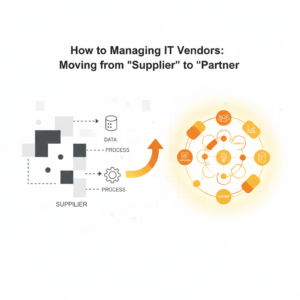
The distinction between suppliers and partners lies in behaviour, not branding. Suppliers deliver defined services at agreed prices. Partners co-own outcomes, adapt to change, and invest in the relationship. Suppliers optimise their margin per contract. Partners optimise total value over time.
A technology procurement guide that supports partnership selection assesses cultural fit, transparency, and collaboration capability alongside technical competence. Longitudinal studies show that organisations using multi-dimensional vendor evaluation frameworks achieve higher digital transformation success rates than those relying on price-led selection⁴.
Where do IT vendor partnerships deliver the most value?
Partnerships are most valuable in areas with high uncertainty and strategic impact. These include automation, data platforms, cybersecurity, and customer-facing systems. In these domains, requirements evolve and integration risk is high.
For example, aligning vendors across automation and analytics enables faster experimentation and more reliable scaling. Customer Science CX Research and Design services support this alignment by translating business outcomes into measurable experience and technology requirements. This shared understanding reduces rework and strengthens vendor accountability across the delivery lifecycle.
What risks arise when moving to a partnership model?
Partnerships introduce new risks if governance is weak. Over-reliance on a single vendor can create lock-in. Informal decision-making can dilute accountability. Trust without transparency exposes organisations to performance and compliance failures.
Mitigation requires balanced scorecards, exit planning, and independent assurance. ISO-aligned supplier relationship management standards emphasise the need for documented roles, performance thresholds, and continuous risk assessment⁵. Effective partnerships balance collaboration with control. They do not remove the need for disciplined oversight.
How should IT vendor performance be measured?
Measurement shifts from task completion to outcome realisation. Key indicators include service stability, delivery velocity, innovation contribution, and experience impact. Financial metrics remain important but are interpreted alongside qualitative indicators such as responsiveness and problem resolution effectiveness.
Advanced organisations use integrated measurement models that connect vendor performance to business results. Customer Science CX Consulting and Professional Services support this by designing value measurement frameworks that link vendor activity to customer and operational outcomes. This evidence-based approach improves investment decisions and strengthens executive confidence in vendor strategies.
What are the next steps to move from supplier to partner?
The transition begins with intent. Leadership must explicitly state that vendors are expected to contribute to outcomes, not just deliverables. Vendor segmentation identifies where partnerships matter most. Contracts are then redesigned to support flexibility, incentives, and shared accountability.
Capability uplift follows. This includes data integration, governance cadence redesign, and skills development in commercial and relationship management. Over time, organisations that apply IT vendor management best practices reduce delivery risk, improve technology resilience, and unlock sustained value from their technology ecosystem.
What evidence supports partnership-based IT vendor management?
Multiple studies link collaborative vendor relationships to superior performance. OECD research associates strategic supplier engagement with higher innovation output⁶. Australian Government ICT sourcing guidance emphasises partnership models for complex digital programs⁷. Empirical analysis in information systems journals confirms that relational governance improves project outcomes in uncertain environments⁸.
Together, this evidence supports a clear conclusion. Managing IT vendors as partners is not a cultural preference. It is a structural requirement for effective technology and automation delivery.
FAQ
What is the difference between IT vendor management and procurement?
Procurement focuses on sourcing and contracting. IT vendor management governs performance, risk, and value across the relationship lifecycle.
When should a supplier be treated as a strategic partner?
When the vendor influences core systems, customer experience, or automation outcomes, partnership models deliver better results.
How can performance be measured without weakening trust?
Use transparent, shared metrics linked to outcomes. Data-driven reviews strengthen trust by reducing ambiguity.
What role does technology play in vendor management?
Analytics platforms such as Customer Science Insights provide objective visibility into vendor performance and value contribution.
Can partnerships increase vendor dependency risk?
Yes, if unmanaged. Balanced governance, exit planning, and periodic market testing mitigate this risk.
How do organisations operationalise this shift at scale?
Structured consulting and governance design services, such as those delivered through Customer Science CX Consulting and Professional Services, enable consistent execution across vendor portfolios.
What tools support ongoing vendor learning and alignment?
Knowledge Quest supports shared learning, capability uplift, and evidence-based decision-making across internal teams and vendor partners.
Sources
- ISO 44001:2017 Collaborative business relationship management systems.
- Lacity, M., et al. Information Systems Journal, 2018. DOI:10.1111/isj.12179
- Poppo, L., Zhou, K. Strategic Management Journal, 2019. DOI:10.1002/smj.2994
- Deloitte Global Technology Sourcing Survey, 2020.
- ISO 37500:2014 Guidance on outsourcing.
- OECD Innovation and Supplier Relationships Report, 2019.
- Australian Government Digital Transformation Agency. ICT Sourcing Framework, 2021.
- Wiener, M., et al. MIS Quarterly, 2020. DOI:10.25300/MISQ/2020/15168