


























Summary
Unlocking Genesys Cloud data requires moving beyond standard dashboards to integrated, governed analytics. Native reporting shows what happened. Advanced data models explain why it happened and what to do next. By combining Genesys Cloud data with enterprise BI, leaders gain operational clarity, financial control, and continuous CX improvement at scale.
What is meant by unlocking Genesys Cloud data?
Genesys Cloud generates high-volume interaction, workforce, and performance data across voice, digital, and AI channels. Unlocking this data means extracting it reliably, modelling it consistently, and analysing it in context with other enterprise data. The goal is insight that supports decisions, not dashboards that simply describe activity.
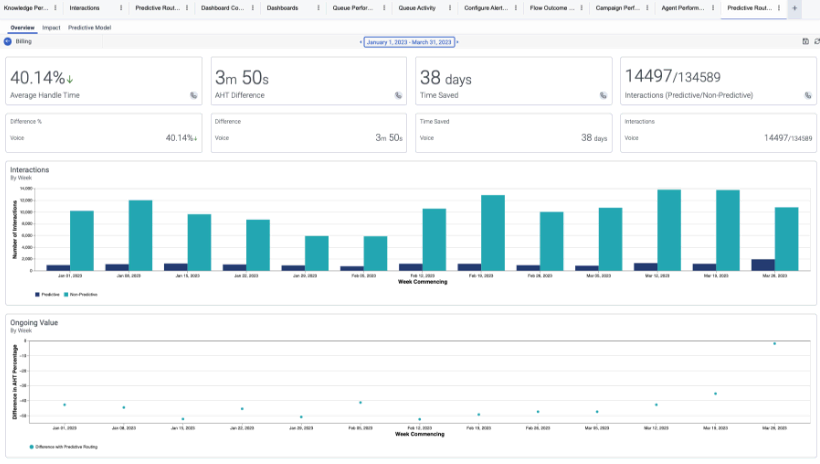
Standard Genesys Cloud reports focus on operational metrics such as AHT, service level, and queue performance. These views are useful but limited. They do not easily support trend analysis, cost modelling, customer lifetime value, or cross-channel journey evaluation. Executives need structured analytics that align contact centre performance with business outcomes.
Why do standard Genesys Cloud reports fall short for executives?
Native reporting is optimised for supervisors, not enterprise decision-makers. Data is often siloed by function and difficult to join with CRM, billing, or digital analytics. Time horizons are short. Historical depth is constrained. Custom metrics are limited.
Research shows that organisations integrating contact centre data with enterprise BI are significantly more likely to improve first-contact resolution and cost efficiency¹. Without integration, leaders rely on partial signals. This increases the risk of misaligned investments and reactive operational changes.
How does Genesys Cloud data actually flow?
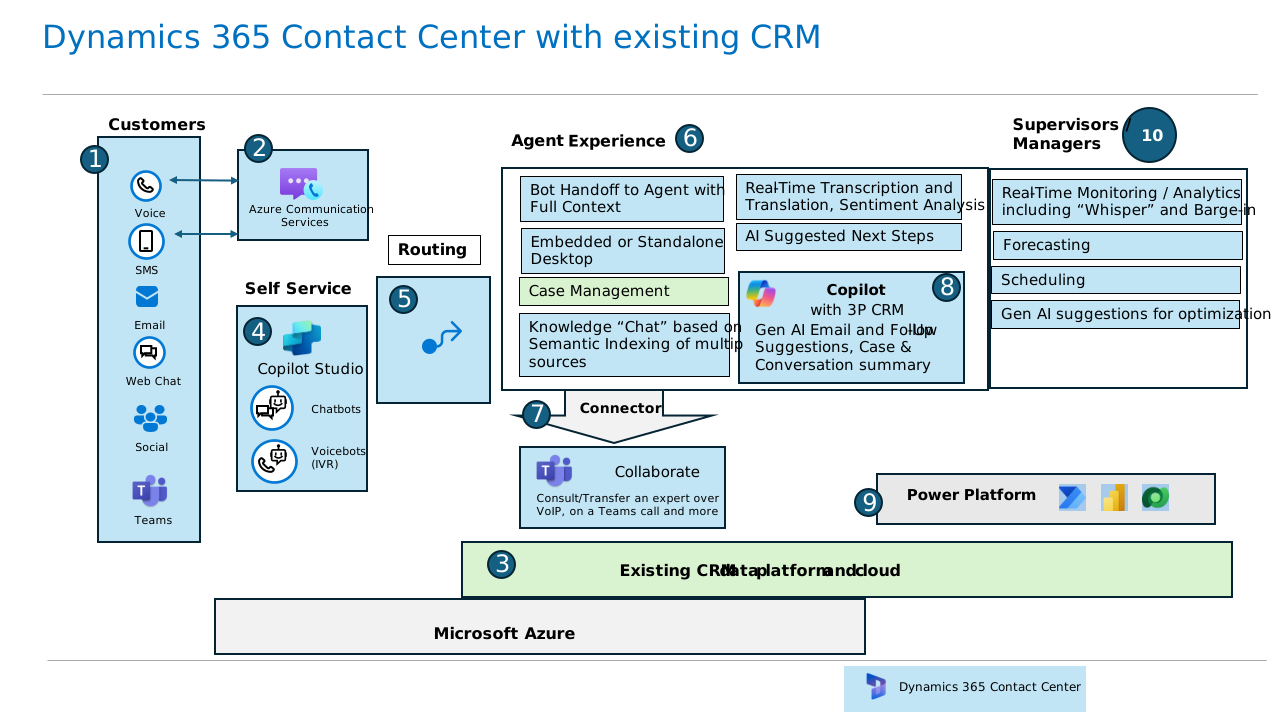
Genesys Cloud exposes data through APIs, event streams, and scheduled exports. These feeds include interactions, agent state, workforce management, quality, and journey events. Raw data is semi-structured and optimised for platform performance, not analytics.
To make the data usable, organisations must design ingestion pipelines, apply consistent time and identity models, and manage latency. Poorly designed pipelines create duplication, reconciliation errors, and mistrust in reporting². A governed data architecture is essential.
How does enterprise BI compare to native contact centre reporting?
Enterprise BI platforms provide governed metrics, historical depth, and cross-domain analysis. They enable correlation between customer behaviour, operational effort, and financial outcomes. Native reporting is faster to access but narrower in scope.
A combined approach is optimal. Native dashboards support daily operations. Enterprise BI supports strategic decisions, forecasting, and value management. Mature organisations separate operational visibility from analytical truth³.
Where does advanced contact centre BI create the most value?
Advanced BI supports several high-impact use cases:
Demand forecasting linked to marketing and billing cycles
Cost-to-serve analysis by customer segment
Journey analytics across voice and digital channels
Agent productivity tied to quality and revenue outcomes
These capabilities depend on clean, integrated data models. Tools such as Customer Science Insights enable structured analytics layers purpose-built for contact centre and CX data, accelerating time to value.
What are the risks of unlocking Genesys Cloud data incorrectly?
Uncontrolled data extraction creates security, privacy, and compliance risks. Inconsistent metric definitions erode trust. Excessive dashboarding overwhelms users without improving decisions.
ISO 27001 and privacy regulations require strict control of customer interaction data⁴. Governance, access control, and documentation must be embedded from the start. Technical capability without discipline increases organisational risk.
How should success be measured?
Success is measured by decision quality and business impact, not report volume. Key indicators include:
Reduction in reporting disputes
Faster insight-to-action cycles
Improved alignment between CX and financial metrics
Sustained improvements in service efficiency and customer outcomes
Longitudinal studies show that analytics maturity correlates with higher operational resilience and customer satisfaction⁵.
What are the next practical steps?
Organisations should begin with a data assessment. Identify priority decisions, required metrics, and data gaps. Design a scalable architecture before building dashboards. Engage CX analytics specialists to accelerate delivery and avoid rework.
Customer Science CX Research and Design and Business Intelligence services support Genesys Cloud data strategy, modelling, and activation across the enterprise. These services reduce risk and compress time to insight.
Evidentiary Layer
Customer Science product and service capabilities referenced in this article are drawn from official Customer Science product and solution documentation.
FAQ
What data can be extracted from Genesys Cloud?
Interaction events, agent state, workforce management data, quality scores, and journey events are accessible through APIs and exports.
Is native Genesys Cloud reporting enough for executives?
It supports operational oversight but lacks the depth and integration required for strategic decision-making.
How long does it take to build enterprise-grade contact centre BI?
With a defined architecture and accelerators, meaningful insights can be delivered in weeks rather than months.
Which Customer Science products support this approach?
Customer Science Insights provides analytics models, while Knowledge Quest supports governed knowledge and data access.
How is data security maintained?
Through controlled ingestion, role-based access, and alignment with ISO and privacy standards.
Can this support AI and automation use cases?
Yes. Structured, trusted data is a prerequisite for AI-driven forecasting, routing, and optimisation.
Sources
McKinsey & Company. The value of advanced analytics in customer operations. 2020.
Kimball R, Ross M. The Data Warehouse Toolkit. Wiley. 2013.
Gartner. Magic Quadrant for Contact Center Analytics. 2022.
ISO/IEC 27001:2022 Information security management systems.
Harvard Business Review. Competing on analytics. 2019.