































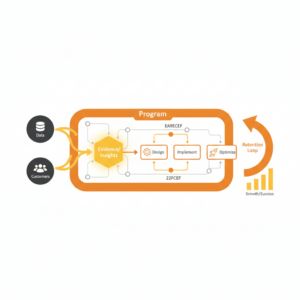
A customer retention program reduces churn by removing the specific service and product causes that make customers leave, then validating which interventions work through disciplined measurement. Evidence-based designs combine journey fixes, proactive service, and targeted save actions with privacy-safe data governance. The result is lower churn, higher lifetime value, and fewer discount-heavy “save” cycles.
Definition
What is a customer retention program in this context?
A customer retention program is an operating system that prevents avoidable churn and recovers at-risk customers through coordinated actions across product, service, pricing, and communications. “Churn” means a customer ends or materially reduces the relationship, such as cancellation, non-renewal, downgrade, or inactivity. This definition excludes employee retention and focuses on customer behaviour change driven by experience, value, and trust.
An evidence-based customer retention program links three elements into one loop: (1) diagnosis of churn drivers using customer insight, service data, and journey evidence¹, (2) interventions designed as testable treatments using causal methods², and (3) an outcome model that proves incremental lift, not just correlated movement³. Without that loop, retention efforts often degrade into broad discounting that erodes margin and trains customers to threaten cancellation.
Context
Why do many churn reduction efforts fail at scale?
Many “reduce churn” initiatives focus on prediction rather than persuasion. Predictive models can identify who is likely to leave, but they do not reliably indicate which action will change the outcome for that person². That gap drives wasted effort, because teams contact customers who would have stayed anyway, while missing customers who need a different experience fix.
Retention also fails when customer signals are fragmented across channels. Complaints, repeat contacts, and unresolved friction show up in service operations long before cancellation, but they are rarely treated as leading indicators that trigger coordinated fixes¹. A mature retention program treats service as a sensor network for churn risk and a delivery channel for recovery, supported by consistent complaints handling and learning routines⁴.
Mechanism
How does evidence-based retention actually reduce churn?
Evidence-based retention turns churn drivers into hypotheses and hypotheses into validated actions. Start with a clear outcome definition for churn (time window, contract state, downgrade rules) and then map churn pathways across journeys and segments. Use interpretability to ensure leaders understand the drivers and to prevent “black box” debates from blocking action⁵.
Next, use causal measurement to determine what changes outcomes. Uplift modeling and heterogeneous treatment effect methods estimate the incremental impact of an action for different customers, rather than the likelihood of churn alone³˒⁶. This supports “next best retention action” decisions, where the priority is the smallest intervention that reliably changes behaviour, such as removing effort in a key service step, fixing a broken onboarding moment, or routing a complaint to the right resolver team⁴.
What interventions typically deliver sustainable retention lift?
Sustainable lift usually comes from reducing customer effort in high-frequency tasks and preventing repeat failure demand. Complaint and recovery research shows the “service recovery paradox” is inconsistent, and over-relying on recovery heroics can miss the more reliable path: operational learning that prevents repeats⁷. A strong retention program uses recovery to protect trust, but uses prevention to protect economics.
Targeted retention offers still matter, but they should be constrained by incremental value. Value-driven uplift evaluation helps teams avoid “discount leakage” by estimating whether an incentive creates net benefit after cost and margin effects³. In practice, this means fewer blanket save offers and more precise actions tied to the customer’s actual friction, vulnerability, and value trajectory.
Comparison
What is the difference between reactive save offers and an evidence-led program?
Reactive save offers are designed around cancellation moments. Evidence-led programs start earlier, using service and journey signals as triggers and addressing causes upstream. The reactive model improves short-term saves but often increases long-term discount dependency. The evidence-led model reduces the number of customers reaching the cancellation point by removing friction and building trust loops⁴.
Predictive churn models vs causal and uplift approaches
Predictive churn models answer “who is at risk.” Causal and uplift approaches answer “what will change the outcome for this customer under real constraints.” Metalearners and uplift benchmarking research provides practical approaches for estimating treatment effects and comparing model families across decision contexts⁶˒⁸. For executives, this distinction is the difference between a reporting asset and a decision engine.
Applications
How do you design a customer retention program end to end?
Design around a small number of repeatable retention “plays,” each with a clear trigger, owner, and measured outcome. Typical plays include:
Onboarding protection: identify early friction and fix first-value steps before habits form.
Service prevention: remove the top drivers of repeat contacts and unresolved complaints⁴.
Proactive outreach: contact customers only when uplift evidence indicates the action is likely to change the outcome³.
Save and win-back: use constrained offers, script discipline, and escalation rules tied to incremental value³.
Operationally, these plays need an execution layer that can run continuously, not as a one-off project. A managed model such as CX improvement delivery with CX Integrator (https://customerscience.com.au/solution/cx-integrator/) helps organisations sustain the operating rhythm of diagnosis, change delivery, and measurement across CX and service operations.
What does “customer insight” mean in a churn and retention program?
Customer insight is structured evidence that explains why churn happens and what customers are trying to achieve when they contact you. It should combine quantitative signals (complaints, repeat contacts, digital drop-off, tenure, product mix) with qualitative evidence (journey narratives, verbatims, service blueprints). The goal is to isolate a small set of high-leverage causes that can be fixed, then to test fixes with measurable impact on churn and value².
Risks
What risks can derail a retention program?
Privacy and trust risk is the fastest way to destroy retention economics. In Australia, customer data use must align to the purpose of collection and the Australian Privacy Principles, with clear consent practices where required⁹˒¹⁰. Retention programs that overreach on sensitive data, identity matching, or intrusive profiling invite regulator scrutiny and reputational damage.
Security risk matters because retention programs unify data across channels. ISO/IEC 27001 provides a recognised framework for establishing and maintaining an information security management system that protects the data foundation of retention interventions¹¹. Operational risk also rises if retention triggers overload frontline teams or introduce inconsistent recovery decisions. A complaints handling framework aligned to ISO 10002 supports consistent treatment, auditability, and organisational learning⁴.
Measurement
What metrics prove a retention program is working?
The core metric is incremental churn reduction, not raw churn movement. Pair the churn outcome with an incremental value model that includes retention cost, service cost-to-serve changes, and downstream revenue. Where feasible, prioritise controlled experiments and quasi-experimental methods to isolate causality².
Also use a layered metric stack:
Lagging outcomes: churn, downgrade rate, renewal rate, lifetime value.
Leading indicators: complaint rate, repeat contact rate, unresolved case age, customer feedback metrics linked to performance¹².
Decision quality: uplift by play, cost per incremental save, and offer leakage³.
For organisations building capability, CX strategy and delivery through CX Consulting and Professional Services (https://customerscience.com.au/service/cx-consulting-and-professional-services/) can help define the measurement design, governance, and the operating cadence needed to sustain a customer retention program across business and service transformation.
Next Steps
What is a practical 90-day plan to launch or reset retention?
Weeks 1–3: define churn precisely, establish data lineage, and create a single “churn pathways” view by segment and journey. Ensure privacy purpose alignment and retention use cases are documented against the APP guidelines⁹.
Weeks 4–8: design three to five retention plays and implement them in one priority segment or journey. Instrument triggers and outcomes, then run A/B tests or staggered rollouts to estimate impact². Add uplift evaluation so contact and offer decisions prioritise incremental lift³.
Weeks 9–12: scale only the plays that prove incremental value, and convert findings into prevention work. The aim is to reduce the volume of cancellation moments, not just improve save rates. Embed learning routines so complaints and service failures become a continuous improvement feedstock⁴˒⁷.
Evidentiary Layer
What evidence should executives expect before scaling investment?
Executives should expect three types of evidence: (1) causal impact estimates that show the retention play changes churn outcomes², (2) economic evidence that shows net value after cost and incentive leakage³, and (3) governance evidence that shows privacy, security, and complaint handling controls are in place⁴˒⁹˒¹¹.
Where evidence is mixed, choose the safer interpretation. Research on service recovery paradox effects is not consistently positive for repurchase, and recent work emphasises organisational learning as the moderator that makes improvements durable⁷. That supports a clear executive stance: protect trust through recovery, but allocate the larger investment to prevention and journey redesign that permanently reduces churn pathways.
FAQ
What is the first step to reduce churn with a customer retention program?
Define churn precisely and map the top churn pathways using service and journey evidence¹. Without a shared definition, measurement and accountability will fail.
Should we prioritise predictive churn scoring or retention actions?
Prioritise actions that prove incremental lift. Prediction identifies risk, but uplift and causal methods identify which treatments change outcomes²˒⁸.
How do we avoid discount dependency in save offers?
Use value-driven uplift evaluation and constrain offers to customers where the incentive creates net value after cost³. Pair offers with friction fixes so the same customers do not return to cancel again.
How do privacy requirements affect retention targeting in Australia?
Use and disclosure must align to the original collection purpose unless an exception applies, and consent practices must be clear where required¹⁰. Design retention plays so the minimum necessary data is used and documented against APP guidance⁹.
What operational changes reduce churn without major technology spend?
Fix the top drivers of repeat contacts, slow resolution, and complaint mishandling using ISO-aligned complaints handling routines⁴. Reducing effort in high-volume service tasks often produces durable retention lift.
How can communications reduce churn in regulated or high-stress journeys?
Clearer, simpler, and more empathetic customer communications reduce confusion, complaints, and avoidable follow-up contacts. Customer-ready correspondence and journey communications via CX Communications (https://customerscience.com.au/solution/cx-communications/) helps align language, compliance, and customer understanding in churn-sensitive moments such as onboarding, billing, disputes, and hardship.
Sources
Agag, G. et al. (2023). Understanding the link between customer feedback metrics and firm performance. Journal of Business Research. Stable link: https://www.sciencedirect.com/science/article/pii/S0969698923000486
Athey, S., & Imbens, G. W. (2019). Machine Learning Methods That Economists Should Know About. Annual Review of Economics, 11, 685–725. https://doi.org/10.1146/annurev-economics-080217-053433
Gubela, R. M. et al. (2021). Uplift modeling with value-driven evaluation metrics. Decision Support Systems. https://www.sciencedirect.com/science/article/abs/pii/S0167923621001585
ISO 10002:2018. Quality management – Customer satisfaction – Guidelines for complaints handling in organizations. Standards catalogue entry: https://www.standards.org.au/standards-catalogue/standard-details?designation=iso-10002-2018
Peng, K., Peng, Y., & Li, W. (2023). Research on customer churn prediction and model interpretability analysis. PLOS ONE, 18(12): e0289724. https://doi.org/10.1371/journal.pone.0289724
Künzel, S. R. et al. (2019). Metalearners for estimating heterogeneous treatment effects using machine learning. PNAS, 116(10), 4156–4165. https://doi.org/10.1073/pnas.1804597116
Lunardo, R. et al. (2023). A time(ly) perspective of the service recovery paradox. International Journal of Research in Marketing. Stable link: https://www.sciencedirect.com/science/article/abs/pii/S0148296323004460
Rößler, J. et al. (2022). Bridging the Gap: A Systematic Benchmarking of Uplift Modeling. Journal of Marketing Research. https://doi.org/10.1177/10949968221111083
Office of the Australian Information Commissioner (OAIC). Australian Privacy Principles guidelines. https://www.oaic.gov.au/privacy/australian-privacy-principles/australian-privacy-principles-guidelines
OAIC. Consent to the handling of personal information. https://www.oaic.gov.au/privacy/your-privacy-rights/your-personal-information/consent-to-the-handling-of-personal-information
ISO/IEC 27001:2022. Information security management systems requirements. https://www.iso.org/standard/27001
De Haan, E. et al. (2023). Should Net Promoter Score be supplemented with other metrics? International Journal of Market Research. https://doi.org/10.1177/14707853231219648