































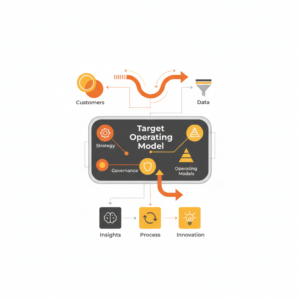
A CX target operating model sets out how your organisation will deliver the customer experience it promises, at scale, with clear ownership, measurable standards, and workable economics. It turns CX strategy into decisions about governance, service design, roles, data, technology, and performance routines so customer outcomes improve in a controlled, repeatable way.
What is a CX target operating model?
A CX target operating model, or CX TOM, is the future-state blueprint for how customer experience strategy becomes day-to-day delivery. In plain terms, it defines who owns which journeys, how decisions are made, how work flows across channels, what data is used, which technology supports staff, and how performance is measured. That matters because customer experience is not only the interaction a customer sees. It is also the hidden operating system behind that interaction, including policy, funding, knowledge, workflow, and governance.¹˒² (ISO)
A strong customer operations TOM usually covers seven design elements: strategy, governance, processes, people and skills, data and insight, technology, and measurement. Customer contact centre standards such as ISO 18295 describe this kind of end-to-end service framework explicitly, rather than treating service quality as a training issue alone.¹ (ISO)
Why do organisations need a customer operations TOM now?
Most organisations already have channels, teams, systems, and targets. But that is not the same as having an operating model. The gap shows up in familiar ways: journey owners without budget authority, digital teams measured on speed while service teams are measured on cost, fragmented knowledge, duplicated contact reasons, and dashboards that report activity but not customer outcomes. Recent CX research also points to the same pattern. Experience quality depends on how consistently the firm coordinates across the whole journey, not on isolated touchpoints.²˒³˒⁴ (SAGE Journals)
For executive teams, the practical issue is control. Without a defined TOM, service transformation becomes a sequence of local fixes. A chatbot is added. A CRM field is changed. A new metric appears. Nothing quite joins up. OECD guidance on public service design makes the same point in a different language: leaders need whole-service measurement, shared design discipline, and organisational conditions that support delivery across silos.⁷ (OECD)
How does a CX target operating model work?
A CX target operating model works by connecting four layers that are often designed separately. First comes intent. This is the customer promise, service proposition, and economic logic. Second comes control. This covers governance, decision rights, policies, risk rules, and escalation paths. Third comes execution. This is the mix of journeys, channels, case handling, workforce design, knowledge, and technology. Fourth comes learning. This includes metrics, feedback loops, continuous improvement, and benefit tracking.¹˒³˒⁸ (ISO)
The design choice is never abstract. If you want lower customer effort, the TOM must define which teams remove failure demand, who owns handoffs, how knowledge is maintained, and which measures trigger intervention. If you want higher trust in regulated services, the TOM must spell out approval controls, communication standards, audit trails, and accountability. Culture matters here as well, but culture follows system design more often than leaders admit. Research on customer experience orientation and organisational culture shows that norms become durable when they are backed by structures, management routines, and knowledge practices.⁵˒⁶ (Springer Nature Link)
What is different between a TOM and a CX strategy?
A CX strategy states what the organisation wants customers to experience and why that matters commercially. A TOM states how the organisation will make that happen. Strategy chooses the ambition. The TOM chooses the machinery. One without the other creates drift. A strategy without a TOM becomes a slide deck. A TOM without strategy becomes process work with no customer logic.²˒⁵ (SAGE Journals)
That distinction helps when boards ask for a business case. The right question is not “Do we need a customer operations TOM?” The right question is “Which operating model changes will move the customer and financial outcomes we care about?” That pushes the design toward concrete choices on service segmentation, journey ownership, channel roles, workforce capability, and performance cadence. (Customer Science)
Where should you apply a CX target operating model first?
Start where customer friction and organisational friction overlap. Common entry points are contact centre redesign, complaints, onboarding, service recovery, case management, and written communications. These areas usually reveal handoff failures, inconsistent knowledge, policy ambiguity, and measurement gaps quickly. In practice, many teams also need a live insight layer so leaders can see queue health, channel demand, and failure patterns in one place. Customer Science Insights is built for that real-time operational visibility across voice, digital, bots, CRM, and Genesys Cloud. (Customer Science)
Customer Science Case Evidence
Victims Services in New South Wales used a revised TOM, redesigned processes, updated roles, improved routing, knowledge management, and workforce planning to cut service delays from an average of 28 days to 48 hours. That is what a TOM looks like when it moves from theory into operating practice. (Customer Science)
Spotlight Retail Group used a contact centre target model review and implementation roadmap that contributed to a 20% reduction in wait and abandonment times, alongside improved booking and quote conversion rates. (Customer Science)
A national services organisation used Triage AI and service redesign to achieve 40% email deflection after setting clear guardrails for privacy, audit, and reversibility. That example matters because it shows the TOM is also the control layer for automation, not only the organisation chart. (Customer Science)
What risks should leaders watch?
The first risk is designing around technology before deciding service intent. The second is over-centralising governance so local teams cannot improve journeys. The third is treating measurement as a reporting exercise instead of a management routine. Another common mistake is copying a generic TOM pattern from another sector without testing transaction complexity, vulnerability, regulation, or channel mix.¹˒⁷˒⁸ (ISO)
There is also a people risk. When roles, incentives, and knowledge rules stay unchanged, the old model survives inside the new one. Research on organisational culture and customer experience has shown that knowledge practices and management systems shape customer outcomes directly.⁶ (Taylor & Francis Online)
How should you measure a customer operations TOM?
Measure the TOM as a system, not as a set of disconnected KPIs. At minimum, track customer outcome measures, operational flow measures, quality and risk measures, and change measures. That usually means customer effort or satisfaction, resolution, repeat contact, backlog age, transfer rate, knowledge accuracy, avoidable demand, employee capability, and benefits realised. Government service guidance is useful here because it insists on meaningful performance metrics from the start, not months after go-live.⁸ (GOV.UK)
For most organisations, the better next move is to establish a TOM baseline, identify journey and governance gaps, and sequence change into manageable waves. CX Consulting and Professional Services is relevant at this stage because the work usually spans strategy, service transformation, technology, and implementation rather than a single functional fix. (Customer Science)
What should happen next?
A good next step is a short diagnostic. Map the major journeys. Clarify decision rights. Identify where policy, knowledge, data, and workflow break the experience. Then design the minimum viable target state. Not the perfect end-state. The one you can govern, fund, and measure in the next 12 months. That gives the board a practical transformation path instead of an abstract maturity model. (Customer Science)
FAQ
What does a CX target operating model include?
It includes governance, service design, roles, processes, technology, data, knowledge, controls, and performance routines. Its job is to turn customer strategy into repeatable execution.¹˒² (ISO)
Is a customer operations TOM only for contact centres?
No. Contact centres are often the fastest starting point because they expose failure demand and handoff issues, but a TOM should cover the wider service system, including digital, field, back office, and policy functions.¹˒⁷ (ISO)
How long does TOM design usually take?
Initial diagnosis and target-state design can be done in weeks, while phased implementation usually runs over multiple quarters. The pace depends on governance complexity, technology debt, procurement, and the number of journeys in scope. (Customer Science)
What is the difference between a TOM and an org restructure?
An org restructure changes reporting lines. A TOM changes how work is governed and delivered. Structure may change, but so do decision rights, processes, knowledge rules, measures, and service controls. (Customer Science)
How do you stop a TOM becoming a paper exercise?
Tie it to live metrics, named owners, funding choices, and implementation waves. Then review it through normal business governance, not only through project meetings.⁸ (GOV.UK)
What if fragmented knowledge is the main blocker?
Then the TOM needs a knowledge operating layer, not just new content. Knowledge Quest is designed to turn live customer interactions into accurate, brand-aligned answers and to manage knowledge health in real time. (Customer Science)
Evidentiary Layer
The case for a CX target operating model is simple. Customer experience quality depends on coordination across the journey, not on one team or one channel. The evidence base supports whole-service design, formal governance, measurable standards, and active knowledge management. In practice, the organisations that improve fastest are the ones that treat CX as an operating model problem first, then as a technology or training problem.¹˒³˒⁵˒⁷ (ISO)
Sources
-
ISO. ISO 18295-1:2017 Customer contact centres, Part 1: Requirements for customer contact centres. Stable record: ISO 18295-1:2017. (ISO)
-
Lemon, K.N., Verhoef, P.C. Understanding Customer Experience Throughout the Customer Journey. Journal of Marketing, 2016. DOI: 10.1509/jm.15.0420. (SAGE Journals)
-
De Keyser, A. et al. Customer Experience: Conceptualization, Measurement, and Application in the Digital Environment. Journal of Service Research, 2022. DOI: 10.1177/10946705221126590. (SAGE Journals)
-
Rahman, S.M. et al. Perceived Omnichannel Customer Experience (OCX): Concept, Measurement, and Impact. Journal of Retailing, 2022. DOI: 10.1016/j.jretai.2022.03.003. (Macquarie University)
-
Arkadan, F., Macdonald, E.K., Wilson, H.N. Customer Experience Orientation: Conceptual Model, Propositions, and Research Directions. Journal of the Academy of Marketing Science, 2024. DOI: 10.1007/s11747-024-01031-y. (Springer Nature Link)
-
Chakravorti, S. Managing Organizational Culture Change and Knowledge to Enhance Customer Experiences. Journal of Strategic Marketing, 2011. DOI: 10.1080/0965254X.2010.529160. (Taylor & Francis Online)
-
OECD. Good Practice Principles for Public Service Design and Delivery in the Digital Age, 2024. Stable record: OECD report PDF. (OECD)
-
GOV.UK Service Manual. How to Set Performance Metrics for Your Service, updated 5 December 2017. Stable record: GOV.UK Service Manual. (GOV.UK)
-
Zha, D. et al. Synthesizing the Customer Experience Concept. Journal of Business Research, 2023. Stable record: ScienceDirect article page. (ScienceDirect)
-
Ceesay, L.B. Building a High Customer Experience Management Organization: Toward Customer-Centricity. Jindal Journal of Business Research, 2020. DOI: 10.1177/2278682120968983. (IDEAS/RePEc)
Internal briefing files reviewed for link selection and style controls.