































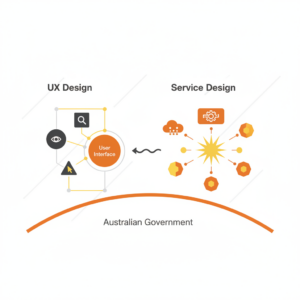
Service design sets up the whole service so people can complete an outcome across channels, teams, policies, data, and operations. UX design shapes the usability of a specific interface or touchpoint. Australian Government agencies need both to meet digital standards, reduce rework, improve accessibility, manage privacy, and deliver measurable outcomes that work in real operating conditions.
What is the difference between service design and UX design?
Service design definition in government
Service design is the discipline of designing the entire service system that produces a public outcome, not just a digital screen. It covers end-to-end journeys, eligibility rules, supporting processes, workforce roles, channel handoffs, data flows, vendors, and measurement. In government, service design must reconcile policy intent with delivery reality, including vulnerable cohorts, constrained budgets, and legacy platforms. This is why government service design principles typically emphasise inclusion, clarity of outcomes, and whole-of-service accountability rather than interface aesthetics.
Service design outputs often include a service blueprint, operating model changes, channel strategy, capability uplift plan, and a prioritised backlog that includes both policy and delivery work. The aim is consistent value for people and businesses in real contexts, including contact centres and assisted channels.
UX design definition in government
UX design focuses on the user’s experience of a specific touchpoint, usually a digital product interface such as a form, portal, app, or knowledge article. UX work defines information architecture, interaction patterns, content structure, and usability improvements. In government settings, UX design should explicitly account for accessibility, language, comprehension, and error recovery so that people can complete tasks under stress or time pressure.
UX design outputs commonly include prototypes, UI patterns, content layouts, usability test findings, and interaction specifications. UX performance is typically evaluated with usability outcomes such as effectiveness, efficiency, and satisfaction as defined in ISO usability frameworks⁷, while staying aligned to accessibility requirements and content standards.
Why do Australian Government agencies need both disciplines?
How the Digital Service Standard changes expectations
Australian agencies face a rising bar for consistent, measurable service outcomes because whole-of-government standards increasingly shape delivery expectations. The Digital Transformation Agency Digital Service Standard sets requirements for designing and delivering high-quality digital services¹, and it is supported by a practical service design and delivery process with staged delivery from discovery through live improvement². This framing matters because it treats service quality as an end-to-end system responsibility, not a “website problem”.
When agencies treat service design as optional and rely only on UX improvements, they often optimise a screen while the underlying process, channel handoffs, or evidence requirements remain broken. That creates avoidable cost, delays, and failure demand that returns through contact centres.
Inclusion, accessibility, and privacy are whole-service issues
Accessibility is positioned as a mandatory standard for Australian Government agencies in the Australian Government Style Manual guidance³, and WCAG 2.2 is the current W3C technical standard for web accessibility⁴. These requirements rarely sit neatly inside one UI team. They affect content, identity, assisted channels, document workflows, and procurement decisions.
Privacy is also structural. The Office of the Australian Information Commissioner explains how agencies should interpret and apply Australian Privacy Principles under the Privacy Act⁵. If a journey collects excessive data, shares it across vendors, or fails to explain purpose clearly, the risk is created by the service design, not only the interface design.
How do service design and UX design work together end-to-end?
How to connect policy intent to delivery mechanics
Service design translates policy intent into delivery mechanics that can be executed by teams and understood by the public. It identifies where an outcome depends on human decisions, evidence checks, or third-party data, then simplifies or re-sequences those steps. UX design then makes the required interactions clear, low-effort, and error-tolerant for the chosen channel.
A practical way to align the disciplines is to define the “unit of value” first. In government, that unit is usually an outcome like “apply”, “renew”, “report”, or “resolve”, not “visit a page”. Service design defines the end-to-end journey and operational responsibilities. UX design optimises the touchpoints people must use to complete the outcome.
How staged delivery reduces rework
The DTA service design and delivery process explicitly uses stages such as discovery, alpha, beta, and live². This staged approach works best when service design and UX design share artefacts and decisions. For example, service design discoveries about eligibility confusion should directly change UX content structure, form logic, and error prevention. Likewise, UX usability testing should feed back into service blueprint updates to correct upstream process issues.
This tight loop prevents a common government failure mode: building a polished interface that “tests well” in isolation but collapses in production due to back-office constraints, unclear communications, or channel mismatch.
Service design vs UX design: what is different in governance, scope, and artefacts?
What each discipline is accountable for
Service design owns outcomes across the full journey, including assisted channels, operational steps, and measurement. It is accountable for reducing friction across agency boundaries, simplifying handoffs, and ensuring the service can be delivered at scale. UX design owns the experience quality of specific touchpoints and the usability of interactions that occur within those touchpoints⁷.
This difference matters for governance. Service design decisions often require executive sponsorship because they change roles, policy interpretation, or cross-team coordination. UX design decisions can often be executed within product teams, but they still require alignment to accessibility and content obligations³⁴.
What artefacts you should expect in government programs
Service design artefacts usually include journey maps, service blueprints, channel strategies, stakeholder maps, and operating model changes. UX design artefacts usually include interaction designs, prototypes, content models, component usage, and usability test reports.
Both should share one prioritised backlog. Government delivery fails when service design outputs sit in slide decks while UX teams ship UI changes disconnected from operational reality.
Where should agencies apply government service design principles first?
Which services benefit most from a service design vs UX design reset
Service design creates the most value when services have one or more of the following traits:
High volume and high consequence transactions, where small friction creates large cost
Multiple channels, especially heavy contact centre use and assisted support
Cross-agency dependencies, where handoffs create delays and duplication
Vulnerable cohorts, where inclusion and comprehension must be engineered, not assumed
UX design creates fast value when services have avoidable errors, confusing content, high drop-off, or poor task completion. In practice, agencies should treat UX as the “front-line optimisation” and service design as the “system redesign” that removes the causes of repeat contact.
Customer Science Insights can support this by connecting real-time contact centre signals to service improvement decisions.
How to build a Customer Insight and Design capability
A sustainable capability combines Customer Insight and Design with delivery accountability. That means integrating VOC signals, usability findings, and operational metrics into the same prioritisation process. It also means formalising research governance so insights are reusable, not repeatedly rediscovered. ISO human-centred design guidance supports this approach by treating user needs as lifecycle requirements, not a one-time discovery output⁶.
In government, the most practical capability design is one that places service design leadership close to operations and policy, and places UX design leadership close to product delivery, with shared measurement and shared decision rights.
What risks arise when the distinction is blurred?
What compliance and trust risks appear first
When agencies treat service design as UX, they often fail in accessibility and inclusion because the “service” includes content, documents, and assisted channels, not just web screens³⁴. This risk is amplified by population realities. In 2022, 21.4% of Australians had disability⁸, so accessibility gaps become a material service delivery failure, not an edge case.
Privacy and data minimisation risks also rise when service design is weak. Privacy obligations sit across collection, storage, and disclosure decisions, not just screen-level consent text⁵. If third parties deliver parts of the service, the service design must define responsibilities, retention, and controls.
What operational risks drive cost and failure demand
The most expensive failure mode is avoidable repeat contact. UX changes can reduce confusion, but only service design can remove upstream causes like unclear eligibility logic, duplicate evidence requests, inconsistent status visibility, or broken handoffs between systems. If these remain, contact centres absorb the load, and digital deflection targets become unrealistic.
Another operational risk is building services that cannot be measured well. If teams cannot see where and why users fail, they cannot improve the service in live operations. The DTA’s emphasis on measurable services is a direct response to this risk¹.
How do you measure service design and UX design success in government?
What to measure for UX design
UX design measurement should include task success, time on task, error rates, and user-reported confidence. These align to ISO definitions of usability outcomes, which emphasise effectiveness, efficiency, and satisfaction in context of use⁷. Agencies should segment results by cohort needs, device constraints, and channel type, because “average” hides exclusion.
Accessibility conformance should be measured as a release gate, not a quarterly audit. WCAG 2.2 provides the testable success criteria⁴, and the Style Manual guidance frames accessibility as an agency commitment³. This is best managed through automated testing plus representative assistive-technology testing.
What to measure for service design
Service design measurement must connect experience to operational performance. Useful measures include completion rates across channels, avoidable contact rate, rework rate, end-to-end cycle time, and cost-to-serve by journey step. Equity measures matter, including the outcomes achieved by people with lower digital ability or limited access, because digital inclusion gaps remain material in Australia⁹.
For public accountability, agencies can align service outcomes to established performance reporting approaches such as those used in the Productivity Commission Report on Government Services⁽¹²⁾. This helps leaders connect service metrics to executive reporting and funding decisions.
What should agencies do next to build capability?
A practical 90-day plan for agencies
Days 1 to 30: Select one high-volume journey and define the outcome, boundaries, and measures. Create a baseline service blueprint and identify the top three drivers of failure demand using contact centre and digital analytics. Set accessibility and privacy guardrails early so teams do not “discover” constraints late³⁴⁵.
Days 31 to 60: Run discovery and alpha in parallel. Service design should test simplification options such as fewer steps, fewer evidence requirements, clearer status, or better channel handoff. UX design should prototype critical touchpoints and validate comprehension, not just aesthetics.
Days 61 to 90: Deliver a beta slice with live measurement. Treat the backlog as shared, with service and UX work items prioritised together. Use ISO human-centred design lifecycle guidance to keep research and validation continuous, not episodic⁶.
Customer Science CX Research and Design services can be used to establish the research, design, and delivery cadence across channels and stakeholders. The Customer Science link set referenced in this article comes f
Evidentiary layer: what evidence supports investment in service design and UX?
A strong evidence base supports “whole service” investment. Australian whole-of-government guidance frames service delivery as people-centred, staged, and measurable¹². Accessibility obligations are treated as mandatory³ and grounded in a current international standard⁴, which is essential given disability prevalence in Australia⁸.
Digital equity evidence is also relevant. The Australian Digital Inclusion Index shows that while national inclusion improves, affordability stress and capability gaps persist for some cohorts⁹. This makes multi-channel service design a risk control, not a legacy preference.
Finally, public sector research consistently highlights that service design is promising but difficult in government due to complexity and stakeholder constraints. Recent peer-reviewed work documents common barriers and opportunities for applying service design methods in public administration¹¹, and a 2026 Cambridge Element synthesises how citizen-centred and co-design approaches can be integrated into public management practice¹⁰.
FAQ
Is service design the same as UX design in government?
Service design defines how the whole service works end-to-end, including operations, policy logic, and channels. UX design improves how a person completes tasks in a specific touchpoint, using usability outcomes such as effectiveness and efficiency⁷.
Which should an agency fund first: service design or UX design?
Agencies should fund both, but sequence based on the problem. If failure demand and handoffs drive cost, start with service design. If drop-off and errors in a form drive failure, start with UX. Use the DTA staged model to converge them quickly².
How do government service design principles relate to the Digital Service Standard?
Government service design principles operationalise the Standard’s intent by turning “people-centred” requirements into practical journey, process, and measurement changes¹².
What is the minimum measurement set for executives?
Executives need outcome completion, avoidable contact, end-to-end cycle time, cost-to-serve, and accessibility conformance³⁴. These measures should be cohort-segmented, not averaged.
What roles should own service design and UX design?
Service design should sit with authority across operations and policy, because changes often require cross-team decisions. UX design should sit with product delivery teams, with embedded accessibility and content capability³⁴.
How can agencies improve communications quality as part of service design?
Communications quality is a service touchpoint that drives comprehension, errors, and repeat contact. CommScore AI can support consistent, measurable customer communications quality as part of service improvement.
Sources
Digital Transformation Agency. Digital Service Standard (digital.gov.au).
Digital Transformation Agency. Service design and delivery process (digital.gov.au toolkit).
Australian Government Style Manual. Agency responsibilities and commitments for accessibility.
W3C. Web Content Accessibility Guidelines (WCAG) 2.2, W3C Recommendation (TR WCAG22), 12 Dec 2024.
Office of the Australian Information Commissioner. Australian Privacy Principles guidelines (interpretation of APPs under the Privacy Act).
ISO. ISO 9241-210:2019 Ergonomics of human-system interaction, human-centred design for interactive systems.
ISO. ISO 9241-11:2018 Ergonomics of human-system interaction, usability framework.
Australian Bureau of Statistics. Survey of Disability, Ageing and Carers: 2022 summary findings (21.4% Australians with disability).
Australian Digital Inclusion Index. 2025 findings and key scores.
Cucciniello, M., Nasi, G., Porumbescu, G., Tarricone, R. Design Strategies in Public Services. Cambridge University Press (Cambridge Core), 2026. DOI: 10.1017/9781009451734.
Tsotsas, I., Fragidis, G. The Contribution of Service Design in Public Sector Modernization. Proceedings, 2024. DOI: 10.3390/proceedings2024111002.
Productivity Commission. Report on Government Services: approach to performance reporting and measurement (RoGS).