




























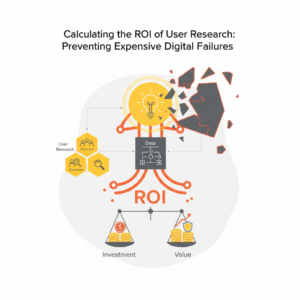
User research prevents expensive digital failures by reducing rework, lowering avoidable contact centre demand, and improving task completion before launch. The ROI of user research becomes measurable when you treat it as risk control: compare the cost of research to the avoided cost of remediation, lost conversion, and non-compliance. A practical ROI model uses baseline performance, tested uplift, and measured operational savings.
What is ROI of user research?
ROI of user research is the financial return generated by learning about real user needs early enough to change design and delivery decisions. ISO 9241-210 defines human-centred design as a lifecycle approach that focuses on users, tasks, and iterative evaluation¹ and this matters because most digital failures are not “technology failures”. They are adoption failures.
For enterprise leaders, the business logic is simple. Digital products create value only when customers can complete critical tasks reliably. When customers fail, they retry, abandon, complain, or switch. Each of those outcomes has a unit cost you can measure in Australia: contact centre minutes, abandonment rates, remediation sprints, and complaint handling effort. Once those costs are visible, research becomes a capital-protection activity rather than a discretionary expense.
Why does the cost of bad UX in Australia become so high?
The cost of bad UX in Australia rises quickly because complex services amplify error. Government and essential services are the clearest example because volume is high, edge cases are common, and trust damage is public. Recent reporting on the Bureau of Meteorology website redesign highlighted large program costs and intense usability backlash, followed by urgent changes after release². The lesson is not that large programs fail by default. The lesson is that late discovery is expensive, especially when the service is already embedded in the daily routines of millions.
Regulators and public-sector standards also raise the stakes. The Australian Government’s Digital Service Standard expects teams to “understand user needs” and to conduct ongoing user research for existing services³˒⁴. In enterprise settings, the same principle applies through customer attrition, brand impact, and the operational cost of compensating for unclear digital journeys.
How does user research prevent expensive digital failures?
User research prevents failure by changing decisions while change is still cheap. It does this through three mechanisms.
First, it reduces assumptions. Guidance from the Australian Government notes that user research reduces the risk of expensive failures by building with certainty and releasing in increments⁵. In practice, that means validating top tasks, decision points, and comprehension before development locks in.
Second, it improves design quality in measurable ways. Usability research summarised by Nielsen Norman Group reports substantial performance gains after redesign, including material improvements in task success and business metrics in many contexts⁶, which can translate into fewer retries, fewer calls, and better conversion.
Third, it supports compliance and inclusion earlier. Accessibility requirements are more predictable and testable than many organisations assume. WCAG 2.2 is the current W3C recommendation for web accessibility⁷ and Australian Human Rights Commission guidance points organisations toward WCAG 2.2 Level AA as a minimum expectation in many contexts⁸. Research that includes people with disability and assistive technology users reduces remediation cost and legal exposure at the same time.
What is the difference between user research, analytics, and stakeholder feedback?
User research explains “why” users succeed or fail. Analytics describes “what” happened at scale. Stakeholder feedback reflects internal expectations and operational constraints. They are complementary, but they are not substitutes.
Analytics can show that a form has a high abandonment rate, but it cannot reliably explain whether the cause is comprehension, trust, accessibility, or device constraints. Stakeholders can identify policy or risk limits, but they are rarely representative of customer capability, stress, language, or disability. The Digital Service Standard explicitly centres user research as an ongoing activity³˒⁵ because observation and testing are the fastest way to resolve ambiguity before it becomes an incident queue.
For ROI purposes, this distinction matters. Research is the tool that converts uncertain “opinions” into testable hypotheses with measurable uplift. Analytics then validates whether the uplift holds at scale, and operations confirms whether the uplift reduces cost-to-serve.
Where does ROI of user research come from in CX and digital delivery?
ROI typically comes from four value streams.
Reduced rework and delivery waste
Rework happens when teams build the wrong thing or build the right thing in the wrong way. Audit and assurance work in the Australian public sector repeatedly emphasises the importance of governance and disciplined procurement for ICT outcomes⁹, and governance only works when it is anchored to validated customer needs. In enterprise programs, the same logic shows up as avoided change requests, fewer defect cycles that are actually “usability defects,” and fewer post-launch redesign sprints.
Lower avoidable contact centre demand
When digital journeys are unclear, customers move channels. That creates avoidable demand and increases average handling time because the customer’s context is fragmented. Research that focuses on top tasks and failure points can directly reduce calls, chats, and complaints by removing the reasons customers must ask for help.
Higher conversion and retention
In commercial services, UX improvements often lift conversion and reduce churn. While the exact magnitude varies by category, long-standing industry evidence shows that usability redesign can materially improve desired outcomes⁶. The ROI model should use your own baseline funnel metrics and test-driven uplift estimates rather than generic benchmarks.
Reduced compliance and accessibility risk
Accessibility issues are expensive late because they require redesign across components, content, and interaction patterns. WCAG 2.2 provides testable criteria⁷ and Australian guidance encourages conformance as a practical baseline⁸. Including accessibility research early reduces the probability of urgent remediation, complaint escalation, and reputational impact.
What is a practical ROI model for calculating user research value?
A defensible model uses conservative assumptions and ties each benefit to an observable metric.
Define the decision at risk. Examples include a new navigation model, onboarding flow, authentication step, or content structure.
Establish a baseline. Use current completion rate, abandonment rate, error rate, and channel shift. For cost-to-serve, baseline contact volumes and handling time by reason code.
Run research that produces a measurable delta. Prefer moderated usability testing for complex flows and unmoderated at scale for simpler tasks. Include accessibility checks aligned to WCAG 2.2 criteria⁷.
Translate deltas into dollars.
Avoided contacts: (reduced contacts) × (unit cost per contact)
Recovered conversion: (incremental conversions) × (margin per conversion)
Avoided rework: (sprints avoided) × (fully loaded team cost)
Risk reduction: expected cost × reduced probability, using scenario ranges
Compute ROI.
ROI = (Total quantified benefits − Research cost) ÷ Research cost
This approach aligns with government practice that treats research as a control to reduce expensive failure risk⁵ and it also supports executive decision-making because the inputs are operational and financial, not aesthetic.
What risks can make ROI claims unreliable?
The most common failure is overstating attribution. Research rarely causes all improvement. It enables better decisions that must still be executed well. To avoid inflated claims, use conservative uplift ranges, and track confounding changes like pricing, marketing, and policy updates.
A second risk is sampling bias. If research excludes low-literacy users, older users, rural connectivity constraints, or people using assistive technologies, the product may pass tests but fail at launch. WCAG-related testing reduces this risk by making accessibility issues observable and repeatable against a standard⁷˒⁸.
A third risk is treating ROI as a one-time business case. User needs change, competitors change, and regulations change. The Digital Service Standard’s emphasis on regular research for existing services³ is a useful operating principle for enterprises as well.
How should leaders measure and report ROI of user research?
Measurement should combine experience metrics with operational and financial metrics, reported together.
Experience performance: task success rate, time-on-task, error rate, comprehension checks
Accessibility conformance: priority WCAG 2.2 criteria pass rate⁷, plus assistive tech task completion
Operational outcomes: avoidable contact rate, repeat contact rate, complaints per 10,000 users
Commercial outcomes: conversion, activation, churn, retention cohort performance
Risk outcomes: incident volume, severity, remediation cycle time
Report pre and post results and show the chain of evidence from research finding to design change to measured outcome. Where possible, include an external governance frame. ANAO reporting on ICT procurement and digital initiatives shows why transparent assurance and controls matter when spend is material⁹, and your measurement pack becomes part of that assurance.
What are the next steps to operationalise ROI of research?
Start with a portfolio view rather than a single project. Identify the journeys with the highest failure cost: high-volume tasks, regulated tasks, and tasks that trigger contact.
Then build a repeatable research operating system:
A standard set of top-task scripts and accessibility-inclusive protocols aligned to WCAG 2.2⁷
A decision log that ties each research finding to a delivery decision and an owner
A benefits register that tracks expected vs realised savings and revenue
For organisations that need a structured, enterprise-ready approach to research and design delivery, Customer Science’s CX research and design services can be used as a managed capability: https://customerscience.com.au/solution/cx-research-design/
Evidentiary Layer
Evidence is strongest when it combines standards, regulatory guidance, and real-world failure patterns. ISO 9241-210 provides a formal basis for human-centred design activities across the lifecycle¹. WCAG 2.2 provides testable accessibility criteria⁷, and Australian guidance links accessibility to equal access expectations⁸. Government digital standards explicitly require ongoing user research³˒⁵, reinforcing that “research as control” is established practice, not a niche preference.
Australia also provides visible examples of what happens when usability risk is discovered late, including public criticism and rapid post-launch change cycles in major services². Leaders can treat these signals as a prompt to institutionalise research in governance, not as isolated media events.
To embed that approach with consistent insight capture and benefit tracking, teams often adopt a single insights system of record. One option is Customer Science Insights: https://customerscience.com.au/csg-product/customer-science-insights/
FAQ
How much should we spend on user research to get ROI?
Spend enough to reduce the largest risks first: the top tasks, the highest-volume journeys, and the highest-consequence failures. Use the ROI model to scale investment based on avoidable cost-to-serve and conversion impact, not a fixed percentage.
What is the simplest way to prove ROI of user research?
Start with avoidable contacts. Measure failure reasons that trigger calls or chats, run usability research to remove those failure points, and track contact reduction against unit cost.
Does accessibility testing change the ROI calculation?
Yes. WCAG 2.2 provides testable criteria, and early conformance reduces late remediation and complaint risk. Treat accessibility as both inclusion and risk reduction, with scenario-based expected value.
What if analytics shows problems but we do not know why?
Use short-cycle user research to identify causes, then validate fixes at scale with analytics. Analytics without research often produces slow, expensive trial-and-error.
How do we keep research findings from becoming reports with no action?
Tie each finding to a delivery decision, an owner, and a measurable outcome. Maintain a benefits register and report realised value quarterly.
What tools help us scale research and keep an evidence trail?
Use a knowledge system that stores findings, decisions, and outcomes in one place. One option is Knowledge Quest: https://customerscience.com.au/csg-product/knowledge-quest/
Sources
ISO. ISO 9241-210:2019 Ergonomics of human-system interaction. https://www.iso.org/standard/77520.html
The Guardian (Australia). Reporting on Bureau of Meteorology website redesign costs and usability backlash (Oct–Nov 2025). https://www.theguardian.com/australia-news/2025/oct/31/cost-of-boms-website-revamp-revealed-after-deluge-of-public-criticism
Australian Government Digital Transformation Agency. Digital Service Standard guidance and checklist for existing services. https://www.digital.gov.au/policy/digital-experience/toolkit/digital-experience-policy-checklist-existing-services
Australian Government Style Manual. User research and content, linked to Digital Service Standard Criterion 1. https://www.stylemanual.gov.au/writing-and-designing-content/user-research-and-content
Australian Government Digital Transformation Agency. User research toolkit, value and risk reduction. https://www.digital.gov.au/policy/digital-experience/toolkit/user-research
Nielsen Norman Group. Return on Investment for Usability. https://www.nngroup.com/articles/return-on-investment-for-usability/
W3C. Web Content Accessibility Guidelines (WCAG) 2.2. https://www.w3.org/TR/WCAG22/
Australian Human Rights Commission. Standards and guidelines on digital accessibility referencing WCAG 2.2 Level AA. https://humanrights.gov.au/resource-hub/by-resource-type/guidelines-and-standards/guides-and-standards-disability-rights/chapter-3-standards-and-guidelines-digital-accessibility
Australian National Audit Office. Auditor-General Report No. 5 2022–23, Digital Transformation Agency’s procurement of ICT-related services (PDF). https://www.anao.gov.au/sites/default/files/2022-10/Auditor-General_Report_2022-23_5.pdf
Australian National Audit Office. MyGov Digital Services (performance audit overview). https://www.anao.gov.au/work/performance-audit/mygov-digital-services
NIST. Human factors and human-centered design overview, referencing ISO 9241-210. https://www.nist.gov/itl/iad/visualization-and-usability-group/human-factors-human-centered-design
Dehaghani SMH, Hajrahimi N. Which factors affect software projects maintenance cost more? (peer-reviewed, PubMed Central). https://pmc.ncbi.nlm.nih.gov/articles/PMC3610582/