



























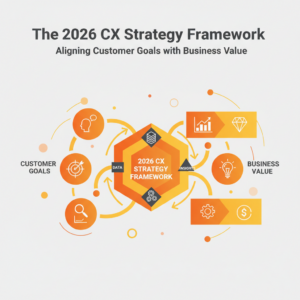
A 2026 CX strategy framework aligns customer goals with business value by translating what customers need into measurable outcomes, owned by clear decision rights and tracked through a disciplined operating cadence. It connects journey-level improvements to financial and risk metrics, so investment choices stay evidence-led. The result is faster prioritisation, lower cost-to-serve, higher retention, and stronger compliance through consistent governance and measurement.
Definition
What is a CX strategy framework in 2026?
A CX strategy framework 2026 is a structured method for developing a customer experience strategy that links customer outcomes to business outcomes, then governs delivery through roles, processes, and measures. The “strategy” component sets direction: which customer goals matter most, for which segments, and why. The “framework” component makes execution repeatable: how you prioritise initiatives, fund work, manage trade-offs, and prove value.
Customer experience is best treated as the total experience across the customer journey, not an individual interaction. Research defines CX as a holistic response created across touchpoints, channels, and time¹. In practice, that definition forces a shift from channel KPIs to journey outcomes, and from isolated projects to an enterprise operating model.
Context
Why do CX strategies fail to create business value?
Most CX programs fail to create business value when they stop at intent. Common failure patterns include fragmented ownership, “metric theatre,” and an investment pipeline disconnected from the CFO’s value tests. Many organisations also over-index on sentiment without pairing it to operational drivers, so teams cannot explain which levers moved outcomes.
The market context makes this more costly. Experience is now a buying factor for most customers, and many will pay more for attributes such as convenience and a welcoming experience². That willingness to pay is real value, but only if you can trace it to specific experiences and product decisions. In parallel, data misuse and breaches directly erode trust. Australian data breach notifications remain high, with 532 notifications reported to the OAIC in one recent six-month reporting period³. That elevates governance, data minimisation, and security controls from “risk topics” into core CX design inputs.
Mechanism
How do you translate customer goals into measurable business outcomes?
Start by expressing customer goals as outcome statements, then map each to a business value hypothesis. Customer goals are not features. They are end-states customers seek, such as “resolve my issue on first contact” or “understand the total cost before committing.” Business value hypotheses turn those goals into measurable effects: reduced rework, higher conversion, fewer complaints, lower churn, or reduced remediation cost.
A practical mechanism uses four linked artefacts:
Journey outcome map: customer goals, key moments, and failure modes.
Value tree: how outcomes affect revenue, cost, risk, and capital.
Control plan: who owns each lever, what data proves movement, and how often it is reviewed.
Decision cadence: quarterly prioritisation, monthly performance reviews, weekly delivery rituals.
Standards can anchor the mechanism. Complaints handling guidance in ISO 10002 positions complaint management as a designed process within an overall quality system⁴. For contact centres, ISO 18295-1 sets service requirements and a framework aimed at consistently meeting or exceeding customer needs⁵. These standards are useful because they force explicit process design and accountability, not just aspiration.
Comparison
How does this framework differ from common CX maturity models?
Maturity models often describe what “good” looks like at each stage, but they do not always specify how to connect decisions to value. A 2026-ready CX strategy framework differs in three ways.
First, it is journey-led rather than channel-led. Omnichannel measurement research shows the need to evaluate CX across interaction types, not only within a single channel³˒⁶. Second, it is governance-forward. It defines decision rights, escalation paths, and a funding logic that links outcomes to the balance sheet and risk register. Third, it is evidence-tight. It uses causal logic and leading indicators, so teams can act before lagging metrics deteriorate.
Use ISO 23592 as a calibration tool for service excellence language and model⁷, but avoid treating it as a checklist. The executive job is not to “implement a standard.” It is to build an operating system that makes excellent service predictable, measurable, and economically rational.
Applications
Where should executives apply the 2026 CX strategy framework first?
Apply it where customer friction creates the largest combined cost, churn risk, and regulatory exposure. For most enterprises, three starting points dominate:
Revenue protection journeys: onboarding, billing clarity, renewals, and returns. These journeys shape trust and retention and typically include avoidable contacts and complaints.
High-volume service journeys: “where is my order,” password resets, claims, appointment changes, and outages. Here, reducing effort typically cuts cost-to-serve while lifting sentiment.
Regulated harm journeys: hardship, vulnerable customers, disputes, and complaints. These journeys demand strict governance and auditability, not only empathy.
To operationalise at speed, deploy a single source of truth for insights and prioritisation. Customer Science Insights can support this by consolidating evidence, linking it to initiatives, and making decisions traceable across teams: https://customerscience.com.au/csg-product/customer-science-insights/
Risks
What governance risks derail CX strategies in 2026?
The most common risks are predictable and preventable if treated as design constraints.
Vanity metric risk occurs when teams optimise NPS or CSAT without proving operational drivers. This creates activity without value.
Fragmented ownership risk appears when product, service, digital, and risk teams run separate backlogs. Customers experience one journey, but the organisation funds four partial fixes.
Data and model risk increases as AI expands into CX decisions. Poor consent practices, weak access controls, or opaque decisioning can destroy trust and trigger regulatory consequences.
Australian regulators explicitly reinforce complaint standards expectations. For example, APRA references complaint handling standards based on the Australian Standard aligned to ISO 10002⁸. That means governance is not optional. It must define accountability, escalation, and evidence capture for both customer outcomes and compliance outcomes.
Measurement
Which metrics prove CX creates business value?
A 2026 measurement system should combine leading indicators (diagnostic, actionable) and lagging indicators (outcomes). The goal is to prove value movement, not to produce dashboards.
Use a three-layer metric stack:
Layer 1: Journey outcomes
First contact resolution, time to value, task completion, complaint rate, and customer effort. These are closest to the experience.
Layer 2: Business outcomes
Retention, conversion, repeat purchase, cost-to-serve, write-offs, remediation cost, and employee attrition in service roles. Service-profit chain research links employee experience to customer outcomes and financial performance⁹.
Layer 3: Risk and trust outcomes
Privacy incidents, security control performance, vulnerability handling, and dispute escalation rates. Data breach notifications remain material in Australia³, so trust must be a measured outcome, not a brand concept.
Set “decision thresholds” for each metric: when to invest, when to stop, and when to redesign.
Next Steps
What is the 90-day plan for developing a customer experience strategy?
Days 1–30: Define and agree outcomes. Select 2–3 priority journeys, write customer goal statements, and build the value tree with Finance and Risk. Lock owners and decision rights.
Days 31–60: Instrument and baseline. Establish data definitions, baseline metrics, and a simple causal model for each journey. Pilot closed-loop actions for one failure mode per journey.
Days 61–90: Fund, deliver, and prove. Move from project funding to outcome funding. Deliver the first measurable improvement, then publish a value case that ties journey movement to cost, revenue, or risk outcomes.
If you need an external operating partner to design governance, prioritisation, and measurement, CX consulting support can accelerate the build and transfer capability: https://customerscience.com.au/service/cx-consulting-and-professional-services/
Evidentiary Layer
What evidence supports the framework’s focus on journeys, standards, and trust?
The framework rests on three evidence bases.
Journey science: Peer-reviewed research establishes CX as a journey-wide, multi-touchpoint phenomenon¹ and provides rigorous premises for conceptual clarity and managerial implications¹⁰.
Service standards: ISO standards define practical requirements for complaint handling⁴, contact centre service delivery⁵, and service excellence models⁷. These standards reinforce repeatable process design and governance discipline.
Trust and value signals: Customers’ stated willingness to pay more for experience attributes² is a monetisation signal, while Australian data breach reporting³ is a risk signal. Together, they justify a CX strategy framework 2026 that treats value and trust as co-equal outcomes.
FAQ
What is the single most important output of a CX strategy framework?
A governed set of journey outcomes with named owners, funding logic, and measures that connect customer goals to revenue, cost, and risk.
How many journeys should an executive team prioritise at once?
Two to three. Fewer ensures focus and evidence quality. More usually fragments ownership and weakens measurement.
How do you avoid “metric theatre” in CX reporting?
Use a value tree and causal logic. Every sentiment metric must have an operational driver and a financial or risk linkage.
How should contact centres fit into the 2026 CX strategy framework?
Treat them as a journey control point, not a silo. Align service requirements and KPIs to journey outcomes using recognised service frameworks⁵.
What platform capability helps sustain governance and knowledge reuse?
A structured knowledge and decisioning layer that standardises evidence and makes actions repeatable. Knowledge Quest can support this type of enterprise knowledge governance: https://customerscience.com.au/csg-product/knowledge-quest/
How do you balance personalisation with privacy expectations?
Minimise data, be explicit about consent, and measure trust outcomes alongside conversion. Treat security and privacy controls as part of the experience, not a separate function.
Sources
Lemon, K.N., Verhoef, P.C. (2016). Understanding Customer Experience Throughout the Customer Journey. Journal of Marketing. https://doi.org/10.1509/jm.15.0420
PwC. Future of Customer Experience (consumer willingness to pay more for convenience and friendliness). Stable page.
Office of the Australian Information Commissioner (OAIC). Latest Notifiable Data Breach statistics (Jan–Jun 2025). Stable page.
ISO. ISO 10002:2018 Quality management, customer satisfaction, complaints handling guidelines. https://www.iso.org/standard/71580.html
ISO. ISO 18295-1:2017 Customer contact centres, service requirements. https://www.iso.org/standard/64739.html
Gahler, M. et al. (2023). Customer Experience: Conceptualization, Measurement and Application in Omnichannel Environments. Journal of Service Research. https://doi.org/10.1177/10946705221126590
ISO. ISO 23592:2021 Service excellence, principles and model. https://www.iso.org/standard/76358.html
Australian Prudential Regulation Authority (APRA). APRA’s complaints handling standards (based on AS 10002:2022). Stable page.
Heskett, J.L. et al. (1994/2008). Putting the Service-Profit Chain to Work. Harvard Business Review. Stable page.
Becker, L., Jaakkola, E. (2020). Customer experience: fundamental premises and implications for research. Journal of the Academy of Marketing Science. https://doi.org/10.1007/s11747-019-00718-x
Standards Australia. AS 10002:2022 Guidelines for complaint management in organizations. Catalogue entry.
ISO. ISO/IEC 27001:2022 Information security management systems overview. https://www.iso.org/standard/27001