































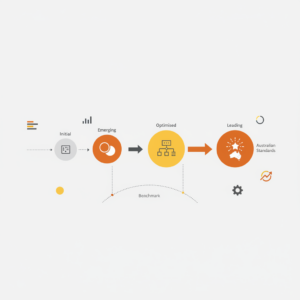
A CX maturity assessment in Australia benchmarks how well your organisation governs, designs, measures, and improves customer journeys against recognised Australian and international standards. It converts “we think we are customer led” into evidence-based maturity levels, clear gaps, and a funded roadmap. Done well, it reduces complaints and rework, strengthens compliance, and improves service performance where it matters most.
What is a customer experience maturity model?
A customer experience maturity model is a structured way to rate how consistently an organisation delivers planned, measurable, and improving customer outcomes across channels and products. It typically uses defined levels, evidence requirements, and scoring rules to reduce opinion bias.
For an Australian context, maturity is not only about experience design quality. It is also about whether governance, complaints handling, measurement, and information management align with recognised expectations from standards bodies and regulators. For example, complaint management maturity should be testable against guidance for complaint handling¹ and the Australian adoption of those requirements², not just internal policy.
A practical customer experience maturity model usually covers 5–7 capability domains and measures both “capability” (what you can reliably do) and “performance” (what outcomes you achieve). The goal is not a score for marketing. The goal is a benchmark that supports investment decisions, risk control, and continuous improvement.
Why do Australian standards matter for CX governance?
Australian boards and executives increasingly treat CX as an operational and compliance discipline, not a brand-only initiative. This is most obvious in regulated sectors, where internal dispute resolution expectations are explicit. ASIC sets enforceable expectations for complaint handling in financial firms through RG 271⁶, including how complaints are recorded, tracked, and responded to within timeframes.
Standards provide a stable backbone for “what good looks like” across industries. The International Organization for Standardization ISO 10000 family includes guidance for complaint handling¹, monitoring and measuring satisfaction³, dispute resolution processes⁴, and customer satisfaction codes of conduct⁵. In Australia, complaint management also has a local standard edition² that organisations can benchmark against, including clear system elements and consistency expectations.
CX maturity in Australia is also shaped by information handling obligations. OAIC describes the Australian Privacy Principles as the cornerstone of the privacy protection framework in the Privacy Act⁷, and it explains when entities must notify serious data breaches⁸. For digital service delivery, Digital Transformation Agency sets a Digital Service Standard that requires services to be user-friendly, inclusive, adaptable, and measurable⁹. These are directly maturity-relevant criteria, even for private sector teams adopting similar delivery models.
How do you run a CX maturity assessment in practice?
A CX maturity assessment Australia program should run like a mini-assurance engagement, with a CX lens. It needs clear scope, evidence rules, and a repeatable scoring method.
Start by defining domains that mirror how value and risk flow through your organisation. A simple structure that maps cleanly to Australian expectations is:
Strategy and governance
Customer understanding and research
Journey and service design delivery
Measurement, insight, and decision support
Complaints, remediation, and dispute readiness
Data, privacy, and information protection
Workforce capability and change enablement
Next, define maturity levels in operational terms. A common five-level pattern works well:
Level 1: Ad hoc, inconsistent, person-dependent
Level 2: Defined, repeatable within teams
Level 3: Standardised across the enterprise with controls
Level 4: Measured and managed with outcome ownership
Level 5: Optimised, predictive, continuously improving
Then collect evidence, not opinions. Evidence should include policies, operating procedures, role definitions, training records, QA artefacts, complaints categorisation, measurement dashboards, governance minutes, and decision logs. Where possible, triangulate with outcomes such as complaint volumes, re-contact rates, time to resolve, and satisfaction metrics. This aligns with the idea that CX is both a management system and an outcomes system, supported by measurement guidance³ and complaints guidance¹.
Finally, calibrate scoring. Use workshops to test interpretation, but make the final rating depend on evidence strength. This reduces “highest voice wins” behaviour and makes results repeatable year to year.
CX maturity models vs compliance audits and NPS programs
A compliance audit checks whether you meet minimum requirements. A maturity model evaluates whether you can sustain and improve outcomes at scale. They overlap, but they are not interchangeable.
An NPS program is a measurement approach, not a management system. It can be useful, but it often fails when it is disconnected from action, ownership, and closed-loop improvement. Academic work on customer experience management emphasises the need to operationalise the concept across the organisation, not just measure it¹¹. Similarly, customer journey research highlights that experience is end-to-end across touchpoints and time, which creates measurement and coordination challenges¹⁰.
A customer experience maturity model integrates these ideas into governance and operating rhythm. It asks:
Who owns outcomes for the journey, not the channel?
How do insights become decisions, and decisions become change?
How do you prove that changes reduce friction, complaints, and cost-to-serve?
How do you demonstrate that complaint management works consistently under pressure, including escalations and dispute pathways⁴˒⁶?
Where does a CX maturity assessment create value fastest?
CX maturity assessment Australia work produces the fastest value where customer demand, service complexity, and compliance pressure intersect.
Contact centres and service operations often get rapid impact because maturity gaps are visible in repeat contacts, inconsistent resolutions, and limited feedback loops. Complaint handling maturity is especially high leverage, because standards focus on consistency, accessibility, and improvement feedback¹˒².
Digital service teams often benefit quickly from maturity benchmarking because the Digital Service Standard’s “measurable” requirement⁹ forces a shift from delivery outputs to service outcomes. This makes it easier to fund improvements based on measurable friction reduction.
Enterprise CX leaders also use maturity assessments to move from scattered initiatives to a portfolio that executives can govern. A practical way to accelerate this is to centralise evidence and insight, so teams can identify drivers, quantify impact, and prioritise fixes. Customer Science Insights isvidence to action” workflow, supporting prioritisation and governance through better visibility into customer and operational signals: https://customerscience.com.au/csg-product/customer-science-insights/
What can go wrong when benchmarking CX maturity?
The most common failure is treating maturity as a branding score rather than an operating capability. When teams optimise for a number, they often select weak evidence, ignore control gaps, or inflate self-ratings.
A second risk is misalignment between maturity and regulatory exposure. For example, organisations may invest in journey mapping while underinvesting in complaint management and dispute readiness, even though dispute resolution guidance⁴ and enforceable requirements⁶ create real exposure.
A third risk is poor information governance. CX programs frequently combine behavioural, transactional, and feedback data. If privacy controls are weak, the organisation can breach expectations under the Australian Privacy Principles⁷ or mishandle a data breach response that requires notification⁸. Mature CX governance therefore includes privacy-by-design practices and clear roles for data stewardship.
A final risk is change fatigue. Maturity improvements fail when ownership is unclear and frontline teams do not see process simplification. A good roadmap removes friction for staff as well as customers.
How should you measure CX maturity improvement over time?
Measure maturity change in two layers: capability indicators and outcome indicators.
Capability indicators confirm that the management system is becoming reliable. Examples include:
Percentage of key journeys with named outcome owners and governance cadence
Coverage of complaint categorisation, root cause, and improvement feedback loops aligned to guidance¹˒²
Auditability of satisfaction monitoring and measurement processes consistent with measurement guidance³
Dispute readiness pathways defined and tested against dispute resolution guidance⁴ and applicable regulatory requirements⁶
Privacy controls embedded in CX data workflows consistent with privacy principles⁷
Outcome indicators confirm that capability improvements translate into service performance. Examples include:
Reduced time to resolve complaints and reduced re-open rates
Reduced avoidable contact and repeat contacts
Improved digital completion rates and reduced drop-off, with measurable service outcomes aligned to the Digital Service Standard approach⁹
Improved retention and reduced churn risk. For context, PwC reported that 24% of Australian consumers would stop doing business with a brand they love after one bad experience¹², which is a material risk signal in many categories.
To make measurement usable at executive level, tie each maturity improvement initiative to a business case that includes expected movement in one or two outcome indicators, then review progress in a fixed governance cycle.
A practical 90-day plan to lift CX maturity
Days 0–30: Baseline and prioritise
Run the maturity assessment with evidence collection, scoring, and executive readout. Identify 3–5 “control points” where improvement will reduce both cost and risk. Typical control points include complaint triage and categorisation, closed-loop feedback, journey ownership, and service measurement design³.
Days 31–60: Design operating rhythm
Define journey governance, decision rights, and the measurement spine. Implement complaint management improvements that align with complaint guidance¹ and Australian expectations², and confirm dispute escalation readiness⁴˒⁶. Establish privacy guardrails for CX analytics aligned to the Australian Privacy Principles⁷.
Days 61–90: Deliver visible wins and lock in repeatability
Ship two or three improvements with measurable impact, then codify the process so teams can repeat it. Many organisations use external support to accelerate governance dpline, and roadmap delivery. Customer Science CX Consulting and Professional Services can support maturity assessment and implementation where internal capacity is constrained: https://customerscience.com.au/service/cx-consulting-and-professional-services/
Evidentiary Layer
How do the maturity domains map to Australian standards and expectations?
Strategy and governance maturity should show formal ownership, decision rights, and continuous improvement mechanisms that support measurable service outcomes⁹. Complaints and remediation maturity should show a consistent complaint management system aligned to complaints guidance¹ and the Australian standard², with dispute readiness where relevant⁴˒⁶. Measurement maturity should show defined satisfaction monitoring and measurement processes³ and a clear link from insight to decisions. Data and privacy maturity should demonstrate privacy-by-design and compliance with the Australian Privacy Principles⁷, plus breach preparedness and notification readiness⁸.
FAQ
What is the primary output of a CX maturity assessment Australia program?
The primary output is an evidence-based benchmark across capability domains, plus a prioritised roadmap that links maturity gaps to measurable outcomes and risk controls.
How many maturity levels should a customer experience maturity model use?
Five levels work well in most enterprises because they separate ad hoc practice from standardised, measured, and optimised operation without overcomplicating scoring.
Which Australian standards are most useful for benchmarking complaint handling maturity?
ISO 10002 guidance¹ and the Australian complaint management standard edition² provide clear system elements and consistency expectations that can be assessed against evidence.
How do Customer Science products support maturity improvement?
Customer Science Insights supports the insight-to-priority workflow across signals and operational data, helping teams prove impact and govern improvement at scale.
Which Customer Science product is suitable for building repeatable CX knowledge and assessment evidence?
Knowledge Quest supports structured knowledge capture and reuse that helps teams maintain repeatable practices and reduce inconsistency across channels: https://customerscience.com.au/csg-product/knowledge-quest/
How often should an organisation re-run its maturity benchmark?
Most organisations re-run it annually, and re-check priority domains quarterly, so governance can track progress and adjust investment based on measurable results.
Sources
ISO. ISO 10002:2018 Quality management, customer satisfaction, guidelines for complaints handling. https://www.iso.org/standard/71580.html
Standards Australia. AS 10002:2022 Guidelines for complaint management in organizations (ISO 10002:2018, NEQ). https://www.standards.org.au/standards-catalogue/standard-details?designation=as-10002-2022
ISO. ISO 10004:2018 Quality management, customer satisfaction, guidelines for monitoring and measuring. https://www.iso.org/standard/71582.html
ISO. ISO 10003:2018 Quality management, customer satisfaction, guidelines for dispute resolution external to organizations. https://www.iso.org/standard/71581.html
ISO. ISO 10001:2018 Quality management, customer satisfaction, guidelines for codes of conduct for organizations. https://www.iso.org/standard/71579.html
ASIC. RG 271 Internal dispute resolution (2 September 2021). https://www.asic.gov.au/regulatory-resources/find-a-document/regulatory-guides/rg-271-internal-dispute-resolution/
OAIC. Australian Privacy Principles overview. https://www.oaic.gov.au/privacy/australian-privacy-principles
OAIC. Notifiable data breaches guidance. https://www.oaic.gov.au/privacy/notifiable-data-breaches
Australian Government Digital Transformation Agency. Digital Service Standard. https://www.digital.gov.au/policy/digital-experience/digital-service-standard
Lemon, K.N., Verhoef, P.C. Understanding customer experience throughout the customer journey. Journal of Marketing (2016). DOI: 10.1509/jm.15.0420
Homburg, C., Jozić, D., Kuehnl, C. Customer experience management: toward implementing an evolving marketing concept. Journal of the Academy of Marketing Science (2017). DOI: 10.1007/s11747-015-0460-7
PwC Australia. Report: The future of customer experience (2018). https://www.pwc.com.au/digitalpulse/report-cis-future-customer-experience.html