




























A customer-centric operating model turns CX intent into repeatable execution. It goes beyond the organogram by defining decision rights, governance, funding, metrics, and cross-functional ways of working. The goal is consistent customer outcomes across journeys, channels, and products, while staying compliant and efficient. Done well, it reduces friction, improves service reliability, and makes CX improvements measurable and scalable.
Definition
What is a customer-centric operating model?
A customer centric operating model is the set of governance, processes, roles, and management routines that ensure customer outcomes are designed, delivered, and improved end to end. It formalises how the organisation prioritises work, allocates funding, manages risk, and measures performance against customer needs.
It differs from a “CX organisational structure” because structure is only one lever. An operating model connects leadership accountability to execution through clear decision rights and consistent management cadence. Quality management standards emphasise customer focus and leadership responsibility in how organisations run their systems¹. Practical customer focus also depends on shared principles that shape trade-offs across competing priorities².
Why “beyond the organogram” matters
Restructures often move boxes without changing outcomes. Customer pain points usually sit across functions, policies, and data boundaries, not within a single team. Research on customer journeys shows experience is shaped across multiple touchpoints and stages, often spanning owners and channels⁹. The operating model is the mechanism that connects these touchpoints into one accountable system.
Context
What problems does a customer-centric operating model solve?
Most large organisations face three recurring problems: fragmented ownership, misaligned incentives, and slow prioritisation. Fragmented ownership creates “orphan journeys” where no one can fix root causes. Misaligned incentives push teams to optimise local metrics rather than customer outcomes. Slow prioritisation occurs when CX improvements compete with short-term delivery commitments without a shared value framework.
These issues are reinforced by rigid organisational boundaries. Recent research describes common traps that pull firms away from customer centricity, including boundary rigidity and product focalisation¹³. The solution is not “more CX activity”. The solution is a CX operating system that makes cross-functional improvement routine, funded, and governed.
Mechanism
How does a customer-centric operating model work in practice?
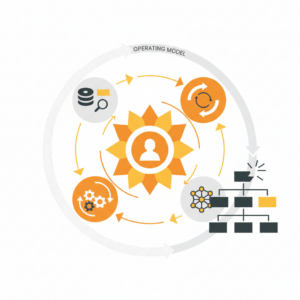
A workable model links six components:
Customer outcome strategy: a small set of measurable outcomes, expressed as journey goals.
Journey governance: decision rights for prioritisation and design standards.
A portfolio and funding model: how initiatives are selected, sequenced, and resourced.
Data and insight loops: how customer signals become actions and how impact is validated.
Performance management: aligned scorecards across customer, risk, people, and cost.
Continuous improvement routines: regular forums that resolve blockers and remove root causes.
Standards for complaint handling and satisfaction measurement provide useful anchors for how feedback should be captured, analysed, and used for improvement³˒⁴. Contact-centre standards add operational requirements for service consistency and customer needs management across channels⁵.
What governance should exist, and at what levels?
Use three levels of governance.
Enterprise level: sets CX ambition, guardrails, and investment principles. ISO guidance frames customer focus as a leadership responsibility within management systems¹.
Journey level: owns end-to-end outcomes, defines experience standards, and approves changes that affect customer effort, compliance, or accessibility.
Operational level: runs weekly execution, resolves bottlenecks, and tracks leading indicators.
In regulated sectors, complaint and dispute handling governance is also a control mechanism. For example, enforceable internal dispute resolution expectations require disciplined recording, response processes, and reporting in financial services⁷.
Comparison
How is an operating model different from a CX organisational structure?
A CX organisational structure describes reporting lines. A customer centric operating model describes how work happens.
A structure can exist without shared prioritisation, consistent design standards, or cross-functional accountability. An operating model makes those elements explicit. It also clarifies the role of enabling functions such as risk, legal, technology, data, and workforce management, so journey improvements do not stall in approval loops.
Evidence from CX management research indicates performance outcomes vary by the practices organisations adopt, not simply by whether they “have a CX program”¹². That difference is usually explained by operating discipline: decision routines, measurement, and sustained execution.
When should you change structure, and when should you not?
Change structure only when decision rights and capacity cannot be achieved otherwise. In many cases, you can keep functional reporting lines while introducing journey ownership and shared governance. This reduces disruption while improving end-to-end delivery.
Structure changes become necessary when accountability is consistently blocked by conflicting targets, unclear escalation paths, or duplicated ownership. In those cases, change structure last, after clarifying the operating model that the new structure must enable.
Applications
What does “customer journey ownership” look like at enterprise scale?
Journey owners are accountable for outcomes, not for controlling every resource. They coordinate cross-functional squads or virtual teams, set priorities, and ensure changes meet design, accessibility, and risk standards. Their authority comes from governance, not from headcount.
This model works best when supported by an insight engine that connects signals to actions. Research on analytics-enabled CX management highlights the need for systematic insight capture and a step-by-step implementation approach to convert data into CX improvements¹⁰.
To operationalise this approach with a repeatable measurement layer, use a dedicated insights platform such as Customer Science Insights (https://customerscience.com.au/csg-product/customer-science-insights/).
How should portfolio funding and prioritisation work?
Most CX backlogs fail because they mix small fixes with transformational changes without a shared value language. Establish an enterprise CX portfolio with explicit categories:
Run: service reliability, complaint reduction, accessibility, and defect removal.
Improve: journey redesign, policy simplification, and digital containment.
Transform: platform changes, data unification, and operating model uplift.
Prioritise using decision criteria that balance customer impact, risk reduction, and cost-to-serve improvement. A published set of criteria reduces political negotiation and speeds delivery.
Risks
What are the most common failure modes?
The most common failure is “governance without power”. Forums meet, but no one can reallocate capacity or change policies. The second failure is “metrics without accountability”, where teams report CX scores but do not own the drivers. The third failure is “insight hoarding”, where data is collected but not translated into decisions.
Data and privacy risk is also increasing. Australia’s privacy regulator reported 532 notifiable data breach notifications for January to June 2025⁸, and noted breaches remained at a high level. Where customer data enables personalisation and proactive service, the operating model must also enforce access controls, third-party oversight, and minimum security practices.
How do you prevent “customer centricity theatre”?
Prevention is operational, not cultural messaging. Define decision rights, mandate shared definitions, and require evidence for prioritisation decisions. Ensure leaders sponsor a small number of measurable journey outcomes rather than a broad set of aspirational statements. Research on customer centricity highlights how organisations drift when boundaries harden or when product focus overrides customer outcomes¹³.
Measurement
Which metrics prove the operating model is working?
Use a layered scorecard:
Customer outcomes: journey completion, effort, repeat contact, complaints, and channel switching.
Operational drivers: service level, transfer rate, defect rate, and time-to-resolution.
Risk and compliance: dispute handling timeliness, vulnerability support, and incident controls.
Financial impact: cost-to-serve, retention proxies, and rework reduction.
Standards for monitoring and measuring customer satisfaction provide guidance on designing a measurement process that supports improvement, not just reporting⁴. Complaint management standards strengthen closed-loop handling and root-cause categorisation³.
How should measurement connect to governance decisions?
Measurement must trigger action. Set thresholds that force escalation, for example when repeat contact rises or complaint volumes spike in a journey segment. Make “insight to action” a governed workflow: signal, diagnosis, decision, fix, validation.
In financial services and other regulated environments, complaint standards also shape customer expectations. APRA publishes complaints handling standards based on Australian complaint management guidance⁶. Use this as a baseline for governance design and assurance routines.
Next Steps
What is a practical 90-day build plan?
Days 1–30: Define the CX North Star, select 3–5 priority journeys, and document decision rights. Inventory current forums and retire those that do not drive decisions.
Days 31–60: Stand up journey governance, create a CX portfolio intake, and agree measurement definitions. Implement closed-loop feedback for the priority journeys.
Days 61–90: Launch a quarterly portfolio review with funding decisions, publish design and accessibility standards, and run two improvement cycles that remove root causes.
If you need external capability to design the governance, measurement, and delivery routines, use a specialist CX consulting partner such as Customer Science CX Consulting & Professional Services (https://customerscience.com.au/service/cx-consulting-and-professional-services/). This should focus on operating model transfer, not dependency.
Evidentiary Layer
What evidence should leaders keep on record?
Maintain a lightweight evidence pack that travels with the operating model:
Operating model blueprint: decision rights, forums, escalation paths, and journey ownership.
Measurement dictionary: metric definitions, data lineage, and thresholds for escalation.
Controls mapping: complaint and dispute standards alignment, privacy controls, and third-party obligations.
Outcome narratives: before-and-after journey performance with validated drivers.
Empirical CX research supports the need to link CX management practices to business outcomes through disciplined practice clusters, not ad hoc initiatives¹². Customer journey literature also reinforces that experience emerges across stages and touchpoints, which is why governance must be end-to-end⁹. These references help ensure your model is defensible to boards, auditors, and regulators.
FAQ
What is the fastest way to improve a customer centric operating model?
Start with decision rights and a single portfolio intake. Reduce competing forums and enforce one prioritisation method across functions. Then prove the model by fixing root causes in two priority journeys.
Does a customer-centric operating model require a major restructure?
Not usually. Many organisations keep functional reporting while introducing journey ownership and cross-functional governance. Restructure only when decision rights cannot be achieved.
How do you choose the right journeys to govern first?
Choose journeys with high volume, high complaints, repeat contact, or high regulatory exposure. Use data to identify where customer effort and operational cost concentrate.
What role does the contact centre play in the CX operating model?
It is a primary sensor and a primary delivery channel. Contact-centre requirements standards provide a framework for consistent service and proactive customer needs management⁵, which should be reflected in journey governance.
How do you make insight reusable across teams?
Standardise taxonomy, root-cause tagging, and measurement definitions. Then create a searchable knowledge base so fixes and learnings travel across journeys. Knowledge Quest can support governed knowledge capture and retrieval (https://customerscience.com.au/csg-product/knowledge-quest/).
How do you ensure CX work stays compliant as you move faster?
Embed risk and privacy controls into the operating model, not as late-stage approvals. Treat complaint handling and dispute requirements as part of service design³˒⁷, and design data access and third-party controls in line with breach trends reported by regulators⁸.
Sources
ISO. ISO 9001:2015 Quality management systems – Requirements. https://www.iso.org/standard/62085.html
ISO. Quality management principles (Customer focus). https://www.iso.org/iso/pub100080.pdf
ISO. ISO 10002:2018 Quality management – Customer satisfaction – Guidelines for complaints handling in organizations. https://www.iso.org/standard/71580.html
ISO. ISO 10004:2018 Quality management – Customer satisfaction – Guidelines for monitoring and measuring. https://www.iso.org/standard/71582.html
ISO. ISO 18295-1:2017 Customer contact centres – Requirements for customer contact centres. https://www.iso.org/standard/64739.html
Australian Prudential Regulation Authority (APRA). APRA’s complaints handling standards (based on AS 10002:2022). https://www.apra.gov.au/apras-complaints-handling-standards
Australian Securities and Investments Commission (ASIC). Regulatory Guide 271: Internal dispute resolution (commenced 5 October 2021). https://download.asic.gov.au/media/3olo5aq5/rg271-published-2-september-2021.pdf
Office of the Australian Information Commissioner (OAIC). Notifiable Data Breaches statistics, January–June 2025. https://www.oaic.gov.au/news/blog/latest-notifiable-data-breach-statistics-for-january-to-june-2025
Lemon, K.N., Verhoef, P.C. Understanding Customer Experience Throughout the Customer Journey. Journal of Marketing (2016). DOI: 10.1509/jm.15.0420
Holmlund, M. et al. Customer experience management in the age of big data analytics: A strategic framework. Journal of Business Research (2020). DOI: 10.1016/j.jbusres.2020.01.022
Habel, J. et al. When do customers perceive customer centricity? Journal of Personal Selling & Sales Management (2020). DOI: 10.1080/08853134.2019.1631174
Wetzels, R.W.H., Klaus, P., Wetzels, M. Linking customer experience management practices to profitability. Journal of Retailing and Consumer Services (2023). DOI: 10.1016/j.jretconser.2023.103338
Dalsace, F., Bonnet, D., Lange, K. Customer centricity: Digital technology and leadership to the rescue. Business Horizons (2025). DOI: 10.1016/j.bushor.2025.02.011
McKinsey & Company. How the operating model can unlock the full power of customer experience (2022). https://www.mckinsey.com/capabilities/growth-marketing-and-sales/our-insights/how-the-operating-model-can-unlock-the-full-power-of-customer-experience