































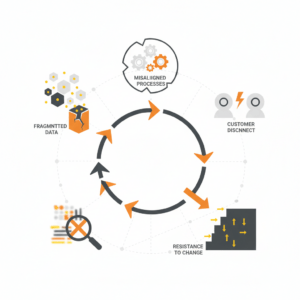
Australian enterprises often invest heavily in customer experience change, yet many programs stall or underdeliver because governance, measurement, and operating-model choices are treated as secondary to technology delivery. The five most common failure patterns are unclear customer value, weak accountability, fragmented data, under-managed change, and over-scoped roadmaps. Addressing these issues early improves delivery certainty, compliance, and measurable customer and financial outcomes.¹˒²˒¹¹
What is a CX transformation in an Australian enterprise?
A CX transformation is a coordinated change to how an organisation designs, delivers, measures, and improves customer outcomes across channels, products, and service operations. It usually spans customer journeys, contact centres, digital platforms, policy, risk, and frontline capability. The goal is not a “better app” or a new CRM. The goal is sustained performance improvement that customers can feel and the business can measure, such as fewer complaints, faster resolution, higher retention, and lower cost to serve.¹¹
In Australian enterprises, CX transformation is also a governance exercise. Many organisations operate under heightened expectations for privacy, operational resilience, complaints handling, and accountability. Data incidents remain frequent, with hundreds of breach notifications reported in each half-year reporting period.⁴ This means CX decisions about identity, consent, data sharing, and third parties must be treated as board-level risk and assurance topics, not only design choices.⁶˒¹⁰
Why do digital transformations fail more often than leaders expect?
Large transformations fail at high rates because they require people to change daily behaviour, not only systems. Research and executive analyses repeatedly report failure rates around 70% across transformations.¹˒² Academic synthesis also highlights recurring patterns: technology-first framing, unclear constructs for “success”, and weak integration of organisational, process, and people factors.¹²
In practice, “why digital transformations fail” becomes “why decisions drift.” Teams start with broad ambition, then lose clarity when trade-offs appear: which journey to fix first, what service levels matter, what data is safe to use, and who is accountable for outcomes. Without explicit decision rights, measures, and a portfolio rhythm, programs accumulate scope and exceptions, and delivery turns into continuous rework.¹˒¹¹
How governance and operating models create predictable failure modes
Governance is the system of decision-making and accountability that connects strategy to delivery. IT governance guidance emphasises directing and controlling current and future use of technology, including clear responsibilities and monitoring.⁹ When governance is weak, transformation becomes a collection of projects optimising local outputs rather than enterprise outcomes.
Operating model choices amplify or reduce risk. If customer journeys cross multiple business units, but funding, reporting, and incentives remain siloed, the program will “complete” work without shifting end-to-end customer experience. If data ownership is unclear, teams will either over-share and increase risk exposure, or under-share and fail to personalise and measure. OAIC breach statistics and cyber threat reporting show why secure-by-design and control assurance must be part of the CX operating model, not an afterthought.⁴˒⁵˒⁶
Five common pitfalls that derail CX transformations in Australia
Pitfall 1: Strategy that describes activity, not customer value
Many programs define success as “launching a platform” or “migrating channels” rather than improving specific customer outcomes. This creates weak prioritisation. Teams cannot decide which releases matter, because the program lacks an explicit value model tied to journeys and service promises.
A practical fix is to define a small set of customer outcomes and link them to measurable business value. Complaints handling standards provide a useful discipline because they force clarity on what constitutes dissatisfaction, resolution, and systemic improvement.⁸ When leaders anchor the program on outcomes such as complaint drivers, re-contact, and time-to-resolution, they can stop low-value work earlier and protect capacity for what changes the customer’s experience.
Pitfall 2: Decision rights and accountability are unclear or avoided
CX programs commonly create steering committees but avoid naming single-threaded owners for cross-functional outcomes. This becomes acute in regulated environments where accountability expectations are explicit. The Financial Accountability Regime strengthens responsibility obligations for senior executives and directors in covered sectors.¹⁰
A working model assigns an accountable executive per priority journey, supported by a transformation office that controls scope, sequencing, and benefits tracking. When accountability is clear, trade-offs become faster: what must be standardised, what can remain local, and what risks require formal acceptance. This reduces the hidden delays that cause programs to miss benefit windows.¹˒¹¹
Pitfall 3: Data fragmentation undermines measurement and trust
CX transformation challenges often present as “we can’t measure end-to-end.” Data is distributed across contact centre platforms, digital channels, product systems, and third parties. When identifiers are inconsistent, organisations cannot connect interactions to outcomes, and teams fall back on channel metrics that do not predict customer satisfaction or retention.
This is also a trust issue. OAIC notifications remain high, and malicious or criminal attacks are a dominant cause of breaches.⁴ Cyber reporting highlights significant losses tied to business email compromise and ongoing phishing risk.⁵ A CX program that expands data sharing without commensurate controls creates avoidable exposure. APRA’s CPS 234 expectations for information security capability, control assurance, and third-party risk are directly relevant to transformation delivery governance.⁶
Pitfall 4: Change adoption is treated as communications only
Senior leaders often underestimate how much frontline behaviour must change for customer outcomes to improve. If policies, scripts, knowledge, coaching, and quality assurance remain unchanged, new tooling simply moves work around. McKinsey’s transformation work emphasises the central role of mindsets and daily behaviour change in beating the odds.¹
A practical adoption design starts with the contact centre and service teams, because they see friction first. Train for new decisions, not only new clicks. Update measures so teams are rewarded for first-contact resolution, complaint prevention, and correct escalation, rather than throughput alone. This aligns human behaviour with the intended customer experience.
Pitfall 5: Over-scoped programs that confuse sequencing with ambition
Many enterprises try to fix every journey, platform, and policy at once. BCG analysis suggests only a minority of transformations deliver enduring value.² Large-scale technology programs also commonly miss time, budget, and scope targets, which erodes confidence and forces rushed compromises.³
A better approach is to reduce simultaneous change. Select a small number of journeys, build repeatable delivery patterns, and scale. Government digital guidance reinforces measurable, user-centred, inclusive service design and ongoing iteration, which is a useful discipline even for private-sector enterprises.⁷ Sequencing is not a reduction in ambition. It is an assurance strategy that protects value and reduces operational risk.
How is CX transformation different from digital transformation?
Digital transformation is primarily about capabilities enabled by technology. CX transformation is about customer outcomes created by the combined system of technology, processes, policies, and people. Digital delivery can succeed on time and still fail customers if it increases effort, creates confusing handoffs, or produces inconsistent service.
This distinction matters because measurement differs. Digital programs may focus on release velocity, uptime, or adoption counts. CX programs must focus on journey performance and customer perception, aligned with quality management expectations to monitor whether needs and expectations are met.⁸ When leaders separate “digital progress” from “customer progress,” they can stop mistaking activity for impact and can manage the full service system more effectively.¹¹
What should Australian enterprises do differently in practice?
Start by turning the five pitfalls into five design requirements.
First, define an outcome model for the priority journeys, including customer promises, service levels, and measurable benefits. Second, establish decision rights and escalation paths that match the cross-functional nature of journeys, with accountable executives and a transformation office cadence.⁹ Third, build a measurement layer that links operational, experience, complaints, and risk metrics, and apply privacy and security controls as design constraints, not approvals at the end.⁴˒⁶
For execution, use a “journey portfolio” approach: fund a small number of journeys, deliver improvements in short cycles, and require evidence of customer impact before scaling. Customer Science’s Customer Science Insights platform can support this discipline by connecting research, operational signals, and measurable customer outcomes into decision-ready insight: https://customerscience.com.au/csg-product/customer-science-insights/
What risks increase when governance is weak?
Weak governance increases three risks that matter to Australian boards: customer harm, regulatory exposure, and operational fragility. Customer harm emerges when changes increase effort or create exclusion, especially for vulnerable customers who rely on assisted service channels. Complaints standards exist because poorly handled dissatisfaction becomes systemic cost and reputational damage, not just isolated service events.⁸
Regulatory exposure increases when transformation expands data use, introduces new third parties, or changes control environments without commensurate assurance. CPS 234 sets expectations for resilience and control assurance for information assets, including those held by third parties.⁶ OAIC reporting shows that breaches remain frequent, reinforcing the need for secure design and rapid detection and response.⁴
Operational fragility appears when programs introduce multiple new tools, workflows, and rules without stabilising the operating model. Tech programs that miss delivery targets consume capital and leadership attention, then trigger “transformation fatigue,” making later waves even harder.³˒¹¹
How do you measure whether the CX transformation is working?
Measurement must prove both customer impact and delivery control. Use a layered scorecard.
At the customer layer, track journey-level effort, resolution, complaints, and targeted experience measures, not only channel satisfaction. Complaints handling guidance provides a structured way to define complaint categories, resolution quality, and systemic corrective action.⁸
At the operational layer, track contact drivers, re-contact, end-to-end time-to-resolution, and cost-to-serve, aligned to outcome owners. At the risk layer, monitor privacy and security controls, third-party assurance, and incident readiness, using CPS 234-aligned controls as minimum expectations for entities in scope and as a practical benchmark for others.⁶
To build this measurement system and embed it into governance, a managed professional services approach can help establish the cadence, benefits tracking, and operating model uplift required for sustained outcomes: https://customerscience.com.au/service/cx-consulting-and-professional-services/
What should leaders do in the next 90 days?
Begin with a governance reset and a scope reset.
Governance reset: assign accountable executives for the top two or three journeys, define decision rights, and establish a transformation office rhythm with benefits tracking, risk acceptance, and portfolio prioritisation. Use IT governance principles to ensure the program is directed, controlled, and monitored for outcomes, not only delivery outputs.⁹
Scope reset: reduce concurrent initiatives to what the organisation can absorb. Select journeys with measurable pain and clear value, and require evidence of improvement before scaling. This aligns with evidence that successful change depends on behaviour change and sustained execution discipline, not initial enthusiasm.¹˒¹¹
Risk reset: review data flows, third parties, and control assurance in the scope, and apply cyber incident readiness as a “when, not if” requirement consistent with national cyber guidance.⁵
Evidentiary layer for the five pitfalls
The five pitfalls align closely with what the broader evidence base reports about transformation performance and failure patterns.
Failure rates and value shortfalls appear consistently across executive analyses, with transformation success remaining the exception rather than the norm.¹˒² Delivery performance challenges in large technology programs reinforce the need to reduce scope and improve program discipline.³ Academic synthesis also shows that digital transformation failure is repeatedly linked to oversimplified framing and insufficient integration of organisational and people factors.¹²
Australian risk conditions intensify the consequences. Data breach notifications remain high, and cybercrime reporting indicates material business impact and persistent social engineering risk.⁴˒⁵ Accountability and security standards set expectations that make governance quality a performance and compliance issue, not only a management preference.⁶˒¹⁰
FAQ
What are the most common CX transformation challenges in Australia?
The most common challenges are unclear customer value, weak accountability, fragmented data, under-managed adoption, and over-scoped roadmaps, which together reduce delivery certainty and measurable customer outcomes.¹˒²˒¹¹
Why do digital transformations fail even when projects deliver on time?
Projects can deliver technical outputs while failing to change end-to-end customer journeys, policies, and frontline behaviour, which are necessary for sustained customer outcomes and benefits realisation.¹˒¹²
How do you set governance that improves CX outcomes?
Assign accountable owners for priority journeys, define decision rights, run a transformation office cadence, and monitor outcomes using IT governance principles that direct and control technology use for business value.⁹˒¹¹
How do privacy and cybersecurity affect CX transformation design?
Expanded data use and third-party reliance increase exposure. Australian breach statistics and security expectations mean CX design must include controls, assurance, and incident readiness as core requirements.⁴˒⁵˒⁶
What metrics best show that CX transformation is working?
Journey-level resolution, re-contact, complaints, and customer effort should move alongside operational measures like time-to-resolution and cost-to-serve, with risk measures for control assurance and incident readiness.⁶˒⁸
How does knowledge management reduce CX transformation risk?
High-quality, governed knowledge reduces inconsistent advice and re-contact, and supports faster resolution. A structured approach can be enabled with a platform designed for enterprise knowledge discovery and reuse: https://customerscience.com.au/csg-product/knowledge-quest/
Sources
McKinsey & Company. “Perspectives on transformation.” (Failure rate discussion) https://www.mckinsey.com/capabilities/transformation/our-insights/perspectives-on-transformation
Boston Consulting Group. “How CEOs Can Beat the Transformation Odds.” 21 June 2024. https://www.bcg.com/publications/2024/how-ceos-can-beat-the-transformation-odds
Boston Consulting Group. “Most Large-Scale Tech Programs Fail: How to Succeed.” 13 Nov 2024. https://www.bcg.com/publications/2024/most-large-scale-tech-programs-fail-how-to-succeed
Office of the Australian Information Commissioner (OAIC). “Latest Notifiable Data Breach statistics for January to June 2025.” 4 Nov 2025. https://www.oaic.gov.au/news/blog/latest-notifiable-data-breach-statistics-for-january-to-june-2025
Australian Cyber Security Centre (ASD’s ACSC). “2023–2024 Cyber threat trends: For businesses and organisations.” PDF. Nov 2024. https://www.cyber.gov.au/sites/default/files/2024-11/2023-24-cyber-threat-trends-for-businesses-and-organisations.pdf
Australian Prudential Regulation Authority (APRA). Prudential Standard CPS 234 Information Security (and supporting guidance pages). https://www.apra.gov.au/information-security-requirements-for-all-apra-regulated-entities
Australian Government Digital Transformation Agency. “Digital Service Standard.” https://www.digital.gov.au/policy/digital-experience/digital-service-standard
International Organization for Standardization. ISO 10002:2018 “Quality management – Customer satisfaction – Guidelines for complaints handling in organizations.” https://www.iso.org/standard/71580.html
Standards Australia. AS/NZS ISO/IEC 38500:2026 “Information technology – Governance of IT for the organization.” Published 23 Jan 2026. https://store.standards.org.au/product/as-nzs-iso-iec-38500-2026
APRA. “Financial Accountability Regime (FAR).” https://www.apra.gov.au/financial-accountability-regime
Project Management Institute (PMI). “Maximizing Project Success (2024).” PDF, 17 Dec 2024. https://www.pmi.org/-/media/pmi/documents/public/pdf/learning/thought-leadership/project_success_report_2024.pdf
Oludapo, S., Carroll, N., & Helfert, M. “Why do so many digital transformations fail? A bibliometric analysis and future research agenda.” Journal of Business Research, 2024. DOI: 10.1016/j.jbusres.2024.114528 https://doi.org/10.1016/j.jbusres.2024.114528