




















Why do leaders confuse journey maps and service blueprints?
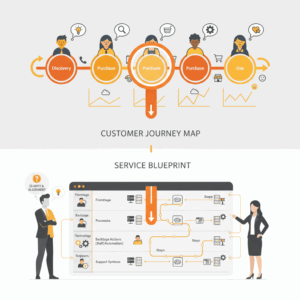
Executives chase clarity and alignment. Teams often mix up customer journey maps and service blueprints because both visualize experiences across channels. Similar visuals mask different intents. A journey map captures the customer’s end-to-end experience, usually for a single persona pursuing a specific goal. A service blueprint exposes how people, processes, policies, and technology deliver that experience behind the scenes. The tools complement each other but answer different questions. When leaders separate the questions, they accelerate decisions and reduce rework.¹ ²
What is a customer journey map?
A customer journey map is a visual narrative of how a defined customer persona moves through stages to accomplish a goal with your organization. It plots actions, thoughts, and emotions across phases, touchpoints, and channels, then summarizes insights and opportunities. The canonical definition frames it as a visualization of the process that a person goes through to accomplish a goal.³ ⁴ Journey maps work best to build empathy, reveal friction, and create a shared understanding of the current or target experience. Jim Kalbach describes mapping as a way to turn insight into action by connecting research to prioritization and design.⁵
What is a service blueprint?
A service blueprint extends the journey by mapping every onstage and backstage activity required to deliver that experience. Typical layers include customer actions, frontstage interactions, backstage processes, and supporting systems, separated by the lines of interaction, visibility, and internal support. Service blueprinting emerged as a practical technique for service innovation and operational alignment, enabling teams to visualize dynamic service processes and their interdependencies.⁶ ² The technique helps identify failure points, handoff risks, and policy or technology constraints that undermine the intended experience.¹
Where do they fit in the CX and operations stack?
Customer journey maps sit in the experience strategy and design space. They align executives and product, marketing, and service teams on customer needs and outcomes.⁵ ³ Service blueprints sit in the service operations and delivery space. They align operations, technology, risk, and compliance with what the customer must experience.¹ ² Mature service design practice treats both artifacts as linked deliverables inside a method toolkit, from discovery to implementation.⁷
How do the artifacts differ in structure and granularity?
Journey maps prioritize the narrative flow and emotional cadence. They usually show stages, touchpoints, moments that matter, and KPIs such as task success or sentiment.³ ⁵ Service blueprints prioritize system mechanics and accountability. They add swim lanes for people and systems, backstage tasks, SLAs, and policies, making dependencies explicit and measurable.¹ ⁶ Teams often create a high-level current-state journey map, then derive one or more blueprints to implement a target state. This progression reflects expert guidance that blueprints expand on journey maps by examining supporting interactions across channels and systems.⁴
When should you use a journey map vs a service blueprint?
Leaders choose a journey map when they need empathy, cross-functional buy-in, and prioritization around pain points and opportunities.³ ⁵ Choose a service blueprint when you need to redesign roles, processes, and systems or orchestrate complex handoffs across channels and partners.¹ ² For large transformations, use both: map the experience to define value, then blueprint delivery to make value real. Industry playbooks advise pairing the methods, since a blueprint visualizes behind-the-scenes processes while a journey map focuses on customer experience and emotions.⁸
How do you build each artifact the right way?
Teams build strong journey maps by grounding them in qualitative and quantitative research, defining one persona and scenario per map, and summarizing insights as explicit opportunities with owners. Canonical templates emphasize persona, scenario, goals, stages, actions, thoughts, and feelings, plus insights and ownership.³ Service blueprinting requires broader stakeholder participation. Practitioners map frontstage interactions, then facilitate sessions with operations, technology, policy, and partners to document backstage steps, tools, queues, and error paths. Expert guides recommend engaging additional teams to surface hidden dependencies and clarify invisible work.⁹ ¹
What risks emerge if you pick the wrong tool?
Organizations that use a journey map to manage delivery often miss constraints and create designs that fail in production. Organizations that start with a blueprint without a journey map risk optimizing internal efficiency at the expense of customer value. Research and practice show blueprinting reduces costly trial and error by testing service mechanics on paper before expensive changes.¹⁰ Misapplication drains momentum and increases change fatigue. The corrective is simple. Start with the journey to define value. Continue with the blueprint to engineer feasibility. Validate both with customers and staff.
How do you measure impact from each artifact?
Journey maps inform outcome metrics such as task success, effort, NPS by journey, and conversion by stage. They also guide qualitative measures like emotion curves and verbatim analysis.³ ⁵ Blueprints inform operational metrics such as cycle time, rework rate, first contact resolution, queue depth, SLA conformance, and failure demand.¹ ² Together they create a line of sight from customer value to operational drivers. Service design literature positions the duo as a bridge from insight to implementation with measurable change in both experience and operations.⁷ ²
Which method accelerates transformation in complex environments?
Use both methods as a sequence. Map the current journey for the highest-value persona and scenario. Prioritize moments that matter and define a target journey. Blueprint the target journey’s most critical flows, including roles, policies, and systems. Pilot changes where backstage risk is high. This pattern aligns with modern practice that embeds service design within agile delivery and change management.⁷ ⁵ Teams that work this way reduce ambiguity for executives and delivery teams, create a single operational narrative, and shorten time to value.
How do journey maps and blueprints integrate with agile and product management?
Journey maps feed product roadmaps with customer outcomes, success metrics, and prioritized moments. Kalbach’s approach supports translating maps into service concepts, epics, and experiments.⁵ Blueprints feed backlog items with process steps, dependencies, and technical enablers. They clarify acceptance criteria across channels and surface nonfunctional requirements such as reliability, policy compliance, and training needs. Service blueprinting also reveals cross-team sequencing, which improves planning and reduces cross-squad blockers.¹ ²
What does good look like for governance and reuse?
Strong CX organizations treat journey maps and service blueprints as living assets with version control, owners, and review cadences. Templates from reputable sources standardize structure and accelerate reuse across teams.³ ¹ Leaders should establish a lightweight taxonomy for personas, journeys, and services so artifacts connect across portfolios. Mature practices curate method libraries and training that scale service design proficiency inside the enterprise.⁷
How to decide quickly: a practical decision tree
Executives can move fast with a simple rule set. If the question is “what does the customer experience and where must we improve,” build a journey map.³ If the question is “how will the organization reliably deliver the target experience,” build a service blueprint.¹ ² If the transformation spans multiple channels and teams, do both in sequence and link them.⁴ ⁸ This decision keeps work focused, prevents tool swapping, and ensures design and delivery pull in the same direction.
What outcomes should you expect if you pair the tools?
Leaders should expect durable alignment, fewer surprises in delivery, and clearer accountability. Journey maps rally teams around customer value and define measurable moments that matter.³ ⁵ Service blueprints expose operational tradeoffs early and reduce waste by validating dependencies on paper first.¹ ² Organizations report better cross-functional conversations because each artifact meets the audience where it works: customers and designers for maps; operators and engineers for blueprints.⁶ ⁴ When used together, the tools convert strategy into service performance with visible impact on customer and business metrics.
FAQ
What is the difference between a customer journey map and a service blueprint?
A customer journey map visualizes the steps, thoughts, and emotions a customer experiences to achieve a goal. A service blueprint visualizes the onstage and backstage activities, roles, and systems that deliver that experience, separated by lines of interaction and visibility.¹ ³ ⁶
When should Customer Science clients use journey maps vs service blueprints?
Use a journey map to build empathy and prioritize customer problems and opportunities. Use a service blueprint to redesign processes, roles, and systems for reliable delivery. For complex changes, create both in sequence and link them to a single narrative.¹ ² ⁴
Which entities should appear in a service blueprint for omni-channel CX?
Include customer actions, frontstage interactions, backstage processes, supporting systems, and evidence. Show the lines of interaction, visibility, and internal support. Add SLAs, handoffs, and failure points to make risk explicit.¹ ⁶
How do journey maps and blueprints support agile delivery and governance?
Journey maps provide customer outcomes, moments that matter, and success metrics for product roadmaps. Blueprints translate flows into epics, dependencies, and acceptance criteria, improving planning and reducing blockers across squads.⁵ ²
Which templates and sources does Customer Science recommend for enterprise teams?
Use Nielsen Norman Group templates to standardize journey maps and service blueprints. Pair with method libraries from This Is Service Design Doing and the Interaction Design Foundation to scale practice and training.³ ¹ ⁷ ⁴
Why pair journey maps and service blueprints during service transformations?
Pairing ensures the target experience is desirable and the delivery is feasible. Research and practice show blueprinting reduces trial and error by exposing dependencies early, while journey mapping aligns stakeholders around customer value.¹ ² ¹⁰
Which quick criteria help executives choose the right artifact?
If you need to understand and prioritize customer experience, choose a journey map. If you need to engineer operational reliability, choose a service blueprint. If both are at stake, do both and connect them.⁴ ⁸
Sources
Nielsen Norman Group. “Service Blueprints: Definition.” 2020. NN/g. https://www.nngroup.com/articles/service-blueprints-definition/ (Nielsen Norman Group)
Bitner, M. J., Ostrom, A. L., Morgan, F. N. “Service Blueprinting: A Practical Technique for Service Innovation.” 2008. California Management Review. https://journals.sagepub.com/doi/pdf/10.2307/41166446 (SAGE Journals)
Nielsen Norman Group. “UX Deliverables Glossary: Journey Map.” 2024. NN/g. https://media.nngroup.com/media/articles/attachments/UX-Deliverables-Glossary-PDF-2.pdf (media.nngroup.com)
Interaction Design Foundation. “Customer Journey Maps: Definition & Process.” 2025. IxDF. https://www.interaction-design.org/literature/topics/customer-journey-map (The Interaction Design Foundation)
Kalbach, Jim. “Mapping Experiences, 2nd Edition.” 2020. O’Reilly Media. https://www.oreilly.com/library/view/mapping-experiences-2nd/9781492076629/ (O’Reilly Media)
Interaction Design Foundation. “What Are Service Blueprints?” 2025. IxDF. https://www.interaction-design.org/literature/topics/service-blueprint (The Interaction Design Foundation)
Stickdorn, M., Hormeß, M., Lawrence, A., Schneider, J. “This Is Service Design Doing.” 2018. O’Reilly Media / Official site. https://www.thisisservicedesigndoing.com/ (thisisservicedesigndoing.com)
Miro. “The Difference Between a Service Blueprint and a Journey Map.” 2025. Miro Blog. https://miro.com/customer-journey-map/service-blueprint-vs-journey-map/ (Miro)
Truss Works. “Service Blueprint.” 2024. Truss Project Toolkit. https://trussworks.github.io/project-toolkit/docs/service-blueprint.html (trussworks.github.io)
The Decision Lab. “Service Blueprints.” 2023. The Decision Lab Reference Guide. https://thedecisionlab.com/reference-guide/design/service-blueprints (thedecisionlab.com)